In signal processing, data compression, source coding, or bit-rate reduction involves encoding information using fewer bits than the original representation. Compression can be either lossy or lossless. Lossless compression reduces bits by identifying and eliminating statistical redundancy. No information is lost in lossless compression. Lossy compression reduces bits by removing unnecessary or less important information.

High fidelity is a term used by listeners, audiophiles and home audio enthusiasts to refer to high-quality reproduction of sound. This is in contrast to the lower quality sound produced by inexpensive audio equipment, or the inferior quality of sound reproduction that can be heard in recordings made until the late 1940s.

Signal processing is a subfield of mathematics, information and electrical engineering that concerns the analysis, synthesis, and modification of signals, which are broadly defined as functions conveying "information about the behavior or attributes of some phenomenon", such as sound, images, and biological measurements. For example, signal processing techniques are used to improve signal transmission fidelity, storage efficiency, and subjective quality, and to emphasize or detect components of interest in a measured signal.
In music, an octave or perfect octave is the interval between one musical pitch and another with double its frequency. The octave relationship is a natural phenomenon that has been referred to as the "basic miracle of music", the use of which is "common in most musical systems". The interval between the first and second harmonics of the harmonic series is an octave.
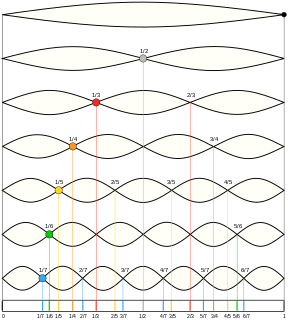
A harmonic is any member of the harmonic series. The term is employed in various disciplines, including music, physics, acoustics, electronic power transmission, radio technology, and other fields. It is typically applied to repeating signals, such as sinusoidal waves. A harmonic of such a wave is a wave with a frequency that is a positive integer multiple of the frequency of the original wave, known as the fundamental frequency. The original wave is also called the 1st harmonic, the following harmonics are known as higher harmonics. As all harmonics are periodic at the fundamental frequency, the sum of harmonics is also periodic at that frequency. For example, if the fundamental frequency is 50 Hz, a common AC power supply frequency, the frequencies of the first three higher harmonics are 100 Hz, 150 Hz, 200 Hz and any addition of waves with these frequencies is periodic at 50 Hz.
An nth characteristic mode, for n > 1, will have nodes that are not vibrating. For example, the 3rd characteristic mode will have nodes at
L and
L, where L is the length of the string. In fact, each nth characteristic mode, for n not a multiple of 3, will not have nodes at these points. These other characteristic modes will be vibrating at the positions
L and
L. If the player gently touches one of these positions, then these other characteristic modes will be suppressed. The tonal harmonics from these other characteristic modes will then also be suppressed. Consequently, the tonal harmonics from the nth characteristic modes, where n is a multiple of 3, will be made relatively more prominent.

An overtone is any frequency greater than the fundamental frequency of a sound. Using the model of Fourier analysis, the fundamental and the overtones together are called partials. Harmonics, or more precisely, harmonic partials, are partials whose frequencies are numerical integer multiples of the fundamental. These overlapping terms are variously used when discussing the acoustic behavior of musical instruments. The model of Fourier analysis provides for the inclusion of inharmonic partials, which are partials whose frequencies are not whole-number ratios of the fundamental.
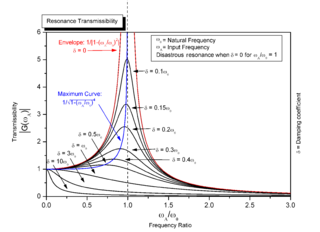
In mechanical systems, resonance is a phenomenon that only occurs when the frequency at which a force is periodically applied is equal or nearly equal to one of the natural frequencies of the system on which it acts. This causes the system to oscillate with larger amplitude than when the force is applied at other frequencies.
In music theory, an interval is the difference in pitch between two sounds.
An interval may be described as horizontal, linear, or melodic if it refers to successively sounding tones, such as two adjacent pitches in a melody, and vertical or harmonic if it pertains to simultaneously sounding tones, such as in a chord.

Pitch is a perceptual property of sounds that allows their ordering on a frequency-related scale,
or more commonly, pitch is the quality that makes it possible to judge sounds as "higher" and "lower" in the sense associated with musical melodies.
Pitch can be determined only in sounds that have a frequency that is clear and stable enough to distinguish from noise.
Pitch is a major auditory attribute of musical tones, along with duration, loudness, and timbre.
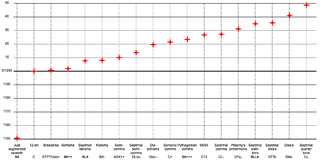
In modern musical notation and tuning, an enharmonic equivalent is a note, interval, or key signature that is equivalent to some other note, interval, or key signature but "spelled", or named differently. Thus, the enharmonic spelling of a written note, interval, or chord is an alternative way to write that note, interval, or chord. For example, in twelve-tone equal temperament, the notes C♯ and D♭ are enharmonic notes. Namely, they are the same key on a keyboard, and thus they are identical in pitch, although they have different names and different roles in harmony and chord progressions. Arbitrary amounts of accidentals can produce further enharmonic equivalents, such as B, although these are much rarer and have less practical use.

In signal processing, sampling is the reduction of a continuous-time signal to a discrete-time signal. A common example is the conversion of a sound wave to a sequence of samples.
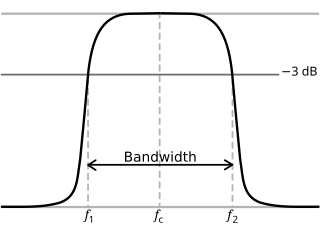
In physics and engineering the quality factor or Q factor is a dimensionless parameter that describes how underdamped an oscillator or resonator is, and characterizes a resonator's bandwidth relative to its centre frequency.
Higher Q indicates a lower rate of energy loss relative to the stored energy of the resonator; the oscillations die out more slowly. A pendulum suspended from a high-quality bearing, oscillating in air, has a high Q, while a pendulum immersed in oil has a low one. Resonators with high quality factors have low damping, so that they ring or vibrate longer.
The cent is a logarithmic unit of measure used for musical intervals. Twelve-tone equal temperament divides the octave into 12 semitones of 100 cents each. Typically, cents are used to express small intervals, or to compare the sizes of comparable intervals in different tuning systems, and in fact the interval of one cent is too small to be heard between successive notes.
Digital cable is the distribution of cable television using digital video compression for distribution. The technology was originally developed by General Instrument before being acquired by Motorola and subsequently acquired by ARRIS Group. Cable companies converted to digital systems during the 2000s, around the time that television signals were converted to the digital HDTV standard, which was not compatible with earlier analog cable systems. In addition to providing higher resolution HD video, digital cable systems provide expanded services such as pay-per-view programming, cable internet access and cable telephone services. Most digital cable signals are encrypted, which reduced the high incidence of cable theft which occurred in analog systems.
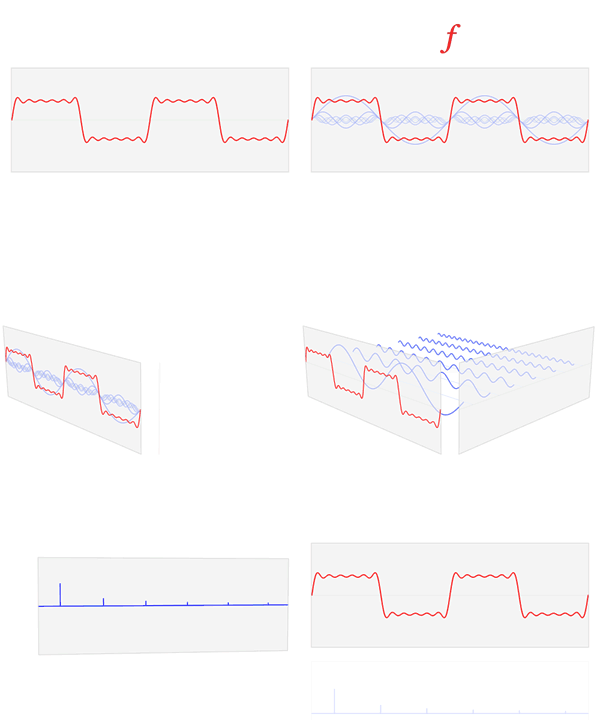
In electronics, control systems engineering, and statistics, the frequency domain refers to the analysis of mathematical functions or signals with respect to frequency, rather than time. Put simply, a time-domain graph shows how a signal changes over time, whereas a frequency-domain graph shows how much of the signal lies within each given frequency band over a range of frequencies. A frequency-domain representation can also include information on the phase shift that must be applied to each sinusoid in order to be able to recombine the frequency components to recover the original time signal.

In music, a pitch class (p.c. or pc) is a set of all pitches that are a whole number of octaves apart, e.g., the pitch class C consists of the Cs in all octaves. "The pitch class C stands for all possible Cs, in whatever octave position." Important to musical set theory, a pitch class is, "all pitches related to each other by octave, enharmonic equivalence, or both." Thus, using scientific pitch notation, the pitch class "C" is the set

A normal mode of an oscillating system is a pattern of motion in which all parts of the system move sinusoidally with the same frequency and with a fixed phase relation. The free motion described by the normal modes takes place at the fixed frequencies. These fixed frequencies of the normal modes of a system are known as its natural frequencies or resonant frequencies. A physical object, such as a building, bridge, or molecule, has a set of normal modes and their natural frequencies that depend on its structure, materials and boundary conditions. When relating to music, normal modes of vibrating instruments are called "harmonics" or "overtones".

Music theory has no axiomatic foundation in modern mathematics, yet the basis of musical sound can be described mathematically and exhibits "a remarkable array of number properties". Elements of music such as its form, rhythm and metre, the pitches of its notes and the tempo of its pulse can be related to the measurement of time and frequency, offering ready analogies in geometry.
Psychoacoustics is the scientific study of sound perception and audiology – how humans perceive various sounds. More specifically, it is the branch of science studying the psychological and physiological responses associated with sound. It can be further categorized as a branch of psychophysics. Psychoacoustics received its name from a field within psychology—i.e., recognition science—which deals with all kinds of human perceptions. It is an interdisciplinary field of many areas, including psychology, acoustics, electronic engineering, physics, biology, physiology, and computer science.