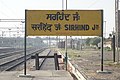
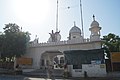
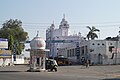
In the 2011 census Sirhind-Fatehgarh had a population of 60852. Males constituted 54% of the population and females 46%. Sirhind-Fatehgarh had an average literacy rate of 90%, higher than the national average of 74%: male literacy is 84%, and female literacy was 80%. 12% of the population was under 6 years of age.
Etymology
According to popular notion, Sirhind, comes from 'Sar-i hind', meaning the Frontier of Hind, as the Mughal emperors saw it as the 'gateway to Hindustan'.[1][2]
In his Sanskrit treatise, Brihat Samhita, Varahamihira (505–587) mentions the city as 'Satudar Desh'. Later it was inhabited by a tribe of Sairindhas Aryans, leading to its present name.[3] According to Huan Tsang, the Chinese traveller who visited India during the seventh century, Sirhind was the capital of the district of Shitotulo, or Shatadru (the present day River Sutlej).[4]
Entrance to the Ramgarh Fort near Sirhind
In the 12th century, Sirhind came under the rule of the Hindu Chauhan Rajputs of Delhi.[5] During the rule of Prithvi Raj Chauhan (1168–1192), the HinduRajput ruler of Delhi, it became his military outpost. The city was besieged by Jasrat Khokhar in 1421. However, he failed to conquer it. In 1431, Jasrat Khokhar allied with Sikander Tohfa, the governor of Lahore, against Afghans of Sirhind. They managed to capture Sirhind, but the Afghans had already left and moved towards the hills, where many of them were massacred by Jasrat Khokhar and Sikander.[6]
It became a provincial capital during the Mughal Empire, controlling the Lahore–Delhi highway. During the Mughal era, Sirhind was the name for Malwa, the area's capital city. Sirhind was the headquarters of the Mughal administration in Eastern Punjab. Many European travelers describe its splendours, and it developed into a cultural center.[7]
Ruins of Daulat Khana-E-Khas at Aam Khas Bagh', built by most probably, Sultan Hafiz Rakhna, during the reign of emperor Akbar
Sirhind was known for dozens of saints, scholars, poets, historians, calligraphers and scribes who lived there. This city is famous to Muslims for Great saint Imām-e-Rabbānī Shaykh Ahmad al-Farūqī al-Sirhindī (R.) (1564–1624). He was an Indian Islamic scholar of Arab origin, a Hanafi jurist, and a prominent member of the Naqshbandī Sufi order. Many buildings survive from this period, including Aam Khas Bagh;[8] it is said that in its heyday, the city had 360 mosques, gardens, tombs, caravansarais and wells.
↑Parihar, Subhash (2006). History and Architectural Remains of Sirhind: The Greatest Mughal City on Delhi–Lahore Highway. Aryan Books International. ISBN81-7305-311-1.
↑"Aam Khas bagh". Sirhind Info. 1 December 2012. Archived from the original on 1 December 2012. Retrieved 12 November 2021.
This page is based on this Wikipedia article Text is available under the CC BY-SA 4.0 license; additional terms may apply. Images, videos and audio are available under their respective licenses.