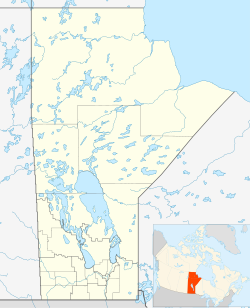
Trappist Monastery Provincial Heritage Park is a small heritage park in the St. Norbert area of Winnipeg, Manitoba, Canada. It preserves the ruins of the Trappist monastery known as Our Lady of the Prairies (Notre-Dame des Prairies), established in 1892 and constructed in its principal surviving form in the early twentieth century on a peninsula of the La Salle River. The site forms part of a publicly accessible cultural and heritage landscape within a historically French-speaking, bilingual community of south Winnipeg.[2][3]
The park is best known for the roofless brick-and-stone shell of a Romanesque Revival church and an attached monastic wing, damaged by fire after the Trappist community relocated from the site in 1978.[2][4]
History
In 1892, Catholic leaders in St. Norbert invited members of the Trappist order, formally known as the Order of Cistercians of the Strict Observance, from France to establish a contemplative monastery in southern Manitoba. The community became known as Our Lady of the Prairies (Notre-Dame des Prairies).[3][4] As a Trappist order, it was a male-only, enclosed religious community focused on prayer and contemplation rather than parish ministry or public service.
The monks lived and worked communally, organizing daily life around prayer, silence, enclosure, and manual labour. Unlike other Catholic religious orders active in Manitoba at the time, the Trappists did not operate schools, hospitals, orphanages, or regular parish services. Their way of life was intentionally inward-facing and governed by a rule that emphasized stability, discipline, and separation from secular society.[3][4]
The monastery was established within the political and cultural context of the Red River region following the Red River Resistance of 1869–1870. St. Norbert was a centre of French-speaking Métis life and Catholic leadership and was closely associated with figures such as Father Noël-Joseph Ritchot. In the decades after 1870, Catholic institutions played a growing role in shaping settlement patterns and community life in southern Manitoba during a period of rapid demographic change.[3][5]
Trappist monasteries functioned as autonomous religious houses under the authority of their abbot and the wider Trappist order, rather than as parish institutions overseen by a local diocese. The abbot was responsible for both spiritual leadership and practical matters such as land management, economic activity, and relations with external authorities. This structure shaped daily life and long-term decisions at the monastery site.[4][3]
The main monastery buildings were constructed between 1903 and 1905 and included a Romanesque Revival church and an adjoining residential wing.[3][4] A separate guesthouse was added in 1912 to accommodate limited visitors. By the late 1970s, urban development in south Winnipeg reduced the site's isolation, making it less suitable for contemplative life. In 1978, the Trappist community relocated to a new monastery near Holland, Manitoba.[2][4]
After the monks' departure, the site entered a transitional period marked by vacancy. In 1983, a fire destroyed the roofs and interiors of the former church and residential wing. The remaining structures were stabilized rather than rebuilt, marking a shift from religious use to heritage preservation and setting the stage for public stewardship of the site.[3][2]
Site
The park occupies a narrow peninsula along the La Salle River in southern Winnipeg and covers 20,000m2 (4.9 acres).[2] The land forms part of longstanding Indigenous travel and land-use corridors connected to the Red and La Salle river systems, predating Métis parish settlement and later Catholic institutional development in the area.[6]
The site lies within the low-lying floodplain of southern Manitoba, shaped by the former basin of glacial Lake Agassiz. Fertile alluvial soils supported agriculture, while seasonal flooding influenced building placement and land use during the monastery's operation.[4][2]
The ruins are designated as a provincial heritage site under Manitoba's Historic Resources Act, with designation granted on 25 January 1988. The site was added to the Canadian Register of Historic Places in 2007. Together, these recognitions acknowledge the site's heritage value at both the provincial and national levels, without conferring federal ownership or administration.[3]
The surrounding property was designated a provincial park by the Government of Manitoba in 2002,[7] and is classified as a Class V protected area under the IUCN protected area management categories.[8]
Character-defining elements include the isolated river-peninsula setting and the remains of the monastery complex, including surviving wall massing, round-arched window openings, and fragments of the bell tower.[3]
The former guesthouse, built in 1912, survived the 1983 fire and was later renovated for use as the St. Norbert Arts Centre. Community advocacy and fundraising were central to preserving the remaining structures and supporting the site's transition from a private religious property to a public cultural landscape.[4][9]
Economic activity
From its establishment, the Trappist monastery functioned as a largely self-sufficient agricultural and craft enterprise. Economic activity was centrally organized under monastic leadership, with land, production, and resources held collectively rather than individually. Manual labour formed an integral part of the Trappist rule, serving both practical and spiritual purposes alongside religious observance.[2][4]
Documented activities included crop cultivation, dairying, livestock care, and food production such as butter and cheese making, baking, and beekeeping, consistent with Trappist practice in North America during the period.[4][10]
As urban development expanded in the St. Norbert area during the twentieth century, the agricultural context that supported the monastery's economic model diminished. Rather than adapting to urban conditions, the community elected to relocate in 1978, reflecting institutional priorities grounded in contemplative seclusion rather than economic expansion.[2][4]
Archaeology
No formal archaeological excavations have been documented at the Trappist Monastery Provincial Heritage Park. Heritage management has focused on the preservation and interpretation of standing structures and the surrounding landscape rather than subsurface investigation, consistent with provincial heritage conservation practice.[3][2]
The absence of significant archaeological excavation may reflect the site's relatively short institutional lifespan, centralized monastic governance, limited material turnover, and conservation approaches that prioritize minimal ground disturbance within designated heritage sites. Any future excavation associated with development or restoration would be subject to provincial heritage and archaeological review requirements under Manitoba's Heritage Resources Act.[11]
Cultural use
Since the late twentieth century, the former monastery grounds have functioned as an active cultural site combining stabilized historic ruins with the adaptive reuse of surviving buildings. Cultural activity is closely associated with the adjacent St. Norbert Arts Centre, which operates year-round exhibitions, performances, workshops, and community events in the former guesthouse.[4][9]
The ruins and surrounding landscape have also served as an outdoor performance venue, most notably for the Winnipeg-based theatre company Shakespeare in the Ruins, which stages annual summer productions using the remaining architecture as an open-air dramatic backdrop.[12]
The site's proximity to the seasonal St. Norbert Farmers' Market places the park within a broader cluster of summer cultural activity in the St. Norbert area.
↑"Trappist Monastery Provincial Park". Protected Planet. United Nations Environment Programme World Conservation Monitoring Centre. Retrieved 9 January 2026.
This page is based on this Wikipedia article Text is available under the CC BY-SA 4.0 license; additional terms may apply. Images, videos and audio are available under their respective licenses.