Zabul Province

Last updated
Zabul Province
زابل
Flickr - The U.S. Army - Mountains of Afghanistan.jpg
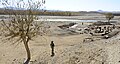
Landscape of Zabul Province
Zabul ADT on mission in Shah Joy 120220-A-CZ512-561.jpg
Children attending a jirga
Operation Karsha Pa Rago Kee 110518-A-WA427-005.jpg
Young villager watches coalition troops pass in Shamulzayi
Almond trees in Zabul Province of Afghanistan.jpg
Almond trees in Zabul
Zabul in Afghanistan.svg
Map of Afghanistan with Zabul highlighted
Coordinates: 32°06′N67°06′E / 32.1°N 67.1°E / 32.1; 67.1
CountryFlag of the Taliban.svg Afghanistan
Capital Qalat
Government
   Governor Mullah Bismillah Abdullah [1]
  Deputy Governor Abdul Khaliq Abid [1]
Area
  Total
17,471 km2 (6,746 sq mi)
Population
 (2021) [4]
  Total
391,150
  Density22.389/km2 (57.986/sq mi)
Time zone UTC+4:30 (Afghanistan Time)
Postal code
40xx
ISO 3166 code AF-ZAB
Main languages Pashto

Zabul Province [a] is one of the 34 provinces of Afghanistan, located in the south of the country. It has a population of 249,000. [4] Zabul became a separate province from neighbouring Kandahar in 1963. Historically, it was part of the Zabulistan region. Qalat serves as the capital of the province. The major ethnic group are Pashtuns. Primary occupations within Zabul are agriculture and animal husbandry.

Contents

According to Iranic legend, Zabul is the birthplace of the hero Rostam. [5]

Geography

A bull walks at the foot of a mountain near Mizan in the southeast of Zabul Province. A bull walks at the foot of a mountain during the construction of a dam near Combat Operating Post Mizan in Zabul, Afghanistan, July 1, 2011 110701-A-UJ825-009.jpg
A bull walks at the foot of a mountain near Mizan in the southeast of Zabul Province.

Zabul borders Uruzgan in the north, Kandahar in the west and in the south, Ghazni and Paktika in the east. It borders Pakistan in the east.

The province covers an area of 17293 km2. Two-fifths of the province is mountainous or semi mountainous terrain (41%) while more than one quarter of the area is made up of flat land (28%).

The primary ecoregion of the province is the central Afghan mountains xeric woodlands. Common vegetation is listed as dry shrub-land and pistachio. The high mountains of the northern portion of the province are in the Ghor-Hazarajat alpine meadow ecoregion, which is characterized by meadows, willows, and sea buckthorn. [6]

Administrative divisions

Districts of Zabul province Zabul districts.png
Districts of Zabul province
Districts of Zabul Province
DistrictCapitalPopulation (2021) [4] AreaPop.
density
Notes
Arghandab 36,9341,49025100% Pashtun. [7] Sub-divided in 2005
Atghar 14,05945831100% Pashtun. [8]
Daychopan 44,5081,49130100% Pashtun. [9]
Kakar 27,2349812899% Pashtun, 1% Hazara. [10] Created in 2005 within Arghandab District Also known as Khak-e-Afghan Province.
Mezana 21,6231,07920100% Pashtun. [11]
Naw Bahar 24,5341,13722100% Pashtun. [12] Created in 2005 from parts of Shamulzayi and Shinkay Districts
Qalat Qalat 44,9281,9142395% Pashtun, 5% Tajik. [13]
Shah Joy 79,8891,87843100% Pashtun. [14]
Shamulzayi 36,5153,29511100% Pashtun. [15]
Shinkay 31,9111,86117100% Pashtun. [16]
Tarnak Aw Jaldak 22,2141,43415100% Pashtun. [17]
Zabul 384,34917,4722299.4% Pashtuns, 0.6% Tajiks, <0.1% Hazaras. [note 1]
  1. Note: "Predominantely" or "dominated" is interpreted as 99%, "majority" as 70%, "mixed" as 1/(number of ethnicities), "minority" as 30% and "few" or "some" as 1%.

Economy

In 2006, the province's first airstrip was opened near Qalat, to be operated by the Afghan National Army, but also for use by commercial aviation. Twice weekly service was scheduled by PRT Air between Qalat and Kabul. The airstrip is not paved. [18] The ANA Chief in Zabul is Major General Jamaluddin Sayed [19]

Zabul Province is bisected by Highway 1 and travelers going between Kandahar and Kabul via road typically pass through the province. [20]

On 4 September 2016, at least 38 people were killed and 28 were injured during the September 2016 Afghanistan road crash.

Demographics

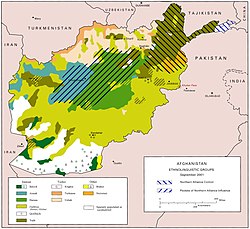
Ethnolinguistic groups in Afghanistan US Army ethnolinguistic map of Afghanistan -- circa 2001-09.jpg
Ethnolinguistic groups in Afghanistan

Population

As of 2021, the total population of the province is about 391,150, [4] which is mostly a rural tribal society. 60.8% of the population lived below the national poverty line, one of the highest figures of all of Afghanistan's provinces. [21]

Ethnicity, languages and religion

According to the Naval Postgraduate School, the population is primarily Pashtuns, sprinkled throughout around 2,500 remote villages. Major tribal groups include the Tokhi, Hotak, Nasar, Kharoti, Taraki, Ghilji and the Noorzai and Panjpai Durrani.

Pashto is the dominant language in the area. The people of Zabul are overwhelmingly Sunni Muslim. Primary occupations within Zabul are agriculture and animal husbandry. [22]

Zabul is by many indications one of Afghanistan's most religious conservative provinces. [23]

Education

Bibi Khala School in Qalat Bibi Khala School in Qalat, Afghanistan.jpg
Bibi Khala School in Qalat

The overall literacy rate (6+ years of age) increased from 1% in 2005 to 19% in 2011.[ citation needed ] The overall net enrollment rate (6–13 years of age) fell from 31.3% in 2005 to 5% in 2011.[ citation needed ]

Health

An Afghan National Police officer, right, stands watch over food before distributing it to families Feb. 5, 2012, in Pinzo village, Zabul province, Afghanistan. The food distribution was intended to supplement the villagers winter food reserves from the fall harvest. An Afghan National Police officer, right, stands watch over food before distributing it to families Feb 120205-N-UD522-028.jpg
An Afghan National Police officer, right, stands watch over food before distributing it to families Feb. 5, 2012, in Pinzo village, Zabul province, Afghanistan. The food distribution was intended to supplement the villagers winter food reserves from the fall harvest.

The percentage of households with clean drinking water increased from 0% in 2005 to 32% in 2011. The percentage of births attended to by a skilled birth attendant increased from 1% in 2005 to 5% in 2011.

Culture

Zabuli elders eating traditional Afghan food on a dastarkhan Village elders share a meal with members of the Afghan Local Police (ALP) during a shura, or meeting, in Shah Joy district, Zabul province, Afghanistan, Feb 120211-N-CI175-117.jpg
Zabuli elders eating traditional Afghan food on a dastarkhan

Sports

The province is represented in Afghan domestic cricket by the Zabul Province cricket team.

Notable people

See also

Notes

  1. Pashto: Pashto pronunciation: [zɑˈbəl] : زابل
    Dari: Dari pronunciation: [zɑː.bʊ́l] : زابل

References

  1. 1 2 "د نږدې شلو ولایاتو لپاره نوي والیان او امنیې قوماندانان وټاکل شول". 7 November 2021. Archived from the original on November 7, 2021.
  2. Provinces of Afghanistan on Statoids.
  3. "Afghanistan's Provinces – Zabul at USAID". USAID . Archived from the original on July 27, 2007. Retrieved 2 April 2018.
  4. 1 2 3 4 "Estimated Population of Afghanistan 2021-22" (PDF). National Statistic and Information Authority (NSIA). April 2021. Archived (PDF) from the original on June 24, 2021. Retrieved June 21, 2021.
  5. Compareti, Matteo. "Heroes Fighting Snake Demons: Problems of Identification in Panjikent Paintings". The Silk Road. Retrieved 4 December 2025.
  6. World Wildlife Fund, ed. (2001). "Central Afghan Mountains xeric woodlands". WildWorld Ecoregion Profile. National Geographic Society. Archived from the original on 2010-03-08.
  7. "UNHCR Sub-Office Kandahar - DISTRICT PROFILE Arghandab" (PDF). Archived from the original (PDF) on 2005-10-27. Retrieved 2023-06-18.
  8. "UNHCR Sub-Office Kandahar - DISTRICT PROFILE Atghar" (PDF). Archived from the original (PDF) on 2005-10-27. Retrieved 2023-06-18.
  9. "UNHCR Sub-Office Kandahar - DISTRICT PROFILE Daychopan" (PDF). Archived from the original (PDF) on 2005-10-27. Retrieved 2023-06-18.
  10. "UNHCR Sub-Office Kandahar - DISTRICT PROFILE Kakar" (PDF). Archived from the original (PDF) on 2005-10-27. Retrieved 2023-06-18.
  11. "UNHCR Sub-Office Kandahar - DISTRICT PROFILE Mezana" (PDF). Archived from the original (PDF) on 2005-10-27. Retrieved 2023-06-18.
  12. "UNHCR Sub-Office Kandahar - DISTRICT PROFILE Naw Bahar" (PDF). Archived from the original (PDF) on 2005-10-27. Retrieved 2023-06-18.
  13. "UNHCR Sub-Office Kandahar - DISTRICT PROFILE Qalat" (PDF). Archived from the original (PDF) on 2005-10-27. Retrieved 2023-06-18.
  14. "UNHCR Sub-Office Kandahar - DISTRICT PROFILE Shah Joy" (PDF). Archived from the original (PDF) on 2005-10-27. Retrieved 2023-06-18.
  15. "UNHCR Sub-Office Kandahar - DISTRICT PROFILE Shamulzayi" (PDF). Archived from the original (PDF) on 2005-10-27. Retrieved 2023-06-18.
  16. "UNHCR Sub-Office Kandahar - DISTRICT PROFILE Shinkay" (PDF). Archived from the original (PDF) on 2005-10-27. Retrieved 2023-06-18.
  17. "UNHCR Sub-Office Kandahar - DISTRICT PROFILE Tarnak Aw Jaldak" (PDF). Archived from the original (PDF) on 2005-10-27. Retrieved 2023-06-18.
  18. First Airstrip in Zabul Province, USAID
  19. Online, Asia Time. "Asia Times Online :: South Asia news, business and economy from India and Pakistan". www.atimes.com. Archived from the original on 3 December 2009. Retrieved 2 April 2018.
  20. "The Back of Beyond: A Report from Zabul Province". worldaffairsjournal.org. Archived from the original on September 8, 2012. Retrieved 2 April 2018.
  21. Giustozzi, Antonio (August 2012). Decoding the New Taliban: Insights from the Afghan Field. Hurst. ISBN   9781849042260.
  22. "Zabul Province". Program for Culture & Conflict Studies. Naval Postgraduate School . Retrieved 2013-06-16.
  23. "Conservative of Zabul Province" (PDF). reliefweb.int. Retrieved 17 Dec 2022.