Logar Province

Last updated
Logar
لوگر
Aerial view of Mohammad Agha District, Logar Province, Afghanistan.jpg
Aerial view of Mohammad Agha District in Logar province
Logar in Afghanistan.svg
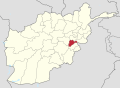
Map of Afghanistan with Logar highlighted
Coordinates(Capital): 34°00′N69°12′E / 34.0°N 69.2°E / 34.0; 69.2
CountryFlag of the Taliban.svg  Afghanistan
Capital Puli Alam
Government
   Governor Maulvi Inayatullah [1]
  Deputy GovernorMaulvi Inamullah Salahuddin [2]
  Police ChiefMohammaduddin Shah Mukhtab [2]
Area
  Total
4,568 km2 (1,764 sq mi)
Population
 (2021) [3]
  Total
442,037
  Density96.77/km2 (250.6/sq mi)
Time zone UTC+4:30 (AFT)
Postal code
14xx
ISO 3166 code AF-LOG
Main languages Dari
Pashto

Logar [a] is one of the 34 provinces of Afghanistan, located in the eastern section of the country. It is divided into 7 districts and contains hundreds of villages. Puli Alam is the capital of the province. As of 2021, Logar has a population of approximately 442,037 people, [3] most of whom are ethnic Pashtuns and Tajiks. [4]

Contents

The Logar River enters the province through the west and leaves to the north.

History

A 2,600-year-old Zoroastrian fire temple was found at Mes Aynak (about 25 miles or 40  kilometers southeast of Kabul). Several Buddhist stupas and more than 1,000 statues were also found. Smelting workshops, miners’ quarters (even then the site's copper was well known), a mint, two small forts, a citadel, and a stockpile of Kushan, Sassanian and Indo-Parthian coins were also found at the site. [5]

Recent history

During the Soviet–Afghan War, Logar was known among some Afghans as the Bab al-Jihad (Gates of Jihad) because it became a fierce theatre of war between US-backed/trained mujahideen groups and the Soviet-backed Afghan government troops [ why? ]. The Ahmadzai Pashtuns and Stanikzai Pashtuns is dominant in this region. Haji Shuja, Haji Zareen and Haji Bahadur were the prominent traders and chieftains in the region before the soviet invasion of Afghanistan. It was one of the main supply routes of mujahideen rebels coming from Pakistan. Like other parts of the country, Logar has also seen heavy fighting since the Soviets started a crackdown against the elders of the Ahmadzai tribe and Stanikzai tribe during the 1980s. [6] Swedish journalist Borge Almqvist, who visited the province in 1982, wrote that: "Everywhere in the Logar province the most common sight except for ruins are graves". [7] Soviet operations included using bombing, the use of flammable liquids to burn alive people in hiding, poisoning of drinking water, and destruction of crops and farmland. One writer who witnessed the events argues that the Soviet actions in Logar amounted to genocide. [6]

By 1995, the province had fallen to the Taliban government. During the presidency of Hamid Karzai, the International Security Assistance Force (ISAF) and Afghan National Security Forces (ANSF) gradually took over the security of the area. The Provincial Reconstruction Team Logar (PRT Logar) was established in March 2008. It provided several benefits to the locals, including security, development, and jobs.

On 19 August 2014, a major Taliban offensive took place with 700 insurgents aiming to take control of the province, [8] while the NATO-led foreign force mistakenly killed three civilians in an airstrike in December 2014. [9]

On 20 January 2019, the Taliban claimed responsibility for a car bomb attack on the province's governor and his convoy, which killed eight security forces and wounded at least 10 on the highway to Kabul. The governor and the provincial head of the National Directorate of Security were uninjured. [10]

On 14 August 2021, the Taliban offensive reached Puli Alam (the province capital), and the province of Logar fell to the Taliban, setting their sights on Kabul the following day.

Geography

Puli Alam, the capital of Logar province. Puli Alam.jpg
Puli Alam, the capital of Logar province.

Logar can be generally described as a relatively flat river valley in the north and central regions, surrounded by rugged mountains to the east, south, and southwest. The district of Azra, in the east, consists almost entirely of mountains, while travel to the Paktia Province to the south is limited to the Tera Pass, a 2896 m high road that was recently completed as part of the international reconstruction effort in Afghanistan. The Kabul-Khost Highway runs north–south through Logar Province, from the Mohammed Agha District.

The government of Afghanistan officially recognizes all the districts of the Logar province as part of the province.

Puli Alam, which is located in the district of Puli Alam, serves as the capital of Logar province. It is connected by a highway to Kabul in the north and Gardez to the southeast.

The highway to Kabul was completed in 2006. Additional projects include numerous schools, radio stations, government facilities, and a major Afghan National Police base situated south of the city.

Like many Afghan cities, there is municipal planning and services. During the tenure of President Ashraf Ghani the city gained electricity, clean drinking and water facilities.

Administrative divisions

Districts of Logar province. This image does not include Azra district, located to the east of Khoshi and Mohammad Agha districts. Lowgar districts.png
Districts of Logar province. This image does not include Azra district, located to the east of Khoshi and Mohammad Agha districts.

Until 2005 the district was administratively subdivided into five districts. In that year the province gained Azra District from neighboring Paktia Province; also part of Charkh District was split off into the new district of Kharwar.

Districts of Logar province
DistrictCapitalPopulation (2021) [3] AreaPop.
density
EthnicityNotes
Azra 22,98577730100% Pashtuns. [11] Officially recognized by the Afghan government as a district of Logar province.
Baraki Barak 99,210239416100% Tajik.Includes the road linking Puli Alam with Highway 1 to the west. Recognised as a vital commerce district.
Charkh 50,220304165Predominately Tajiks.Officially recognized by the Afghan government as a district of Logar province.
Kharwar 29,62846963Predominately Pashtun . [12] Officially recognized by the Afghan government as a district of Logar province. Used to belong to Charkh District
Khoshi 27,23639869Predominately Tajiks . [13] Home to the minority Shiite of Logar.
Mohammad Agha 85,2951,0767960% Pashtuns and 40% Tajik. [14] The northern portion of Mohammad Agha is contiguous with the southern 'suburbs' of Kabul.
Puli Alam Puli Alam 119,8001,131106Mix of Tajiks, Pashtuns, and Hazaras. [15] The Capital
Logar434,3744,56895Majority Tajik, minority of Pashtun and Hazara

    Economy

    The main river valley in the Khoshi District of Logar province. Extensive irrigation and canal works, known as karez, provide water for the majority of the agriculture in southeastern Afghanistan. Khoshi valley.jpg
    The main river valley in the Khoshi District of Logar province. Extensive irrigation and canal works, known as karez, provide water for the majority of the agriculture in southeastern Afghanistan.

    Logar is an agricultural province with a wealth of minerals such as copper and chromite. Many residents of the province are engaged in the agriculture and transport business. In terms of industry, the province has one textile and one copper factory. Agriculture, commerce and services, and livestock products account for the majority of commercial operations. Agriculture is a significant source of income for 31% of households. However, commerce and services provide income to 30% of rural households, while non-farm-related labor provides income to 46% of rural households. Tobacco and sugar extract are the two most important industrial crops. The main industry is honey production, which is a small industry. Jewelry, ceramics, and carpets are made in a small number of settlements. Eighty-four percent of the province's households have access to irrigated land. Wheat, maize, potatoes, alfalfa, clover, and other feed are among the most significant field crops. Sheep, cattle, camels, and poultry are the most frequent livestock. [16]

    Demographics

    Population

    In 2008, the population of Logar was estimated to be at 349,000 people. The province has 44,209 households, with an average of eight individuals per home. Rural districts are home to 72 percent of the population.

    Ethnicity, languages and religion

    Dari is spoken by two-thirds of villages and 60% of the population, whereas Pashto is spoken by one-third of villages and 40% of the people. The Kochi people (nomads) also live in Logar, and their numbers fluctuate with the seasons. In the winter, 96,280 or 4% of them stay in Logar and live in 29 settlements. [17] During the summer, the Kochi's population increases to 208,339, making Logar the province with the second-highest number of Kochi people after neighboring Kabul province.

    As of 2021, Logar has a population of approximately 442,037. It is a multi-ethnic tribal society, while about 60% of its residents are made up by Tajiks, whereas the remainder are Pashtuns and Hazaras. The Logar River enters the province through the west and leaves to the north. [3] Pashtuns (Ahmadzai and Stanikzai Pashtuns are influential in the region) [4] [18] [19]

    Education

    The overall literacy rate (6+ years of age) increased from 21% in 2005 to 30% in 2011. [20] The overall net enrolment rate (6–13 years of age) increased from 22% in 2005 to 45% in 2011. [20]

    The overall literacy rate in Logar province was 21% in 2005 however, while nearly one-third (31%) of men are literate this is true for just under one-tenth (9%) of women. There are around 168 primary and secondary schools in the province catering for 81,538 students. There are nearly 2,082 teachers working in schools in the Logar province. [21] There are several girls schools in the province, mostly located in Koshi and Pul-e-alam. Due to the large Taliban presence in Chark and Baraki Barak, the freedom of women in Logar does not always allow for an education. [18] As of 2007, the province had a literacy rate of 17%. [18]

    There are 19 religious centers including a Dar-ul-Ulum, three Darul Hifaz and the rest are Madrasas. [22]

    Three technical and vocational high schools and two private high schools function in Logar Province. [22]

    Health

    The percentage of households without clean drinking water fell from 45% in 2005 to 14% in 2011. [20] The percentage of births attended to by a skilled birth attendant increased from 9% in 2005 to 73% in 2011. [20]

    In 2008, the province of Logar has 32 health clinics and a 137-bed hospital. According to data from 2008, the Ministry of Health employs 48 doctors and 218 other health professionals in the province. There are 156 pharmacies in the province. The majority of villages do not have a permanent health worker. To access their nearest health center, the majority of the populace must travel 5 to 10 kilometers. [23]

    Culture

    Logari men eating traditional Afghan food Afghan men eat a meal at the Voices of Moderate Islam reunion at Forward Operating Base Shank, Logar province, Afghanistan, Oct. 14, 2010 101014-A-UH396-243.jpg
    Logari men eating traditional Afghan food

    Sport

    Cricket is the most popular sport in the province[ citation needed ]. Logar has been a major supplier of players for the Afghanistan national cricket team. Former players include Dawlat Ahmadzai, Ahmad Shah Pakteen and former national team captain Raees Ahmadzai. Among the active national players hailing from Logar are: Mohammad Nabi (captain of the national team), Shahpoor Zadran, Hashmatullah Shahidi, Nasir Jamal Ahmadzai and Gulbadin Naib Ahmadzai.

    Football is the second most popular sport in the province. De Abasin Sape (meaning "Waves of Abasin") plays in the Afghanistan Premier League. Abasin means "father of the rivers" in Pashto and refers to the Indus River. The team represents the provinces of Khost, Paktia, Logar, and Paktika.

    Other popular sports are volleyball, boxing, taekwondo, Washoe[ clarification needed ], kick boxing and wrestling. [22]

    Notable people

    See also

    Notes

      • Pashto: لوگر, romanized: Logar, pronounced [loˈgaɾ]
      • Dari: لوگر, romanized: Lōgar, pronounced [loːˈgáɾ]

    References

    1. کاکړ, جاويد هميم (14 March 2022). "سرپرست حکومت په وزارتونو، ولایتونو او قول اردو ګانو کې نوې ټاکنې وکړې" [The caretaker government held new elections in ministries, provinces and corps] (in Pashto).
    2. 1 2 "د نږدې شلو ولایاتو لپاره نوي والیان او امنیې قوماندانان وټاکل شول" [New governors and police chiefs were elected for nearly twenty provinces] (in Pashto). 7 November 2021. Archived from the original on November 7, 2021.
    3. 1 2 3 4 "Estimated Population of Afghanistan 2021-22" (PDF). National Statistic and Information Authority (NSIA). April 2021. Archived (PDF) from the original on June 24, 2021. Retrieved June 21, 2021.
    4. 1 2 "Understanding War". Understanding War. Retrieved 2013-08-17.
    5. DeHart, Jonathan. "Saving the Buddhas of Mes Aynak". thediplomat.com.
    6. 1 2 Kakar, M. Hassan (1995). "Massacre in Logar". Afghanistan: The Soviet Invasion and the Afghan Response, 1979–1982. University of California Press. ISBN   978-0-520-20893-3.
    7. Almqvist, Borge (1984). Committee for International Afghanistan Hearing (ed.). International Afghanistan Hearing.
    8. "Logar In Afghanistan Attacked By More Than 700 Taliban Fighters". Ibtimes.com. 19 August 2014. Retrieved 15 May 2018.
    9. "Nato force kills three Afghan civilians in airstrike, mistaking them for insurgents". Singapore Press Holdings Ltd. Retrieved 27 December 2014.
    10. Sediqi, Abdul Qadir. "Car bomb attack kills eight security force members in Afghanistan's south". Reuters . Retrieved 2019-01-20.
    11. "UNHCR Sub-Office Central Region - District profile Logar/Paktya" (PDF). Archived from the original (PDF) on 2005-10-27.
    12. "UNHCR Sub-Office Central Region - District profile Logar" (PDF). Archived from the original (PDF) on 2005-10-27.
    13. "UNHCR Sub-Office Central Region - District profile Logar" (PDF). Archived from the original (PDF) on 2005-10-27.
    14. "UNHCR Sub-Office Central Region - District profile Mohammad Agha" (PDF). Archived from the original (PDF) on 2005-10-27.
    15. "UNHCR Sub-Office Central Region - District profile Puli – Alam" (PDF). Archived from the original (PDF) on 2005-10-27.
    16. Afghanistan Provincial Reconstruction Handbook. p. 107.
    17. Afghanistan Provincial Reconstruction Handbook. p. 108.
    18. 1 2 3 "Province: Farah" (PDF). Program for Culture & Conflict Studies. Naval Postgraduate School (NPS). 2008. Retrieved 2014-10-19.
    19. "Welcome - Naval Postgraduate School" (PDF). Nps.edu. Retrieved 15 May 2018.
    20. 1 2 3 4 Archive, Civil Military Fusion Centre, "Pages - Logar". Archived from the original on 2014-05-31. Retrieved 2014-05-30.
    21. "Logar provincial profile" (PDF). Mrrd.gov.af. 2013-07-27. Archived from the original on August 24, 2015. Retrieved 2013-08-17.
    22. 1 2 3 "Background Profile of Logar". Archived from the original on 2020-10-27. Retrieved 2020-11-13.
    23. Afghanistan Provincial Reconstruction Handbook. p. 106.