Puli Alam

Last updated

Pul-i-Alam
پل علم
Puli Alam.jpg
Pul-i-Alam in 2007
Puli Alam
Interactive map of Pul-i-Alam
Afghanistan physical map.svg
Red pog.svg
Pul-i-Alam
Location in Afghanistan
Coordinates: 33°58′51″N69°02′06″E / 33.98083°N 69.03500°E / 33.98083; 69.03500
CountryFlag of the Taliban.svg Afghanistan
Province Logar
District Puli Alam
Government
  Type Municipality
Elevation
1,922 m (6,306 ft)
Population
 (2025) [1]
130,793
   Urban
7,138
Time zone UTC+04:30 (Afghanistan Time)

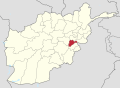
Pul-i-Alam [a] , also written as Puli Alam, Pul-e Alam or Pul-e-Alam, is a city in eastern Afghanistan, serving as the capital of Logar Province. [2] [3] It is within the jurisdiction of Puli Alam District and has an estimated population of 130,793 people. [1] They are mostly ethnic Pashtuns and Tajiks. The city had 2,546 dwellings in 2015. [4]

Contents

Pul-i-Alam is connected by a major road to Kabul in the north, Gardez in the southeast and the Kabul–Kandahar Highway in Saydabad District of Maidan Wardak Province in the west. The Logar University is located around 17 km (11 mi) to the east from the center of the city.
History

During the recent US-led war in Afghanistan, a provincial reconstruction team, PRT Logar of the Czech Republic, was based in Puli Alam.[ citation needed ] After the Americans and their allies fled from Afghanistan in August 2021, Pul-i-Alam was seized by Taliban fighters as part of the wider 2021 Taliban offensive. [5]

Geography

Land use

Pul-i-Alam is an urban village in eastern Afghanistan. [6] Agriculture is the dominant land use, accounting for 49% of total land. Only 19% of land is classified as built-up, and 48% of this area is described as vacant plots. [7] In Districts 1–3, the majority of the dwellings are regular houses. [8]

The city has 4 districts and a total land area of 38 km2 (15 sq mi) or 3,752 ha (9,270 acres). [9]

Climate

Pul-i-Alam is at high altitude. It features a hot-summer humid continental climate (Dsa) under the Köppen climate classification. It has hot, dry summers and cold, snowy winters. The average temperature in Puli Alam is 11.0 °C, while the annual precipitation averages 306 mm.

July is the hottest month of the year with an average temperature of 24.7 °C. The coldest month, January, has an average temperature of -6.8 °C.

Climate data for Puli Alam
MonthJanFebMarAprMayJunJulAugSepOctNovDecYear
Mean daily maximum °C (°F)2.1
(35.8)
2.4
(36.3)
10.3
(50.5)
18.8
(65.8)
24.8
(76.6)
29.3
(84.7)
31.9
(89.4)
30.8
(87.4)
26.9
(80.4)
20.8
(69.4)
12.8
(55.0)
6.4
(43.5)
18.1
(64.6)
Daily mean °C (°F)−3
(27)
−2.3
(27.9)
5.0
(41.0)
13.0
(55.4)
18.7
(65.7)
23.0
(73.4)
25.6
(78.1)
24.5
(76.1)
20.6
(69.1)
14.7
(58.5)
7.4
(45.3)
1.2
(34.2)
12.4
(54.3)
Mean daily minimum °C (°F)−8.0
(17.6)
−7.3
(18.9)
−0.5
(31.1)
6.9
(44.4)
12.4
(54.3)
16.5
(61.7)
19.0
(66.2)
18.1
(64.6)
14.2
(57.6)
8.6
(47.5)
2.2
(36.0)
−3.6
(25.5)
6.5
(43.8)
Average precipitation mm (inches)37
(1.5)
50
(2.0)
54
(2.1)
58
(2.3)
37
(1.5)
11
(0.4)
6
(0.2)
4
(0.2)
3
(0.1)
7
(0.3)
17
(0.7)
22
(0.9)
306
(12.2)
Source: Climate-Data.org [10]

Notable people

Notes

    • Pashto: پل علم, romanized: Puli Alam, pronounced [ˈpuliʔaˈlam]
    • Dari: پل علم, romanized: Pul-i Alam, pronounced [ˈpʰʊlɪʔaˈlam]

References

  1. 1 2 "Estimated Population of Afghanistan 2025-26" (PDF). National Statistics and Information Authority. September 2025. p. 26. Retrieved 28 December 2025.
  2. "Private radio starts educational programme for students in Logar". Pajhwok Afghan News. 13 December 2025. Retrieved 28 December 2025.
  3. "Work begins on two development projects worth 1 billion Afghani in Logar". OMID Radio. 23 October 2025. Retrieved 28 December 2025.
  4. "State of Afghan Cities report 2015 (Volume-I English)". United Nations Human Settlements Programme. p. 12. Retrieved 21 October 2015.
  5. Gopalakrishnan, Raju; Pal, Alasdair (14 August 2021). "Afghan president says in urgent talks as Taliban take key town near Kabul". Reuters. Retrieved 14 August 2021.
  6. "The State of Afghan Cities report 2015". Archived from the original on 31 October 2015. Retrieved 21 October 2015.
  7. "The State of Afghan Cities report 2015". Archived from the original on 31 October 2015. Retrieved 21 October 2015.
  8. "The State of Afghan Cities report 2015". Archived from the original on 31 October 2015. Retrieved 21 October 2015.
  9. "State of Afghan Cities report 2015 (Volume-I English)". United Nations Human Settlements Programme. Retrieved 21 October 2015.
  10. "Climate: Pul-i-Alam - Climate-Data.org" . Retrieved 9 September 2016.