
- List of United States Congress members who died in office (1900–49)
- List of speakers of the Georgia House of Representatives
Related Research Articles

The Seventeenth Amendment to the United States Constitution established the direct election of United States senators in each state. The amendment supersedes Article I, Section 3, Clauses 1 and 2 of the Constitution, under which senators were elected by state legislatures. It also alters the procedure for filling vacancies in the Senate, allowing for state legislatures to permit their governors to make temporary appointments until a special election can be held.

The president pro tempore of the United States Senate is the second-highest-ranking official of the United States Senate, after the vice president. According to Article One, Section Three of the United States Constitution, the vice president of the United States is the president of the Senate, and the Senate must choose a president pro tempore to act in the vice president's absence.
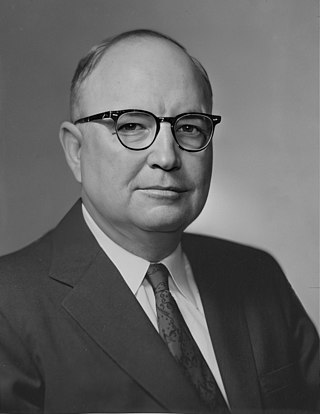
James Oliver Eastland was an American attorney, plantation owner, and politician from Mississippi. A Democrat, he served in the United States Senate in 1941 and again from 1943 until his resignation on December 27, 1978. Eastland was a leader of Southern resistance against racial integration during the civil rights movement, often speaking of African Americans as "an inferior race." Eastland has been called the "Voice of the White South" and the "Godfather of Mississippi Politics."

Macon, officially Macon–Bibb County, is a consolidated city-county in the U.S. state of Georgia. Situated near the fall line of the Ocmulgee River, it is located 85 miles (137 km) southeast of Atlanta and lies near the geographic center of the state of Georgia—hence the city's nickname, "The Heart of Georgia".
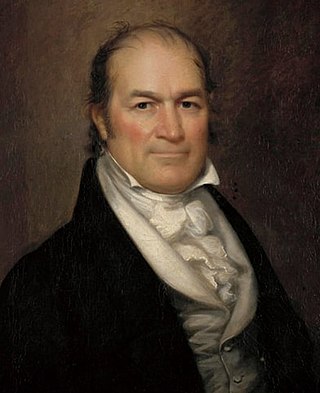
William Harris Crawford was an American politician and judge during the early 19th century. He served as US Secretary of War and US Secretary of the Treasury before he ran for US president in the 1824 election.

Richard Brevard Russell Jr. was an American politician. A member of the Democratic Party, he served as the 66th Governor of Georgia from 1931 to 1933 before serving in the United States Senate for almost 40 years, from 1933 to 1971. Russell was a founder and leader of the conservative coalition that dominated Congress from 1937 to 1963, and at his death was the most senior member of the Senate. He was for decades a leader of Southern opposition to the civil rights movement.

Carl Vinson was an American politician who served in the U.S. House of Representatives for over 50 years and was influential in the 20th century expansion of the U.S. Navy. He was a member of the Democratic Party and represented Georgia in the House from 1914 to 1965. He was known as "The Father of the Two-Ocean Navy". He is the longest-serving member of the United States House of Representatives from the state of Georgia. From 1961 to 1965, he served as the Dean of the US House of Representatives as the longest serving member of the body.

Abraham Baldwin was an American minister, patriot, politician, and Founding Father who signed the United States Constitution. Born and raised in Connecticut, he was a 1772 graduate of Yale College. After the Revolutionary War, Baldwin became a lawyer. He moved to the U.S. state of Georgia in the mid-1780s and founded the University of Georgia. Baldwin was a member of Society of the Cincinnati.
In American politics, a conservative Democrat is a member of the Democratic Party with conservative political views, or with views that are conservative compared to the positions taken by other members of the Democratic Party. Traditionally, conservative Democrats have been elected to office from the Southern states, rural areas, the Rust Belt, and the Midwest. In 2019, the Pew Research Center found that 14% of Democratic and Democratic-leaning registered voters identify as conservative or very conservative, 38% identify as moderate, and 47% identify as liberal or very liberal.

Walter Franklin George was an American politician from the state of Georgia. He was a longtime Democratic United States Senator from 1922 to 1957 and was President pro tempore of the United States Senate from 1955 to 1957.

The cy-près doctrine is a legal doctrine which allows a court to amend a legal document to enforce it "as near as possible" to the original intent of the instrument, in situations where it becomes impossible, impracticable, or illegal to enforce it under its original terms. The doctrine first arose in the English courts of equity, originating in the law of charitable trusts, but it has since been applied in the context of class action settlements in the United States.

The 1914 United States Senate elections, with the ratification of the 17th Amendment in 1913, was the first time that all seats up for election were popularly elected instead of chosen by their state legislatures. These elections occurred in the middle of Democratic President Woodrow Wilson's first term.

Lyman Trumbull was a lawyer, judge, and United States Senator from Illinois and the co-author of the Thirteenth Amendment to the United States Constitution.
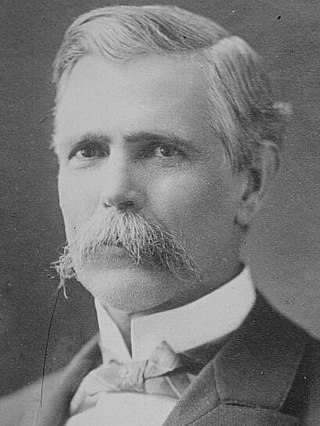
William Stanley West was a United States Senator from the state of Georgia. He was a Democrat. He is notable for being the first person appointed to the Senate after ratification of the Seventeenth Amendment made that possible.

Mercer University School of Law is the professional law school of Mercer University. Founded in 1873, it is one of the oldest law schools in the United States; the first law school accredited by the bar in Georgia, and the second oldest of Mercer's 12 colleges and schools. The School of Law has approximately 440 students and is located in Macon, Georgia on its own campus one mile (1.6 km) from Mercer's main campus. The law school building, one of Macon's most recognizable sites, is a three-story partial replica of Independence Hall in Philadelphia and is located on Coleman Hill overlooking downtown Macon. According to Mercer's official 2020 ABA-required disclosures, 72% of the Class of 2020 obtained full-time, long-term, JD-required employment nine months after graduation.

David Davis was an American politician and jurist who was a U.S. senator from Illinois and associate justice of the United States Supreme Court. He also served as Abraham Lincoln's campaign manager at the 1860 Republican National Convention, engineering Lincoln's successful nomination for president by that party.
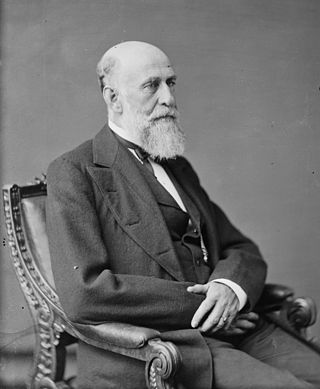
George Franklin Edmunds was a Republican U.S. Senator from Vermont. Before entering the U.S. Senate, he served in a number of high-profile positions, including Speaker of the Vermont House of Representatives, and President pro tempore of the Vermont State Senate.

The Butt–Millet Memorial Fountain is a memorial fountain in President's Park in Washington, D.C., in the United States. Dedicated in October 1913, it commemorates the deaths of Archibald Butt and Francis Davis Millet. Both men died during the sinking of the RMS Titanic on April 15, 1912.

The first election under the Seventeenth Amendment to the United States Constitution was a late election held on June 15, 1913. The election was late because two of the candidates were hospitalized due to illness and could not campaign as required.
References
- 1 2 "Senator Bacon Dies. His, Illness Brief. Blood Clot in Heart the Cause, Complicated with Kidney Trouble and Broken Rib. To Have A State Funeral. Services in Senate Chamber Tuesday. President Wilson Typewrites Tribute to Distinguished Georgian". The New York Times . February 15, 1914.
- ↑ "Congress slaveowners", The Washington Post, 2022-01-19, retrieved 2022-01-23
- 1 2 3 4 Marquis Who's Who, Inc. Who Was Who in American History, the Military. Chicago: Marquis Who's Who, 1975. P. 22 ISBN 0837932017 OCLC 657162692
- 1 2 Krakow, Kenneth K. (1975). Georgia Place-Names: Their History and Origins (PDF). Macon, GA: Winship Press. p. 1. ISBN 978-0-915430-00-0.
- ↑ "Archived copy" (PDF). Archived from the original (PDF) on 2015-04-19. Retrieved 2012-04-14.
{{cite web}}: CS1 maint: archived copy as title (link) page 1339 - ↑ "President Pro Tempore". United States Senate. See footnote 4. Retrieved October 11, 2018.
- ↑ Kelly, John (26 October 2008). "The Mud Really Flew over the First Georgia Avenue". Washington Post. Retrieved 31 October 2016.
- ↑ John Kelly, "The Mud Really Flew Over The First Georgia Avenue", The Washington Post , October 26, 2008.
- ↑ "Evans v. Newton, 382 U.S. 296 (1966)". Justia Law. Retrieved 2018-10-11.
- ↑ "Evans v. Abney, 396 U.S. 435 (1970)". Justia Law. Retrieved 2018-10-11.
- ↑ Stephanie Barron, Jessica Carrier, Chad Moore, William Sanders, and Andrew Smith, "The Case over Baconsfield Park," Remembering the Civil Rights Movement, c. 2012.
Further reading
External links

Augustus Octavius Bacon | |
|---|---|
 | |
| President pro tempore of the United States Senate | |
| In office August 14, 1911 –February 15, 1913 |
| Class 2 |  | |
|---|---|---|
| Class 3 | ||
|  | |


| General | |
|---|---|
| National libraries | |
| Other | |
