Autonomous Region in Muslim Mindanao general election, 2016

Last updated
ARMM general election, 2016
Flag of the Philippines.svg
  2013 May 9, 20162019 

  No Picture.jpg No Picture.jpg
Nominee Mujiv Hataman Sakur Tan
Party Liberal Independent
Running mateHaroun Al-Rashid Lucman Haron Bandila
Popular vote875,200 341,280
Percentage70.16% 27.36%

2016 ARMM elections.png

Election results. Party with the highest number of votes of the gubernatorial election in each province is shaded its party's color. For assembly results, each box represents a seat, shaded by the party that won that seat.

Regional Governor before election

Mujiv Hataman
Liberal

Elected Regional Governor

Mujiv Hataman
Liberal

Coat of Arms of the Philippines.svg
This article is part of a series on the
politics and government of
the Philippines

The 2016 general election in the Autonomous Region in Muslim Mindanao (ARMM) was held on May 9, 2016. This was the second ARMM election that was synchronized with the general elections in the Philippines.

Autonomous Region in Muslim Mindanao former autonomous region of the Philippines

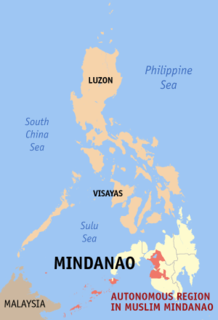
The Autonomous Region in Muslim Mindanao was an autonomous region of the Philippines, located in the Mindanao island group of the Philippines, that consisted of five predominantly Muslim provinces: Basilan, Lanao del Sur, Maguindanao, Sulu, and Tawi-Tawi. It was the only region that had its own government. The region's de facto seat of government was Cotabato City, although this self-governing city was outside its jurisdiction.

Contents

The governor and vice governor are elected via first past the post system; they are elected separately and may come from different parties. Elections for the regional assembly are via plurality-at-large voting, with each assembly district (coextensive with legislative districts as used in House of Representatives elections) having three seats. A voter can vote for up to the three candidates, with the candidates with the three highest total number of votes being elected.

Plurality-at-large voting, also known as block vote or multiple non-transferable vote (MNTV), is a non-proportional voting system for electing several representatives from a single multimember electoral district using a series of check boxes and tallying votes similar to a plurality election. Multiple winners are elected simultaneously to serve the district. Block voting is not a system for obtaining proportional representation; instead the usual result is that where the candidates divide into definitive parties the most popular party in the district sees its full slate of candidates elected, resulting in a landslide.

Legislative districts of the Philippines

The legislative districts of the Philippines are the divisions of the Philippines' provinces and cities for representation in the various legislative bodies. Congressional districts are for House of Representatives, while there are districts for Sangguniang Panlalawigan, and some Sangguniang Panlungsod. For purposes of representation, the Senate, most Sangguniang Panlungsod, Sangguniang Bayan, Sangguniang Barangay and Sangguniang Kabataan are all elected at-large, although there were previously senatorial districts.

Results

Regional governor

2016 ARMM gubernatorial election
PartyCandidateVotes%
Liberal Mujiv Hataman 875,20070.16%
Independent Sakur Tan 341,280 27.36%
Independent Faisal Mangondato 26,468 2.12%
Independent Kharis Pamaloy 4,472 0.36%
Valid ballots 1,247,420 90.03%
Margin of victory 533,920 42.80%
Invalid or blank votes 138,090 9.97%
Total votes1,385,510100.00%
Liberal hold

Regional vice governor

2016 ARMM gubernatorial election
PartyCandidateVotes%
Liberal Haroun Al-Rashid Lucman716,55567.98%
Independent Binladen Sharief 191,177 18.14%
Independent Haron Bandila 127,542 12.10%
Independent Mosib Salipada 18,851 1.79%
Valid ballots 1,054,125 76.08%
Margin of victory 525,378 49.84%
Invalid or blank votes 331,385 23.92%
Total votes1,385,510100.00%
Liberal hold

Regional assembly

Summary

Party Entered Popular vote Seats won
Total % Total %
Liberal 15 1,110,166 35.54% 10 41.67%
UNA 5 215,598 6.90% 1 4.17%
NUP 3 173,216 5.55% 2 8.33%
Aksyon 1 58,257 1.87% 1 4.17%
NPC 2 32,766 1.05% 0 0.00%
LDP 1 19,523 0.63% 0 0.00%
PDP-Laban 2 3,625 0.12% 0 0.00%
Independent 39 1,510,463 48.36% 10 41.67%
Totals 68 3,123,614 100% 24 100%

Basilan (Lone District)

2016 Basilan Lone District Regional Assemblymen election
PartyCandidateVotes%
Independent Haber Asarul97,25528.37%
Independent Abdelmajid Habib Hussin88,52225.82%
Independent Ronie Hantian74,66121.78%
Independent Juni Rasheid Ilimin 41,802 12.19%
Independent Ahmad Ali Ismael 37,758 11.01%
NPC Mon Pacio 2,807 0.82%
Total votes342,805100.00%

Lanao del Sur

1st District
2016 Lanao del Sur 1st District Regional Assemblymen election
PartyCandidateVotes%
Independent Odin Sumagayan142,26524.11%
Independent Ziaur-Rahman Adiong132,47222.45%
Independent Fiat Macarambon129,73021.98%
Independent Janimah Pandi 118,848 20.14%
UNA Manggay Guro, Jr. 49,720 8.43%
Independent Pangalian Casan 6,463 1.10%
Independent Metalicop Unda 5,268 0.89%
Independent Yusairah Monaoray Ampatua 2,720 0.46%
Independent Vikki Bangcola 1,365 0.23%
Independent Jalila Pacatowa 1,270 0.22%
Total votes590,121100.00%
2nd District
2016 Lanao del Sur 2nd District Regional Assemblymen election
PartyCandidateVotes%
Aksyon Froxy Macarambon58,25714.49%
Liberal Alex Menor52,33213.02%
Independent Abol Alam Padate52,28513.01%
Liberal Hosni Macapodi 44,590 11.09%
Independent Macapandi Mindalano 39,346 9.79%
Independent Arrie Balindong 37,502 9.33%
Independent Cardawi Macasilang 37,315 9.28%
NPC Sainoden Balindong 29,959 7.45%
Liberal Amor Lanto 26,831 6.68%
Independent Datolah Maclis Balt 8,847 2.20%
UNA Monaim Guro 7,959 1.98%
Independent Casan Lucman 2,049 0.51%
Independent Mohammad Amerol 2,016 0.50%
Independent Al-Rashid Balt 1,620 0.40%
Independent Alauya Olama 1,044 0.26%
Total votes401,952100.00%

Maguindanao

1st District
2016 Maguindanao 1st District Regional Assemblymen election
PartyCandidateVotes%
Liberal Cahar Ibay149,93232.48%
Liberal Roonie Sinsuat117,86625.54%
Liberal Harold Tomawis116,11825.16%
Independent Jackson Bandila 39,098 8.47%
UNA Solomon Sr. Baraguir 38,562 8.35%
Total votes461,576100.00%
2nd District
2016 Maguindanao 2nd District Regional Assemblymen election
PartyCandidateVotes%
Liberal Khadafeh Mangudadatu101,01723.56%
UNA Sidik Amiril60,82114.18%
Liberal Pearl Joy Piang59,90513.97%
UNA Datu Midpantao Midtimbang 58,536 13.65%
Liberal Sammy Nandang 52,263 12.19%
Independent Ali Sangki 52,038 12.13%
Independent Udtog Kawit 26,260 6.12%
Independent Arghanaim Amboludto 8,730 2.04%
Independent Jashriya Dilangalen 6,518 1.52%
PDP-Laban Pike Mentang 2,740 0.64%
Total votes428,828100.00%

Sulu

1st District
2016 Sulu 1st District Regional Assemblymen election
PartyCandidateVotes%
Liberal Nedra Burahan96,16828.37%
Liberal Rizal Tingkahan, Jr.95,30628.12%
Liberal Hanibal Tulawie84,22324.85%
Independent Al-Michele Hayudini 63,260 18.66%
Total votes338,957100.00%
2nd District
2016 Sulu 2nd District Regional Assemblymen election
PartyCandidateVotes%
Independent Rudjia Anni44,76419.84%
Independent Irene Tillah40,71518.05%
Independent Nashruper Daud40,41017.91%
Independent Al-Sadr Tammang 30,117 13.35%
Independent Khalil Hajibin 29,784 13.20%
LDP Mohammad Bhydir Sarapuddin 19,523 8.65%
Independent Abdulajid Estino 14,347 6.36%
Independent Jul-Amin Kasim 5,960 2.64%
Total votes225,620100.00%

Tawi-Tawi (Lone District)

2016 Tawi-Tawi Lone District Regional Assemblymen election
PartyCandidateVotes%
NUP Romel Matba67,48820.22%
Liberal Rodolfo Bawasanta55,85816.74%
NUP Nur-Mahadil Ahaja53,35315.99%
NUP Anuar Abubakar 52,375 15.69%
Liberal Sulay Halipa 50,925 15.26%
Independent Aquino Sajili 39,413 11.81%
Liberal Almudzhal Salih 6,832 2.05%
Independent Dhes Mangona 4,796 1.44%
Independent Ustadz Hasanul 1,830 0.55%
PDP-Laban Alexander Sumulong 885 0.27%
Total votes333,756100.00%

Related Research Articles

Illinois House of Representatives lower house of the Illinois General Assembly

The Illinois House of Representatives is the lower house of the Illinois General Assembly, the bicameral legislature of the U.S. state of Illinois. The body was created by the first Illinois Constitution adopted in 1818. The House consists of 118 representatives elected from individual legislative districts for two-year terms with no limits; redistricted every 10 years, based on the 2010 U.S. census each representative represents approximately 108,734 people.

The Japanese political process has three types of elections: general elections to the House of Representatives held every four years, elections to the House of Councillors held every three years to choose one-half of its members, and local elections held every four years for offices in prefectures, cities, and villages. Elections are supervised by election committees at each administrative level under the general direction of the Central Election Administration Committee, an attached organization to the Ministry of Internal Affairs and Communications (MIC). The minimum voting age in Japan's non-compulsory electoral system was reduced from twenty to eighteen years in June 2016. Voters must satisfy a three-month residency requirement before being allowed to cast a ballot.

Elections in the Philippines

Philippine elections are of several types. The president, vice-president, and the senators are elected for a six-year term, while the members of the House of Representatives, governors, vice-governors, members of the Sangguniang Panlalawigan, mayors, vice-mayors, members of the Sangguniang Panlungsod/members of the Sangguniang Bayan, barangay officials, and the members of the Sangguniang Kabataan are elected to serve for a three-year term.

Legislative and local elections were held in the Philippines on May 14, 2007. Positions contested included half the seats in the Senate, which are elected for six-year terms, and all the seats in the House of Representatives, who were elected for three-year terms. The duly elected legislators of the 2007 elections joined the elected senators of the 2004 elections to comprise the 14th Congress of the Philippines.

Elections in California

Elections in California are held to fill various local, state and federal seats. In California, regular elections are held every even year ; however, some seats have terms of office that are longer than two years, so not every seat is on the ballot in every election. Special elections may be held to fill vacancies at other points in time. Recall elections can also be held. Additionally, statewide initiatives, legislative referrals and referenda may be on the ballot.

ARMM Regional Legislative Assembly

ARMM Regional Assembly, also known as ARMM Regional Legislative Assembly, was the devolved unicameral regional legislature of the Autonomous Region of Muslim Mindanao (ARMM). It was known as the "Little Congress" of the ARMM.

Autonomous Region in Muslim Mindanao general elections was held in the ARMM for the regional governor, vice-governor posts and election of members of the ARMM Regional Legislative Assembly on August 11, 2008. The electronic voting used is the first in Philippines election history. The P 500 million COMELEC's "ARMM balloting" is a pilot program for the 2010 national polling.

<i>Sema vs. COMELEC</i>

Sema vs. COMELEC is a court case that was heard before the Supreme Court of the Philippines. It was consolidated with Marquez v. COMELEC. It held that the Regional Assembly of the Autonomous Region in Muslim Mindanao does not have the power to create provinces and cities. Thus, the creation of the province of Shariff Kabunsuan was unconstitutional and that province no longer exists as a political entity in the Philippines.

Local government in the Philippines

Officially local government in the Philippines, often called local government units or LGUs, are divided into three levels – provinces and independent cities; component cities and municipalities; and barangays. In one area, above provinces and independent cities, is an autonomous region, the Autonomous Region of Muslim Mindanao. Below barangays in some cities and municipalities are sitios and puroks. All of these, with the exception of sitios and puroks, elect their own executives and legislatures. Sitios and puroks are often led by elected barangay councilors.
2010 Philippine House of Representatives elections in the Autonomous Region in Muslim Mindanao

Elections were held in the Autonomous Region in Muslim Mindanao (ARMM) for seats in the House of Representatives of the Philippines on May 10, 2010.

Local elections were held on the Philippines on May 13, 2013, the same day and on the same ballot as national elections. Elected were governors, mayors and council members of Philippine provinces, Philippine cities and Philippine municipalities. Separate elections for barangay officials were held on October.

The 2013 general election in the Autonomous Region in Muslim Mindanao (ARMM) were held on May 13, 2013. Originally scheduled for October 2011, this was the first ARMM election that was synchronized with the general elections in the Philippines; previously, ARMM elections were held outside the general election day. When the elected officials of the 2008 ARMM elections ended their terms in 2011, President Benigno Aquino III appointed officers-in-charge until the officials elected in 2013 can take their place.

2016 Philippine general election

A general election in the Philippines took place on May 9, 2016, for executive and legislative branches for all levels of government – national, provincial, and local, except for the barangay officials.

Local elections will held in the Province of Lanao del Sur on May 9, 2016 as part of the 2016 general election.Voters will select candidates for all local positions: a town mayor, vice mayor and town councilors, as well as members of the Sangguniang Panlalawigan, the vice-governor, governor and representatives for the two districts of Lanao del Sur.

Election will be held in Autonomous Region in Muslim Mindanao for seats in the House of Representatives of the Philippines on May 9, 2016.

2016 Philippine local elections

Local elections in the Philippines were held on May 9, 2016. This was conducted together with the 2016 general election for national positions. All elected positions above the barangay (village) level were disputed.

The 2019 Philippine general election will be conducted on May 13, 2019. It shall be a midterm election, where the winners will take office on June 30, 2019, midway the term of President Rodrigo Duterte.