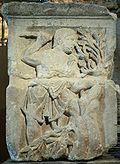
They are mentioned as Caudellensibus on an inscription.[1][2]
Their name has been compared to the toponym Gaudelli villa (10th c. AD), in the area of Pertuis–La Bastidonne.[1]
Attestation
The Caudellenses are attested on one inscription from the oppidum of Castellar (Cadenet) dedicated to the goddess Dexiua, the principal deity of Castellar.[1][3] In this context, Dexiua is associated with the Caudellenses, who are interpreted as collective divinities of a strictly local character as they are not attested elsewhere,[2] and also possibly as mother-goddesses (matres).[4]
Inscription
Translation
Reference
Dexiuae et Caude|lensibus C(aius) Heluius Pri|mus sediliau(otum) s(oluit) l(ibens) m(erito)
Caius Helvius Primus willingly and duly fulfilled his vow to Dexiua and the Caudellenses by offering seats.[5]
ILN Aix, 222 (= CIL XII 1064)
Tribal name theory
Earlier scholarship identified the Caudellenses as the inhabitants of the Cadenet region. Alphonse Sagnier (1884) considered them part of the tribe of the Albici people,[6] but Guy Barruol (1969) argued on historical and philological grounds that the Caudellenses represented collective divinities rather than a people, despite the ethnonym-like suffix in -enses.[1] More recently, Noémie Beck (2013) has returned to the interpretation of the Caudellenses as the inhabitants of Cadenet, suggesting that the inscription refers to seating provided for the local community assembled in the hilltop public space to worship their tutelary goddess Dexiua.[7]
Barruol, Guy (1969). Les Peuples préromains du Sud-Est de la Gaule: étude de géographie historique. E. de Boccard. OCLC3279201.
Beck, Noémie (2013). "Celtic Divine Names Related to Gaulish and British Population Groups". In Hofeneder, Andreas; de Bernardo Stempel, Patrizia (eds.). Théonymie celtique, cultes, interpretatio - Keltische Theonymie, Kulte, Interpretatio. Austrian Academy of Sciences Press. pp.51–72. ISBN978-3-7001-7369-4. JSTORj.ctv8mdn28.7.
Golosetti, Raphaël; Isoardi, Delphine; Agusta-Boularot, Sandrine (2010). "La déesse Dexiua du Castellar (Cadenet, Vaucluse). Confrontation des témoignages épigraphiques et des données archéologiques à l'occasion des premières fouilles". Revue archéologique de Narbonnaise. 43 (1): 109–125. doi:10.3406/ran.2010.1802.
Haeussler, Ralph (2008). "Pouvoir et religion dans un paysage gallo-romain: les cités d'Apt et d'Aix-en-Provence". In Haeussler, R. (ed.). Romanisation et épigraphie. Études interdisciplinaires sur l'acculturation et l'identité dans l'Empire romain. Éditions Mergoil. pp.155–248. ISBN978-2355180071.
This page is based on this Wikipedia article Text is available under the CC BY-SA 4.0 license; additional terms may apply. Images, videos and audio are available under their respective licenses.