Related Research Articles
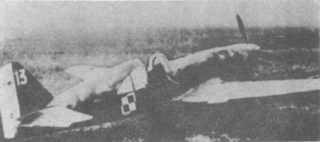
The C.710 were a series of light fighter aircraft developed by Caudron-Renault for the French Air Force just prior to the start of World War II. One version, the C.714, saw limited production, and were assigned to Polish pilots flying in France after the fall of Poland in 1939. A small number was also supplied to Finland.
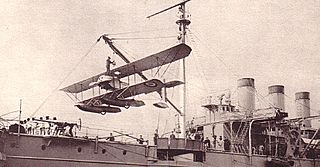
The Société des Avions Caudron was a French aircraft company founded in 1909 as the Association Aéroplanes Caudron Frères by brothers Gaston and René Caudron. It was one of the earliest aircraft manufacturers in France and produced planes for the military in both World War I and World War II. From 1933 onwards, it was a subsidiary of Renault.

The Caudron C.60 was a French two-seat biplane of the 1920s and 1930s with a single engine and a canvas-covered fuselage. The French aircraft manufacturer Caudron developed this aircraft from the Caudron C.59. It was mainly used as a trainer aircraft.

The Caudron G.3 was a single-engined French sesquiplane built by Caudron, widely used in World War I as a reconnaissance aircraft and trainer.
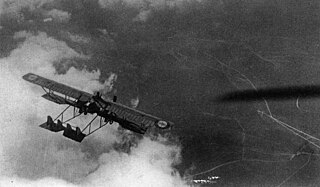
The Caudron G.4 is a French biplane with twin engines, widely used during World War I as a bomber. It was designed by René and Gaston Caudron as an improvement over their single-engined Caudron G.3. The aircraft employed wing warping for banking. The first G.4 was built in 1915, and it was manufactured in France, England and Italy. It was the world's first twin-engine aircraft to be widely used, starting in March 1915.

The Caudron C.600 Aiglon is a 1930s French two-seat monoplane sport/touring aircraft built by Caudron–Renault.

The Caudron R.4 was a French World War I twin-engine biplane reconnaissance/artillery cooperation aircraft and the progenitor of a series of successful aircraft that filled a variety of roles with the French Aéronautique Militaire.

The Caudron C.690 was a single-seat training aircraft developed in France in the late 1930s to train fighter pilots to handle high-performance aircraft. It was a conventional low-wing cantilever monoplane that bore a strong resemblance to designer Marcel Riffard's racer designs of the same period. Caudron attempted to attract overseas sales for the aircraft, but this resulted in orders for only two machines - one from Japan, and the other from the USSR. In the meantime, the first of two prototypes was destroyed in a crash that killed René Paulhan, Caudron's chief test pilot.
The Caudron J Marine was an amphibious, two-seat, biplane equipped with floats and wheels, similar to the earlier Caudron J floatplane.

The Caudron G.2 was a single-engined French biplane built by Caudron, used in World War I as a reconnaissance aircraft and trainer.

The Caudron Type A was the first successful aircraft built by René Caudron and his brother Gaston. During 1910 the Caudron brothers were briefly associated with the Société Anonyme Français d'Aviation (S.A.F.A.), and an example of the type was exhibited at the 1910 Paris Aero Salon as the S.A.F.A. Biplane.

The Caudron C.101 and its variants, the C.103, C.104 and C.107 were French two seat reconnaissance aircraft flown from 1925, differing in their engines.

The Hydroaéroplane Caudron-Fabre, (Caudron-Fabre), was a French amphibious seaplane that competed in the 1912 Monaco event. It was one of the first true amphibians, able to take-off from water and touch down on land.
The Caudron Type H was a collective name for three different Caudron designs of 1912-3. One of these was an amphibious three seat biplane built for the French military. Two were completed, one appearing at the Paris Aero Salon in November 1912.
The Caudron Type B was a 1911 development of the earliest Caudron type, the Caudron Type A, with a nacelle style fuselage and more powerful engine. Initially an equal span biplane, it was modified into a sesquiplane.
The Caudron C.490 was a trainer aircraft built by Caudron in the mid 1930s.

The Caudron Type G was a single-engined French biplane built by Caudron, prior to World War I. Developments of the Caudron G saw widespread service in France, Russia and Great Britain.
The Caudron C.20 was a French army cooperation aircraft/light bomber built by Caudron in World War I. It was powered by a 180-hp Gnome Monosoupape rotary engine.
The Caudron C.98 was a French sports/racing aircraft built by Caudron in the 1920s. Derived from the Caudron C.91, it was powered by a 230 hp Salmson 9 Ab 9-cyl air-cooled radial, and it was intended for the Coupe Zenith race.
References
- ↑ Hauet, André (2001). Les Avions Caudrons. 1. Outreau: Lela Presse. ISBN 2 914017-08-1.
 | This article on an aircraft of the 1920s is a stub. You can help Wikipedia by expanding it. |