Charles Willard Moore was an American architect, educator, writer, Fellow of the American Institute of Architects, and winner of the AIA Gold Medal in 1991. He is often labeled as the father of postmodernism. His work as an educator was important to a generation of American architects who read his books or studied with him at one of the several universities where he taught.

Arthur Brown Jr. was an American architect, based in San Francisco and designer of many of its landmarks. He is known for his work with John Bakewell Jr. as Bakewell and Brown, along with later works after the partnership dissolved in 1927.

Bowles Hall is a coed residential college at the University of California, Berkeley, known for its unique traditions, parties, and camaraderie. Designed by George W. Kelham, the building was the first residence hall on campus, dedicated in 1929, and was California's first state-owned residence hall. It was built in 1928 with a $350,000 grant from Mary McNear Bowles in memory of her husband, Berkeley alumnus and University of California Regent Phillip E. Bowles. Mr. Bowles was said to have three loves: horses, horticulture and the University of California.

Bernard Ralph Maybeck was an American architect in the Arts and Crafts Movement of the early 20th century. He worked primarily in the San Francisco Bay Area, designing public buildings, including the Palace of Fine Arts in San Francisco, and also private houses, especially in Berkeley, where he lived and taught at the University of California. A number of his works are listed on the National Register of Historic Places.

Rosie the Riveter World War II Home Front National Historical Park is a United States national historical park located in Richmond, California, near San Francisco. The park preserves and interprets the legacy of the United States home front during World War II, including the Kaiser Richmond Shipyards, the Victory ship SS Red Oak Victory, a tank factory, housing developments and other facilities built to support America's entry into World War II. In particular, the role of women and African-Americans in war industries is explored and honored.

The Hearst Memorial Mining Building at the University of California, Berkeley, is home to the university's Materials Science and Engineering Department, with research and teaching spaces for the subdisciplines of biomaterials; chemical and electrochemical materials; computational materials; electronic, magnetic, and optical materials; and structural materials. The Beaux-Arts-style Classical Revival building is listed in the National Register of Historic Places and is designated as part of California Historical Landmark #946. It was designed by John Galen Howard, with the assistance of architect and Berkeley alumna Julia Morgan and the Dean of the College of Mines at that time, Samuel B. Christy. It was the first building on that campus designed by Howard. Construction began in 1902 as part of the Phoebe Hearst campus development plan. The building was dedicated to the memory of her husband George Hearst, who had been a successful miner.

John Galen Howard was an American architect and educator who began his career in New York before moving to California. He was the principal architect at several firms in both states and employed Julia Morgan early in her architectural career.
The campus of the University of California, Berkeley, and its surrounding community are home to a number of notable buildings by early 20th-century campus architect John Galen Howard, his peer Bernard Maybeck, and their colleague Julia Morgan. Subsequent tenures as supervising architect held by George W. Kelham and Arthur Brown, Jr. saw the addition of several buildings in neoclassical and other revival styles, while the building boom after World War II introduced modernist buildings by architects such as Vernon DeMars, Joseph Esherick, John Carl Warnecke, Gardner Dailey, Anshen & Allen, and Skidmore, Owings and Merrill. Recent decades have seen additions including the postmodernist Haas School of Business by Charles Willard Moore, Soda Hall by Edward Larrabee Barnes, and the East Asian Library by Tod Williams Billie Tsien Architects.

The Masonic Temple in Downtown Berkeley, California is a historic building listed on the National Register of Historic Places. It is located at 2105 Bancroft Way at the corner of Shattuck Avenue, just one block west of the University of California, Berkeley. The Classical Revival style building, designed by William H. Wharff, was built in 1905. The building was built for Berkeley's Masons, who started a local lodge in 1882 and formed the Berkeley Masonic Temple Association to build the temple. In 1944, the building was converted to a bank. The ground floor of the building was unoccupied and the remaining floors were used by University staff, including the California Center for Innovative Transportation and the National Writing Project.

Charles Morrison Robinson, most commonly known as Charles M. Robinson, was an American architect. He worked in Altoona and Pittsburgh, Pennsylvania from 1889 to 1906 and in Richmond, Virginia from 1906 until the time of his death in 1932. He is most remembered as a prolific designer of educational buildings in Virginia, including public schools in Richmond and throughout Virginia, and university buildings for James Madison University, College of William and Mary, Radford University, Virginia State University, University of Mary Washington, and the University of Richmond. He was also the public school architect of the Richmond Public Schools from 1910 to 1929. Many of his works have been listed on the National Register of Historic Places.

Judson Studios is a fine arts studio specializing in stained glass located in the Highland Park section of northeast Los Angeles. The stained glass studio was founded in the Mott Alley section of downtown Los Angeles in the mid-1890s by English-born artist William Lees Judson and his three sons. It moved to its current location in 1920 and remains in operation as a family-run business. The Judson Studios building was named a Historic-Cultural Landmark by the City of Los Angeles in 1969 and listed in the National Register of Historic Places in 1999.

The Benjamin Stickney Cable Memorial Hospital is a historic hospital building at the junction of Massachusetts routes 1A and 133 in Ipswich, Massachusetts, U.S. The Colonial Revival building was built in 1917, following an extended fundraising effort, begun in 1906 and pushed further along by philanthropist and Castle Hill owner Richard T. Crane, Jr., after the 1915 death in a car accident of his friend, Benjamin Stickney Cable. Crane purchased the land on which the building sits and made a further donation of $145,000 to the construction fund.

George William Kelham (1871–1936) was an American architect, he was most active in the San Francisco Bay Area.
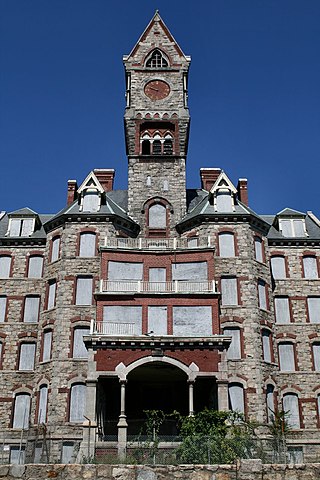
Worcester State Hospital was a Massachusetts state mental hospital located in Worcester, Massachusetts. It is credited to the architectural firm of Weston & Rand. The hospital and surrounding associated historic structures are listed as Worcester Asylum and related buildings on the National Register of Historic Places.

Baltimore Heritage is an American nonprofit historic-preservation organization headquartered in Baltimore, Maryland.

Grace Hospital is an American historic hospital in Richmond, Virginia. The original Colonial Revival structure was built in 1911 based on a design by noted Virginia architect Charles M. Robinson. The hospital is located to the west of Richmond's central business district and was substantially expanded by additions in 1930 and 1964. The original three-story main structure with an entrance pavilion on West Grace Street, is a Colonial Revival building with paired Ionic order columns and gauged arches. In 1930, a five-story Moderne style addition was built to the south along Monroe Street. In 1964, a further three-story addition was built along Grace Street. The 1964 addition is devoid of ornamentation, and the west wing "projects a modern, utilitarian character."

The Chelsea Commercial Historic District is a historic district located along both sides of Main Street from Orchard to North Street in Chelsea, Michigan; the district also includes the adjacent 100 blocks of Jackson, East Middle, and West Middle Streets, as well as structures on Park, East, and Orchard Streets. It was listed on the National Register of Historic Places in 2011.

Julia Morgan Hall is a historic building in the University of California Botanical Garden in Berkeley, California. Built in 1911, the building was designed by prominent California architect Julia Morgan and originally located on the central campus of the University of California, Berkeley, near the present location of the Haas School of Business. It served as a gathering place for Berkeley's female students, who wanted a female counterpart to Senior Hall, the senior men's meeting hall.