The 1968 United States presidential election was the 46th quadrennial presidential election. It was held on Tuesday, November 5, 1968. The Republican nominee, former Vice President Richard Nixon, defeated the Democratic nominee, incumbent Vice President Hubert Humphrey. Analysts have argued the election of 1968 was a major realigning election as it permanently disrupted the New Deal Coalition that had dominated presidential politics for 36 years.

Galo Lincoln Plaza Lasso de la Vega was an Ecuadorian statesman who served as President of Ecuador from 1948 to 1952 and Secretary General of the Organization of American States from 1968 to 1975. He is the son of former Ecuadorian President Leonidas Plaza.

The 1968 United States Senate elections were elections for the United States Senate which coincided with the presidential election. Although Richard Nixon won the presidential election narrowly, the Republicans picked up five net seats in the Senate. Republicans would gain another seat after the election when Alaska Republican Ted Stevens was appointed to replace Democrat Bob Bartlett.

Andrés Fernández de Córdova Nieto was President of Ecuador from December 1939 to August 1940. He later ran in the presidential election of 1968, losing to José Maria Velasco Ibarra.

Rodrigo Borja Cevallos was President of Ecuador from August 10, 1988 to August 10, 1992.
Communist Party of Ecuador is a political party in Ecuador. It was formed in 1925 as the Socialist Party. The party publishes El Pueblo, the general secretary is Winston Alarcón and the youth wing of the PCE is the Juventud Comunista del Ecuador (JCE).

Rafael Vicente Correa Delgado is an Ecuadorian politician and economist who served as President of Ecuador from 2007 to 2017. The leader of the PAIS Alliance political movement, Correa is a democratic socialist and his administration focused on the implementation of left-wing policies. Internationally, he served as president pro tempore of the Union of South American Nations.

Álex Dario Aguinaga Garzón is an Ecuadorian retired football midfielder and manager of Categoría Primera A team Itagüí. As a player, he is one of the all-time cap leaders for Ecuador with 109 matches, scoring 23 goals. Aguinaga is known as one of the best Ecuadorian footballers of all time. On the club level, Aguinaga has played for Deportivo Quito, Necaxa, Cruz Azul and LDU Quito.
PAIS Alliance is an Ecuadorian center-left social democratic political party.

Jaime José Nebot Saadi is an Ecuadorian lawyer and politician. He currently serves as mayor of Guayaquil, which is Ecuador's largest city. He is affiliated with the Social Christian Party (PSC) and the Madera de Guerrero Civic Movement. Nebot ran twice for president of Ecuador, in 1996 losing against Sixto Duran-Ballén, and in 1996 losing against Abdalá Bucaram.

The following outline is provided as an overview of and topical guide to South America.

The 1968 New York state election was held on November 5, 1968, to elect a judge of the New York Court of Appeals and a U.S. Senator, as well as all members of the New York State Assembly and the New York State Senate.
The Conservative Party was an Ecuadorian conservative party formed in 1869. Initially associated with the military of Ecuador the PC became one of the two great parties of state in the country, alternating in power with the Ecuadorian Radical Liberal Party. Its traditional support basis has been amongst the landowning classes, as well as merchants and artisans and it tended to favour a unitary structure rather than federalism.
The National Assembly is the legislative branch of the government of Ecuador that replaced the National Congress in 2009, under the 2008 Constitution. The current President of the Assembly is Elizabeth Cabezas, as of May 14, 2018. Within Ecuador, the National Assembly has the power to pass laws, while appointment of judges to the National Court of Justice is done by a separate Judicial Council.

General elections were held in Ecuador on 5 June 1960. The presidential election was won by José María Velasco Ibarra of the Velasquista National Federation, who received 48.2% of the vote. His fourth term of office began on 1 September.
A referendum on allowing the election of independents was held in Ecuador on 2 June 1986 alongside provincial elections. The proposal was rejected by 69% of voters.
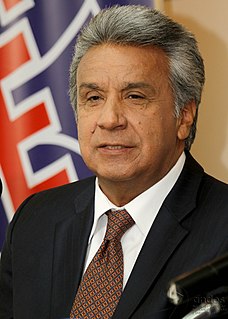
General elections were held in Ecuador on 19 February 2017 alongside a referendum on tax havens. Voters elected a new President and National Assembly. Incumbent President Rafael Correa of the PAIS Alliance was not eligible for re-election, having served two terms. In the first round of the presidential elections, PAIS Alliance candidate Lenín Moreno received 39% of the vote. Although he was more than 10% ahead of his nearest rival, Guillermo Lasso of the Creating Opportunities party, Moreno was just short of the 40% threshold required to avoid a run-off. As a result, a second round was held on 2 April. In the second round Moreno was elected President with 51.16% of the vote.
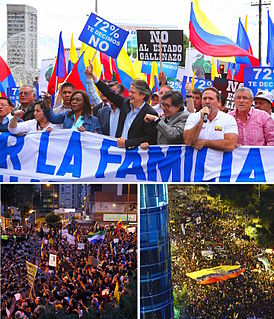
The 2015 Ecuadorian protests were a series of protests against the inheritance tax laws introduced by Ecuadorian President Rafael Correa. The protests began during the first week of June; becoming more organized and growing to hundreds of people on 8 June 2015. Since then, hundreds of thousands of Ecuadorians protested throughout Ecuador against President Correa and the controversial inheritance tax laws he introduced. The opposition and demonstrators protested stating that Correa wanted to follow "the same path as Venezuela’s government", creating a "criminal war of classes" while President Correa stated that the protests were aimed at destabilizing the government and such measures were for combatting inequality.
J. Francisco Guzmán Carmigniani, known as Pancho Guzmán, is a former professional tennis player from Ecuador.