Lean manufacturing is a management system built on three principles: produce only what is needed, when it is needed; correct abnormalities as soon as they occur; and empower workers to improve the process themselves.
At its core, Lean eliminates activities that do not add value for the customer. Where just-in-time manufacturing (JIT) focuses on inventory strategy — receiving goods only as needed to reduce costs and waste — Lean goes further by reducing cycle time, flow time, and throughput time across the entire system, including marketing and customer service. According to one study: "While Just-In-Time manufacturing focuses on efficiency of inventory strategy to eliminate waste and enhance productivity, Lean manufacturing uses efficiency in its system setups to reduce cycle, flow, and throughput times being the added values to customers."[1]
Companies employ the strategy to increase efficiency. By receiving goods only as they need them for the production process, it reduces inventory costs and wastage, and increases productivity and profit. The downside is that it requires producers to forecast demand accurately, as the benefits can be nullified by minor delays in the supply chain. It may also impact negatively on workers due to added stress and inflexible conditions. A successful operation depends on a company having regular outputs, high-quality processes, and reliable suppliers.
Before World War II, American statistician W. Edwards Deming and Walter A. Shewhart developed the earliest formalized modern manufacturing philosophies, applying statistical models to improve efficiency in large U.S. military manufacturers during the war. American industry largely rejected their methods at the time.[2]
Continuous production improvement and incentives for such were documented in Taylor's Principles of Scientific Management (1911):
"... whenever a workman proposes an improvement, it should be the policy of the management to make a careful analysis of the new method, and if necessary conduct a series of experiments to determine accurately the relative merit of the new suggestion and of the old standard. And whenever the new method is found to be markedly superior to the old, it should be adopted as the standard for the whole establishment."
"...after a workman has had the price per piece of the work he is doing lowered two or three times as a result of his having worked harder and increased his output, he is likely entirely to lose sight of his employer's side of the case and become imbued with a grim determination to have no more cuts if soldiering [marking time, just doing what he is told] can prevent it."
Shigeo Shingo cites reading Principles of Scientific Management in 1931 and being "greatly impressed to make the study and practice of scientific management his life's work".[3][4]
Post-war Japan
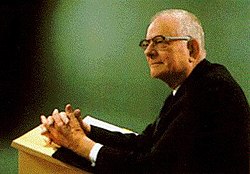
W. Edwards Deming
After the war, Deming was assigned by General Douglas MacArthur to assist in Japan's reconstruction. Working as a manufacturing consultant for struggling heavy industries — including Toyota and Mitsubishi — Deming found the Japanese far more receptive to his methods than American industry had been.[5][6][7][8]
Japan's post-war conditions made efficiency essential. American supply chain specialist Gerhard Plenert has offered four reasons:[9]
Japan's lack of cash made it difficult for industry to finance the big-batch, large inventory production methods common elsewhere.
Japan lacked space to build big factories loaded with inventory.
The Japanese islands lack natural resources with which to build products.
Japan had high unemployment, which meant that labor efficiency methods were not an obvious pathway to industrial success.
In response, Japanese manufacturers leaned out their processes: "They built smaller factories ... in which the only materials housed in the factory were those on which work was currently being done. In this way, inventory levels were kept low, investment in in-process inventories was at a minimum, and the investment in purchased natural resources was quickly turned around so that additional materials were purchased."[10]
Toyota's Shigeo Shingo and Taiichi Ohno, building on Deming's teachings, redesigned Toyota's manufacturing process after the war. Toyota — originally a textile company that moved into automobiles in 1934 — had struggled with wasted resources from poor-quality castings. In 1936, after winning its first government truck contract, Toyota developed Kaizen improvement teams in response to new production problems. These teams eventually evolved into the Toyota Production System (TPS), and later into what became known in the West as The Toyota Way.[11]
Levels of demand in the post-war economy of Japan were low; as a result, the focus of mass production on lowest cost per item via economies of scale had little application. Having visited supermarkets in the United States, Ohno recognized that the scheduling of work should not be driven by sales or production targets but by actual sales. Given the financial situation during this period, over-production had to be avoided, and thus the notion of "pull" (or "build-to-order" rather than target-driven "push") came to underpin production scheduling.
Japan still recognizes Deming's contribution through the Deming Prize, awarded annually to the world's best manufacturers.
American industrialists had recognized the threat of cheap offshore labor as early as the 1910s. Henry Towne, past president of the American Society of Mechanical Engineers, wrote in the foreword to Frederick Winslow Taylor's Shop Management (1911): "We are justly proud of the high wage rates which prevail throughout our country, and jealous of any interference with them by the products of the cheaper labor of other countries. To maintain this condition, to strengthen our control of home markets, and, above all, to broaden our opportunities in foreign markets where we must compete with the products of other industrial nations, we should welcome and encourage every influence tending to increase the efficiency of our productive processes."[12]
Spread to the West
News of the Toyota Production System reached Western countries in 1977 through two English-language articles: one referred to the methodology as the "Ohno system", after Taiichi Ohno, who was instrumental in its development within Toyota;[13] the other, by Toyota authors in an international journal, provided additional details.[14]
Adoption accelerated after a landmark 1980 conference at Ford World Headquarters in Detroit, co-sponsored by the Repetitive Manufacturing Group (RMG) of the American Production and Inventory Control Society (APICS). The principal speaker, Fujio Cho (later president of Toyota Motor Corp.), explained the Toyota system to an American manufacturing audience.[15]
By the mid-1980s, companies including Hewlett-Packard, Motorola, General Electric, Deere & Company, Westinghouse Electric, and Apple Inc. had adopted JIT practices.[16]Omark Industries' Zero Inventory Production System (ZIPS) became a widely cited case study: at Omark's plant in Portland, Oregon, after 40 hours of ZIPS training, workers reduced a week's lead time at a stroke — "things ran smoother" — and ZIPS spread through operations "like an amoeba." At one of Omark's smaller plants in Mesabi, Minnesota making drill bits, large-size drill inventory was cut by 92%, productivity increased by 30%, scrap and rework dropped 20%, and lead time from order to finished product was slashed from three weeks to three days.[17]
Coining the term
John Krafcik coined the term Lean in his 1988 article, "Triumph of the Lean Production System".[18] The article states: (a) Lean manufacturing plants have higher levels of productivity and quality than non-Lean plants; and (b) "The level of plant technology seems to have little effect on operating performance." Risks with implementing Lean can be reduced by "developing a well-trained, flexible workforce, product designs that are easy to build with high quality, and a supportive, high-performance supplier network."
In 1996, researchers James Womack and Daniel Jones formally defined Lean in Lean Thinking,[19] as detailed further in the books The Machine that Changed the World[20] (1990) and Lean Thinking (1996). The term steadily replaced "JIT manufacturing" throughout the 1990s. Lean manufacturing is described as "a more recent name for JIT" that is "deeply rooted in the automotive industry and focuses mostly on repetitive manufacturing situations."[21]
Jidoka — often translated as "autonomation" or "automation with a human touch" — is the principle of designing equipment and processes to detect abnormalities and stop automatically the moment a problem occurs, rather than passing defects downstream.[22] The concept originates with Sakichi Toyoda, founder of the Toyota Group, who invented a textile loom in the early 1900s that stopped automatically when any thread broke. Previously, a broken thread would produce mounds of defective fabric requiring an operator at every machine; Toyoda's innovation allowed one operator to oversee many machines simultaneously.[23]
In practice, jidoka has two forms: mechanical jidoka, where sensors or devices halt a machine upon detecting a defect; and human jidoka, where operators are empowered and expected to stop the production line whenever they identify a problem. A key tool for implementing human jidoka is the andon system — a visual and auditory signal (originally a cord or button at each workstation) that alerts supervisors and support teams to a problem and its location.[24] Once stopped, the root cause is identified and addressed before production resumes, embedding quality at every stage rather than relying on end-of-line inspection.
Jidoka and just-in-time are interdependent: for a JIT pull system to function, every part moving to the next stage must meet quality standards. Jidoka provides that assurance.
The seven wastes
Toyota engineer Shigeo Shingo identified seven categories of waste (muda) to be eliminated:[25]
Inventory — excess raw materials and finished goods
Overproduction — producing more than currently needed
Over-processing — working beyond the standard expected by the customer
Transportation — unnecessary movement of people or goods
Excess motion — automating or mechanizing before improving the method
Waiting — inactive periods due to job queues
Defects — reworking avoidable errors in products or processes
Later contributors identified additional waste types, including unused worker skills, poor metrics, and underutilization of employee ideas.[26]
Key principles
Womack and Jones define Lean as "a way to do more and more with less and less—less human effort, less equipment, less time, and less space—while coming closer and closer to providing customers exactly what they want" and identify five key principles:[27]
Value — Specify the value desired by the customer; form a team for each product to stick with that product during its entire production cycle; enter into a dialogue with the customer (e.g. Voice of the customer).
Value stream — Identify the value stream for each product providing that value and challenge all of the wasted steps (generally nine out of ten) currently necessary to provide it.
Flow — Make the product flow continuously through the remaining value-added steps.
Pull — Introduce pull between all steps where continuous flow is impossible.
Perfection — Manage toward perfection so that the number of steps and the amount of time and information needed to serve the customer continually falls.
Lean is founded on the concept of continuous and incremental improvements on product and process while eliminating redundant activities. "The value of adding activities are simply only those things the customer is willing to pay for, everything else is waste, and should be eliminated, simplified, reduced, or integrated."[28]
In 1999, Spear and Bowen identified four rules characterizing the "Toyota DNA":[29]
All work shall be highly specified as to content, sequence, timing, and outcome.
Every customer-supplier connection must be direct, and there must be an unambiguous yes-or-no way to send requests and receive responses.
The pathway for every product and service must be simple and direct.
Any improvement must be made in accordance with the scientific method, under the guidance of a teacher, at the lowest possible level in the organization.
Methodology
Lean can be understood in four complementary ways:[30]
A philosophy — a way of thinking about value and waste
Value-stream mapping (VSM) and 5S are the most common approaches companies take on their first steps to Lean. Lean can be focused on specific processes, or cover the entire supply chain. Front-line workers should be involved in VSM activities.[31]
5S
5S is a workplace organization method originating from the Toyota Production System, described by the U.S. Environmental Protection Agency as providing "the foundation on which other lean methods, such as TPM, cellular manufacturing, just-in-time production, and six sigma can be introduced."[32] The name derives from five Japanese terms — seiri, seiton, seisō, seiketsu, and shitsuke — typically translated as Sort, Set in Order, Shine, Standardize, and Sustain.[33] Each step builds on the previous: Sort removes unnecessary items from the workspace; Set in Order assigns logical, labeled locations for everything that remains; Shine involves regular cleaning and inspection that makes abnormalities immediately visible; Standardize captures best practices so the first three steps are consistently maintained; and Sustain embeds the habits through training and audits until they become routine.
5S is often described as the foundation on which other Lean methods — such as kanban, cellular manufacturing, and total productive maintenance — can be introduced, because a stable, organized, and visually managed environment is a prerequisite for reliable flow.[34]
Kanban
Kanban (Japanese: signboard or visual signal) is the scheduling system that makes pull production operational. Developed by Taiichi Ohno at Toyota, it was inspired by the way supermarkets replenish shelves: items are restocked only after they are consumed, not in anticipation of future demand.[35] In a kanban system, a card, container, or electronic signal authorizes the upstream process to produce or move a fixed quantity of a specific part — but only when downstream consumption has created that need. As long as no parts are produced or moved without a kanban, a true pull system is maintained and overproduction is structurally prevented.[36]
The two most common kanban types are the production kanban, which authorizes a workstation to produce a container of parts, and the withdrawal kanban, which authorizes the movement of parts to a downstream process.[37] Many manufacturers have moved to electronic kanban (e-kanban) systems integrated with ERP software, enabling real-time demand signaling across the supply chain while eliminating lost or misread cards.
Takt time — the rate at which products must be produced to match customer demand — is a key planning tool. JIT systems are designed to produce at takt time, ensuring output matches demand without overproduction.[38]
A successful implementation requires genuine leadership commitment, involvement of front-line workers, coaching, and clear improvement metrics. Management should not decide on solutions without understanding the true problem by consulting shop floor personnel.[39] One paper recommends that organizations develop their own Lean plan under "Lean Leadership", enabling Lean teams to make suggestions while managers make implementation decisions; coaching is recommended when starting out.[40] Solutions must be tailored to specific problems; what works at one company may not generalize to another.
Lean principles have been applied widely outside traditional manufacturing.
In healthcare, several hospitals have adopted the concept of the lean hospital, prioritizing the patient, thus increasing employee commitment and motivation, as well as boosting medical quality and cost effectiveness.[41]
In software development and information technology, Lean principles have had a particularly deep influence. Mary and Tom Poppendieck's Lean Software Development: An Agile Toolkit (2003) formally translated Lean manufacturing principles into seven software equivalents and provided a conceptual link between Lean and the emerging Agile community.[42] Many of the developers of various Agile methods were already influenced by Lean manufacturing ideas from the beginning; the Poppendiecks made that connection explicit.[43] Lean concepts such as value-stream mapping, elimination of inventory (treating undeployed code or unvalidated requirements as waste), and pull scheduling now underpin widely adopted frameworks including Scrum and DevOps.
In call centers, Lean's waste reduction practices have been used to reduce handle time, within and between agent variation, accent barriers, and to attain near-perfect process adherence.[44]
In the public sector, Lean has been adopted in government services, though most results have been achieved using a much more restricted range of techniques than Lean provides.[45]
In retail and logistics, quick-response supply chains trace their roots to JIT principles; fast fashion is a downstream evolution of these ideas.[46]
The main challenge in moving Lean to services is the lack of widely available reference implementations to allow people to see how directly applying Lean manufacturing tools and practices can work. This makes it more difficult to build the level of belief seen as necessary for strong implementation.[47]
Quantified outcomes
Published case studies provide empirical grounding for Lean's claimed benefits. A summary from Daman Products (1999) reported cycle times reduced by 97%, setup times by 50%, lead times from 4–8 weeks down to 5–10 days, and flow distance by 90%, achieved through cellular factories, pull scheduling, kanban, visual management, and employee empowerment.[48]
A study from NCR (Dundee, Scotland, 1998), a make-to-order producer of automated teller machines, reported that switching to JIT over a single weekend eliminated buffer inventories, reduced inventory from 47 days to 5 days, flow time from 15 days to 2 days, with 60% of purchased parts arriving JIT and 77% going dock-to-line, and suppliers reduced from 480 to 165.[49]
Hewlett-Packard, one of western industry's earliest JIT implementers, documented results across four divisions during the mid-1980s:
Lean is associated with an increased level of stress among employees, who have a small margin of error in their work environment which requires perfection.[51] Employees are further at risk of precarious work when employed by factories that utilize just-in-time and flexible production techniques. A longitudinal study of US workers since 1970 indicates employers seeking to easily adjust their workforce in response to supply and demand conditions respond by creating more nonstandard work arrangements, such as contracting and temporary work.[52]
Supply chain fragility
Natural and human-made disasters will disrupt the flow of energy, goods, and services. Down-stream customers will, in turn, not be able to produce their product because they were counting on incoming deliveries "just in time" and have little or no inventory to work with.[53] A severe geomagnetic storm could disrupt electrical power delivery for hours to years; lack of supplies on hand to repair the electrical system would have catastrophic effects.[54]
The COVID-19 pandemic caused disruption in JIT practices, with quarantine restrictions on international trade interrupting supply while stockpiles were lacking, alongside increased demand for medical supplies like personal protective equipment (PPE) and ventilators. This has led to suggestions that stockpiles and diversification of suppliers should be more heavily focused upon.[55][56][57]
According to Williams, ordering small quantities of materials can also cause difficulties in meeting suppliers' minimum order policies.[58]
Short-termism and overfocus on waste
Lean also over-focuses on cutting waste, which may lead management to cut sectors of the company not essential to short-term productivity but nevertheless important to the company's legacy. Lean also over-focuses on the present, which hinders a company's plans for the future.[51]
Lack of standardization
Critics note that "Lean is more a culture than a method, and there is no standard lean production model," which makes consistent implementation and evaluation difficult. Critics also make negative comparisons of Lean to 19th-century scientific management, which had been fought by the labor movement and was considered obsolete by the 1930s.[51]
Lean accounting
A significant tension exists between Lean operations and standard cost accounting, the dominant accounting method in manufacturing since the early twentieth century. Standard cost accounting allocates overhead to products based on direct labor hours and evaluates managers on utilization and efficiency variances — metrics that can actively discourage Lean behavior. For example, a decision to reduce inventory (a core Lean goal) appears as a loss of overhead absorption in traditional accounts, making the improvement look like deteriorating performance.[59]
The term lean accounting and its core method, value stream costing, were developed by Brian Maskell and Bruce Baggaley, whose book Practical Lean Accounting (2003) became the primary practitioner reference.[60] Rather than allocating overhead through standard rates, value stream costing collects all actual costs — labor, materials, support services, and facilities — against each value stream and reports them weekly without variance adjustments. This gives managers clear, direct information tied to the lean improvements they are making.[61] The principles reached a broader audience at the first Lean Accounting Summit, held in September 2005 in Dearborn, Michigan, attended by over 300 practitioners.
Supplier concentration
After years of success, the consolidation of Toyota's supply chain networks brought it to the position of being the world's biggest carmaker. In 2010, a crisis of safety-related problems at Toyota made other carmakers that had duplicated Toyota's supply chain system wary of similar recall issues. James Womack had warned Toyota that cooperating with single outsourced suppliers might bring unexpected problems.[62]
↑Kamarudin Abu Bakar; Mohd Fazli Mohd. Sam; M.I. Qureshi (2022), "Lean Manufacturing Design of a Two-Sided Assembly Line Balancing Problem Work Cell", in Mohd Najib Ali Mokhtar; Zamberi Jamaludin; Mohd Sanusi Abdul Aziz; Mohd Nazmin Maslan; Jeeferie Abd Razak (eds.), Intelligent Manufacturing and Mechatronics: Proceedings of SympoSIMM 2021, Springer Nature, p.250
↑"Deming the Man". youtube. Deming Institute. March 2, 2013. Retrieved October 27, 2024.
↑Walters, C.R. 1984. Why everybody's talking about "just-in-time." Inc. (March 1) 77–90.
↑Walters, C.R. 1984. Why everybody's talking about "just-in-time." Inc. (March 1) 77–90.
↑Krafcik, John F. (Fall 1988). "Triumph of the Lean Production System"(PDF). Sloan Management Review. pp.41–52. Archived(PDF) from the original on February 12, 2020. Retrieved February 10, 2020.
↑Alkalay, M.; Angerer, A.; Drews, T.; Jäggi, C.; Kämpfer, M.; Lenherr, I.; Valentin, J.; Vetterli, C.; Walker, D. (2015). Walker, Daniel (ed.). The Better Hospital: Excellence Through Leadership And Innovation. Medizinisch Wissenschaftliche Verlagsgesellschaft. ISBN9783954662241.
↑Poppendieck, Mary; Poppendieck, Tom (2003). Lean Software Development: An Agile Toolkit. Addison-Wesley. ISBN978-0-321-15078-3.
↑Fowler, Martin. "Agile Versus Lean". martinfowler.com. Retrieved March 6, 2026.
↑Hines, T. 2001. "From analogue to digital supply chains: Implications for fashion marketing," in Fashion Marketing: Contemporary Issues. eds, T. Hines and M. Bruce. Oxford: Butterworth Heinemann, 26–47.
↑Grahovec, D. and Bernie Ducan, Jerry Stevenson, Colin Noone. 1999. How lean focused factories enabled Daman to regain responsiveness and become more agile. Target. 4th quarter, pp 47–51.
↑Caulkin, Simon. 1990. Britain's best factories. Management Today. November 60–89.
↑Simpson, Alex. Effective just-in-time manufacture at Hewlett-Packard. In Mortimer, J. 1986. Just-in-Time: An Executive Briefing. Kempston, Bedford, UK: IFS Ltd.
↑Baggaley, B.; Maskell, B. (March–April 2003). "Value stream management for lean companies, Part I". Journal of Cost Management: 23–27.
↑Maskell, Brian H.; Baggaley, Bruce; Grasso, Larry (2003). Practical Lean Accounting: A Proven System for Measuring and Managing the Lean Enterprise. Productivity Press. ISBN978-1-56327-243-1.
↑Maskell, Brian H.; Baggaley, Bruce L. (2006). "Lean accounting: What's it all about?". Target Magazine. 22 (1): 35–43.
↑The Economist, 2010, Toyota's overstretched supply chain — The machine that ran too hot: The woes of the world's biggest carmaker are a warning for rivals.
References
Ohno, Taiichi (1988). Toyota Production System: Beyond Large-Scale Production. CRC Press. ISBN978-0-915299-14-0.
Shingo, Shigeo. 1985. A Revolution in Manufacturing: The SMED System. Stamford, Ct.: Productivity Press.
Maskell, Brian H.; Baggaley, Bruce; Grasso, Larry (2003). Practical Lean Accounting: A Proven System for Measuring and Managing the Lean Enterprise. Productivity Press. ISBN978-1-56327-243-1.
Poppendieck, Mary; Poppendieck, Tom (2003). Lean Software Development: An Agile Toolkit. Addison-Wesley. ISBN978-0-321-15078-3.
Plenert, G. (2007), Reinventing Lean: Introducing Lean Management into the Supply Chain. Oxford, U.K.: Butterworth-Heinemann.
This page is based on this Wikipedia article Text is available under the CC BY-SA 4.0 license; additional terms may apply. Images, videos and audio are available under their respective licenses.