
Bach is a double-ringed impact basin within the Bach quadrangle of Mercury. It was named by the IAU in 1976.

Vivaldi is a crater on Mercury. It was named by the IAU after Italian composer Antonio Vivaldi in 1976. It has a prominent and nearly continuous inner ring whose diameter measures about half that of the outer ring. It is one of 110 peak ring basins on Mercury. Unlike some of the lunar multiringed structures, no vestiges of additional rings are apparent around this crater. It is classified as c3 age.

Mozart is a crater on Mercury, named by the IAU in 1976 after Austrian composer Wolfgang Amadeus Mozart.
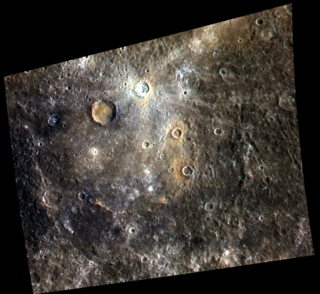
Homer is a crater on Mercury. It is one of 110 peak ring basins on Mercury.

Praxiteles is a crater on Mercury. It is one of 110 peak ring basins on Mercury.

Raditladi is a large impact crater on Mercury with a diameter of 263 km. Inside its peak ring there is a system of concentric extensional troughs (graben), which are rare surface features on Mercury. The floor of Raditladi is partially covered by relatively light smooth plains, which are thought to be a product of the effusive volcanism. The troughs may also have resulted from volcanic processes under the floor of Raditladi. The basin is relatively young, probably younger than one billion years, with only a few small impact craters on its floor and with well-preserved basin walls and peak-ring structure. It is one of 110 peak ring basins on Mercury.

Berkel is a crater on the planet Mercury. Its name was approved by the IAU on July 9, 2009. It was named after the modernist painter Sabri Berkel.

Izquierdo is a crater on Mercury. Its name was adopted by the International Astronomical Union (IAU) in 2009, for the Mexican painter María Izquierdo. The floor of Izquierdo is smooth, the result of having been partially filled with volcanic lava. Circular outlines of the rims of “ghost craters” – smaller, older craters that have been largely buried by the lavas that infilled the basin – are visible in a few places on Izquierdo's floor. The remnants of a buried inner ring are also barely discernible in spots, and it is one of 110 peak ring basins on Mercury. There have been more recent impacts into the floor of Izquierdo, resulting in some small, sharply defined craters.

Scarlatti is a pit-floored crater on Mercury, which was discovered in 1974 by the Mariner 10 spacecraft. It has a prominent peak ring, and it is one of 110 peak ring basins on Mercury. The crater floor is covered by the smooth plains material. The crater displays an arcuate collapse feature along the northeastern peak ring. The size of the pit, which was first noticed in MESSENGER images obtained in January 2008, is 38 × 12 km. Such a feature may have resulted from collapse of a magma chamber underlying the central peak ring complex of the crater. The collapse feature is an analog of Earth's volcanic calderas. Scarlatti is thought to have the same age as the Caloris basin.

Ahmad Baba is a crater on Mercury. It has a diameter of 127 kilometers. Its name was adopted by the International Astronomical Union (IAU) in 1979.

Aksakov is a crater on Mercury. It has a diameter of 174 kilometers. Its name was adopted by the International Astronomical Union (IAU) on April 24, 2012. Aksakov is named for the Russian author Sergey Aksakov, who lived from 1791 to 1859 C.E.
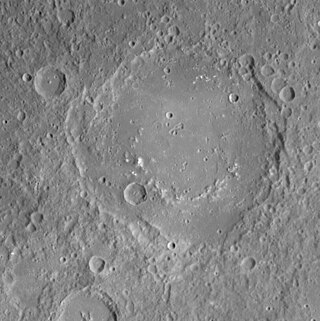
Al-Hamadhani is a crater on Mercury. It has a diameter of 186 kilometers. Its name was adopted by the International Astronomical Union in 1979. Al-Hamadhani is named for the Iranian writer Badi' al-Zaman al-Hamadani, who died in 1007 C.E.

Bartók is a crater on Mercury. Its name was adopted by the International Astronomical Union (IAU) in 1979. Bartók is named for the Hungarian composer Béla Bartók, who lived from 1881 to 1945.

Darío is a crater on Mercury. It has a diameter of 151 kilometers. Its name was adopted by the International Astronomical Union (IAU) in 1976. Dario is named for the Nicaraguan poet Rubén Darío, who lived from 1867 to 1916.

Dürer is a crater on Mercury. It has a diameter of 195 kilometers. Its name was adopted by the International Astronomical Union (IAU) in 1976. Durer is named for the German artist Albrecht Dürer, who lived from 1471 to 1528.

Mark Twain is a crater on Mercury. Its name was adopted by the International Astronomical Union (IAU) in 1976. Mark Twain is named for the American author Mark Twain, who lived from 1835 to 1910.

Holst is a crater on Mercury. Its name was adopted by the International Astronomical Union (IAU) on April 24, 2012.

Alver is a crater on Mercury. It has a diameter of 151.49 kilometers. Its name was adopted by the International Astronomical Union (IAU) on March 15, 2013. Alver is named for the Estonian poet Betti Alver.

Seuss is a crater on Mercury. Its name was adopted by the International Astronomical Union (IAU) in 2012. It is named for the American author and cartoonist Theodor Seuss Geisel, better known as Dr. Seuss.
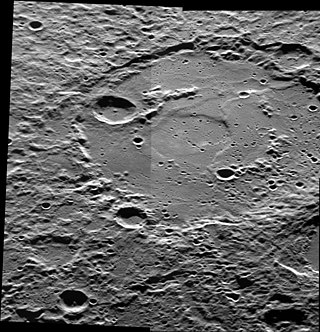
Steichen is a crater on Mercury. Its name was adopted by the International Astronomical Union (IAU) in 2010. The crater was named after American photographer and painter, Edward Steichen.

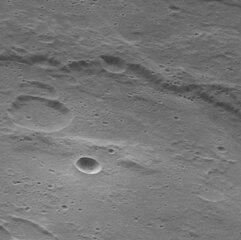 Oblique view of circular bright crater within Manley
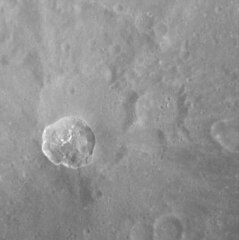 Bright crater within northern Manley crater. The crater has a ray system and the bright areas within it may be hollows.
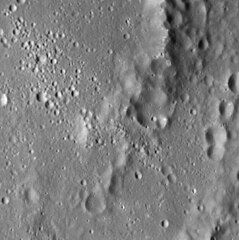 The southeastern peak ring has a lower albedo than the rest of the crater, and there are possible hollows on the peaks.


