Meghalaya Legislative Assembly election, 2008

Last updated

Meghalaya Legislative Assembly election, 2008
Flag of India.svg
  2003 3 Mar 2008 2013  

59 seats in the Assembly

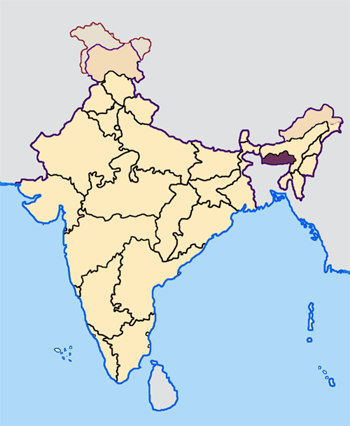
Meghalaya Meghalaya in India.png
Meghalaya

The Meghalaya Legislative Assembly election of 2008 took place in a single phase on 3 March 2008 to elect the Members of the Legislative Assembly (MLA) from each of the 60 Assembly Constituencies (ACs) in Meghalaya, India. Counting of votes happened on 7 March 2008 and because of the use of Electronic Voting Machines (EVMs) in this election, the results were ready within the day.

A Member of the Legislative Assembly (MLA) is a representative elected by the voters of an electoral district (constituency) to the legislature of the State government in the Indian system of government. From each constituency, the people elect one representative who then becomes a member of the Legislative Assembly (MLA). Each state has between seven and nine MLAs for every Member of Parliament (MP) that it has in the Lok Sabha, the lower house of India's bicameral parliament. There are also members in two unicameral legislatures in Union Territories: the Delhi Legislative Assembly and Puducherry Legislative Assembly.

Contents

The ruling coalition Meghalaya Democratic Alliance (MDA) had broken apart in the lead-up to this election, forcing the main partner Indian National Congress (INC) to take on their erstwhile partners including United Democratic Party (UDP) and Meghalaya Democratic Party (MDP) who had decided to fight against the INC on basis on corruption charges against the incumbent Government.

The Meghalaya Democratic Alliance (MDA) was a coalition of political parties that formed the Government in the state of Meghalaya, India, after the Legislative Assembly elections in Meghalaya, 2003. It was headed by the Indian National Congress (INC), which was the party with the highest number of seats in the 7th Meghalaya Legislative Assembly. Chief Minister D. D. Lapang and the other ministers in the Government were all members of the MDA. D. D. Lapang also served as the Chairperson of the MDA.

Indian National Congress Major political party in India

The Indian National Congress(pronunciation ) is a broadly based political party in India. Founded in 1885, it was the first modern nationalist movement to emerge in the British Empire in Asia and Africa. From the late 19th century, and especially after 1920, under the leadership of Mahatma Gandhi, Congress became the principal leader of the Indian independence movement. Congress led India to independence from Great Britain, and powerfully influenced other anti-colonial nationalist movements in the British Empire.

United Democratic Party (Meghalaya) political party recognised in Meghalaya state, India

The United Democratic Party is a political party recognised in Meghalaya state, India. It is now led by Donkupar Roy. It was started by E. K. Mawlong.

The election provided a hung verdict and both the incumbent INC and the post-election coalition of NCP-UDP (who called themselves the Meghalaya Progressive Alliance (MPA) staked claim with the Governor of Meghalaya M.M. Jacob to form the next Government of Meghalaya. [1] By virtue of being the single largest party in this election, winning 25 of the total 60 seats, the incumbent Chief Minister D. D. Lapang of the INC was invited by the Governor to form the new Government on 10 March 2008. [2] However, the Lapang Government was unable to get enough support in the Meghalaya Legislative Assembly and the Chief Minister resigned 9 days later ahead of the vote of confidence scheduled for 20 March 2008. The Governor then invited the head of the UDP Donkupar Roy to form the Government with the support of the MPA coalition who claimed support of 31 of the 60 seats in the Assembly. This included 14 seats from NCP, 11 from UDP, 2 from Hill State People's Democratic Party(HPDP), 1 from Bharatiya Janata Party (BJP), 1 from Khun Hynniewtrep National Awakening Movement (KHNAM) and 2 independents [3]

A hung parliament is a term used in legislatures under the Westminster system to describe a situation in which no particular political party or pre-existing coalition has an absolute majority of legislators in a parliament or other legislature. This situation is also known, albeit less commonly, as a balanced parliament, or as a legislature under no overall control, and can result in a minority government. The term is not relevant in multi-party systems where it is rare for a single party to hold a majority.
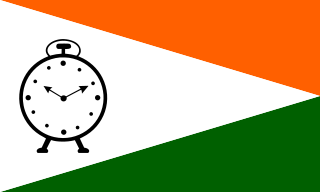
Nationalist Congress Party Political party of India

The Nationalist Congress Party (NCP) is a national level political party in India.

The Meghalaya Progressive Alliance (MPA) was the ruling coalition of political parties that formed the Government in the state of Meghalaya, India from 2008 to 2009. It was led by the Nationalist Congress Party (NCP) and the United Democratic Party (UDP) who are the second and third largest parties in the 8th Meghalaya Legislative Assembly. Chief Minister Dr. Donkupar Roy and the other ministers in the Government belong to the MPA.

Background

The previous elections to the 7th Meghalaya Legislative Assembly was held in 2003 and the term for this Assembly was set to expire on 10 March 2008. Hence, the Election Commission of India (ECI) announced fresh elections to the 8th Meghalaya Legislative Assembly on 14 January 2008. Of the 60 ACs in Tripura, 55 are reserved for Scheduled Tribes. Elections in all polling stations were held using EVMs. [4]

Meghalaya Legislative Assembly

The Meghalaya Legislative Assembly is a unicameral legislature in the government of the state of Meghalaya in India. Constituted as a directly elected body in 1972, it has 60 members, filled through direct elections held every five years. Like other Indian states, Meghalaya has a parliamentary system of government. The executive branch of the Meghalaya Government is derived from the Legislative Assembly.

Election Commission of India election regulatory body of India

The Election Commission of India is an autonomous constitutional authority responsible for administering election processes in India. The body administers elections to the Lok Sabha, Rajya Sabha, state Legislative Assemblies, state legislative Councils, and the offices of the President and Vice President of the country. The Election Commission operates under the authority of Constitution per Article 324, and subsequently enacted Representation of the People Act. The commission has the powers under the Constitution, to act in an appropriate manner when the enacted laws make insufficient provisions to deal with a given situation in the conduct of an election. Being a constitutional authority, Election Commission is amongst the few institutions which function with both autonomy and freedom, along with the country’s higher judiciary, the Union Public Service Commission and the Comptroller and Auditor General of India.

After the 2003 elections to the 7th Meghalaya Legislative Assembly, the INC led MDA formed the Government under the leadership of INC's D. D. Lapang. The members of the MDA were INC (22 seats), UDP (9 seats), Meghalaya Democratic Party (MDP) (4 seats) and 3 independents. By 2006, Lapang faced revolt within the INC and the party took the decision to replace him as the Chief Minister. On 15 June 2006, Lapang resigned and his protégé J. D. Rymbai was sworn in as the new Chief Minister by the Governor of Manipur S. S. Sidhu, who administered the oath of office on behalf of Governor M. M. Jacob who was on leave. [5] [6] However, the conflict within the INC did not end there and both Lapang and Rymbai continued to claim majority support among the Congress Legislative Party (CLP). After 8 months in control of the Government, Rymbai was asked by the Congress high command to resign. Lapang was reelected as the leader of the Meghalaya CLP and was reinstated as Chief Minister by Governor M. M. Jacob on 10 March 2007. [7] [8] This time Lapang held onto the post until the completion of the term of the 7th Meghalaya Assembly.

The Meghalaya Democratic Party (MDP) is a political party recognised in the India state of Meghalaya. Its symbol is the bridge (unalloted), and its present chief is S.B. Nongdhar. The MDP is aligned neither with the NDA nor with the UPA. The party has its office at Nongrimmaw, Laitumkhrah, Shillong, Meghalaya.

J. Dringwell Rymbai is a politician from Meghalaya, India.

Shivinder Singh Sidhu Indian political figure

Shivinder Singh Sidhu was an Indian political figure.

Campaign

In this election the INC was battling not just the Bharatiya Janata Party (BJP), but also its former MDA partners UDP and MDP. In addition, the NCP, a United Progressive Alliance (UPA) partner at the Centre, was also contesting against the INC in Meghalaya. Under the leadership of P. A. Sangma (who gave up national politics in favour of state politics before the elections [9] ), the NCP was expected to provide the most stiff competition to the INC.

Bharatiya Janata Party Major right-wing political party in India

The Bharatiya Janata Party is one of the two major political parties in India, along with the Indian National Congress. As of 2018, it is the country's largest political party in terms of representation in the national parliament and state assemblies, and it is the world's largest party in terms of primary membership. BJP is a right-wing party, and its policy has historically reflected Hindu nationalist positions. It has close ideological and organisational links to the Rashtriya Swayamsevak Sangh (RSS).

United Progressive Alliance (UPA) is a coalition of left and centre-left political parties in India formed after the 2004 general election. The largest member party of the UPA is the INC, whose Former National President Sonia Gandhi is chairperson of the UPA. It formed a government with support from some other left-aligned parties in 2004.

P. A. Sangma Indian politician

Purno Agitok Sangma was an Indian politician who served as the Speaker of the Lok Sabha from 1996 to 1998 and Chief Minister of Meghalaya from 1988 to 1990.

Elections in the constituency of Baghmara were postponed to 22 March 2008 on count of the death of the sitting INC MLA S. Sangma. [10]

A total of 331 candidates contested the remaining 59 seats up for election. Romgram had the toughest fight with 11 contestants, while Jaiaw had only 2 contestants. [11]

Election Day

Election Day (3 Mar 2008) was largely peaceful across the state. However, there was one incident of violence that claimed the life of an INC worker when clashses broke out between supporters of INC & NCP at Selsella in the Garo Hills area of the state. [12]

Voter turnout of 89.05% was a record for the state. High voter turnout was reported from almost all rural constituencies. [13] Voter turnout for the Baghmara seat on 22 Mar 2008 was 88.50%. [14] Combined voter turnout across the state was 89.44%. [15]

Results

Emblem of India.svg
This article is part of a series on the
politics and government of
India
Performance of the political parties in this election
PartySeats ContestedSeats WonNo. of Votes% of Votes% in Seats contestedSeats Forfeited2003 Seats
Bharatiya Janata Party 23129,4652.71%7.04%21
Communist Party of India 302820.03%0.53%3
Indian National Congress 5925357,11332.88%32.88%9
Nationalist Congress Party 4914221,34120.38%24.32%15
Lok Janshakti Party 1806,8270.63%2.02%18
Meghalaya Democratic Party 18030,6912.83%8.82%15
United Democratic Party 5311201,97618.60%20.49%21
Garo National Council 404,0810.38%6.65%3
Hill State People's Democratic Party 15242,2353.89%13.97%10
Khun Hynniewtrep National Awakening Movement 16148,8334.50%16.88%9
Independents 735143,12213.18%25.22%55
Total331591,085,966179

[16] Note: The above results are only for 59 seats. The results of Baghmara constituency is not included as elections in Baghmara were postponed.

Related Research Articles

The National Democratic Alliance (NDA) is a coalition of Progressive centre-right to right-wing political parties in India. At the time of its formation in 1998, it was led by the BJP and had 13 constituent parties. Its chairman was late Prime Minister Atal Bihari Vajpayee. Also representing the alliance are L. K. Advani, former Deputy Prime Minister, who is the acting chairman of the Alliance, Narendra Modi, current Prime Minister and the Leader of the House in Lok Sabha; and Arun Jaitley, Leader of the House in Rajya Sabha and Finance minister. The coalition ruled from 1998 to 2004. The alliance returned to power in the 2014 General election with a combined vote share of 38.5%. Its leader, Narendra Modi, was sworn in as Prime Minister of India on 26 May 2014.

Dr. Donwa Dethwelson Lapang, popularly known as Dr. D. D. Lapang, is a politician from Meghalaya, India, and the ex-chief minister of Meghalaya.

Donkupar Roy is an Indian politician, formerly serving as Chief Minister of Meghalaya. He is the head of the United Democratic Party, a political party recognised in Meghalaya.

Multiple State Assemblies of India went to elections in 2008.

2008 Tripura Legislative Assembly election

The Tripura Legislative Assembly election of 2008 took place in a single phase on 23 February 2008 to elect the Members of the Legislative Assembly (MLA) from each of the 60 Assembly Constituencies (ACs) in Tripura, India. Counting of votes happened on 7 March 2008 and because of the use of Electronic Voting Machines (EVMs) in this election, the results were ready within the day.

2009 Maharashtra Legislative Assembly election

The 13th Assembly elections were held in Maharashtra, India on October 13, 2009. The ruling Democratic Front contested the elections against the alliance of Shiv Sena and Bharatiya Janata Party (BJP) and Against the Third Front Known as Republican Left Democratic Front popularly known as RIDALOS.

Conrad Sangma Indian politician

Conrad Kongkal Sangma is an Indian politician who is the 12th and current Chief Minister of the State of Meghalaya. He assumed presidency of the National People's Party in 2016 after the death of his father and former Chief Minister Purno Sangma. He was also the Member of Parliament from Tura(2016-2018).

Williamson Ampang Sangma, a Garo leader, was the founder Chief Minister of Meghalaya, twenty-first state in Indian Union on 21 January 1972. He was also the first ever Governor of Mizoram among the Garos in 1989.

Evansius Kek Mawlong was an Indian politician who served as the Chief Minister of Meghalaya from 8 March 2000, until 8 December 2001. He was the main architect in the formation of the United Democratic Party in Meghalaya and was its Founding President.

2012 Gujarat Legislative Assembly election legislative assembly election of 2012 held in Indian state Gujarat

The 2012 Gujarat legislative assembly elections were held in the Indian state of Gujarat in December 2012 for all 182 members of the Gujarat Legislative Assembly. Incumbent Chief Minister Narendra Modi of Bharatiya Janta Party (BJP), in power since 2002, was running for his fourth term. The leader of the opposition was Shaktisinh Gohil of the Indian National Congress (INC).

Legislative Assembly elections in India were conducted for nine legislative assemblies in 2013. Voting in Chhattisgarh was held in two phases on 11 November and 19 November 2013. The Election Commission of India (ECI) successfully conducted elections in Tripura, Meghalaya and Nagaland in February and in Karnataka on 5 May. The elections in Chhattisgarh, Delhi, Madhya Pradesh and Rajasthan were conducted in December while the counting that took place on 8 December showed a clear majority for BJP in the states of Madhya Pradesh, Rajasthan and Chhattisgarh, while Congress retained the state of Mizoram and Delhi got a hung assembly, with no single party getting a clear majority.

The Nagaland Legislative Assembly election of 2013 took place on 23 February 2013 to elect the Members of the Legislative Assembly (MLA) from each of the 60 Assembly Constituencies (ACs) in the state of Nagaland in India.

The term of the Legislative Assembly of Maharashtra was due to expire on 8 November 2014. By virtue of its powers, duties and functions under Article 324 read with Article 172(1) of the Constitution of India and Section 15 of Representation of the People Act, 1951, the Election Commission of India is required to hold elections to constitute the new Legislative Assembly in the State of Maharashtra before expiry of the term. The Model Code of Conduct came into force on 12 September 2014. Gazette Notification was issued on 20 September 2014. A legislative assembly election was held on 15 October 2014, in a single phase, to select the 288 members of the Maharashtra Legislative Assembly in India. The result was announced on 19 October, with the BJP getting a plurality.The term of the current 13th Legislative Assembly is to end on November 9, 2019 as the first meeting of the new house was held on November 10, 2014.

Third Legislative Assembly of Delhi

The Third Legislative Assembly of Delhi was constituted in 2003 after Delhi Legislative Assembly election held on 1 December 2003.

2018 Meghalaya Legislative Assembly election

The Meghalaya Legislative Assembly election was held on 27 February 2018 to elect 59 of 60 members to the Meghalaya Legislative Assembly, with the results declared on 3 March. The scheduled election in Williamnagar constituency was delayed to an undetermined date following the death of Nationalist Congress Party candidate Jonathone Sangma in an IED blast in East Garo Hills district on February 18, 2018. The incumbent Indian National Congress government, led by Chief Minister Mukul Sangma attempted to win a re-election for the third time in a row.

2018 Nagaland Legislative Assembly election A legislative assembly elections in India

The Nagaland Legislative Assembly election, 2018 was held on 27 February 2018 in 59 out of 60 constituencies of the Legislative Assembly of Nagaland. The scheduled election in Northern Angami II constituency did not take place as only incumbent MLA Neiphiu Rio was nominated and was therefore declared elected unopposed. The counting of votes took place on 3 March 2018.

References

  1. "UDP-NCP, Cong stake claim to form govt in Meghalaya – India News – IBNLive". Ibnlive.in.com. Retrieved 27 October 2011.
  2. "Lapang sworn in Meghalaya CM, MPA to move SC". Rediff.com. Retrieved 27 October 2011.
  3. "Lapang Govt falls in Meghalaya, Roy appointed CM". Ibnlive.in.com. 10 May 2011. Retrieved 27 October 2011.
  4. http://www.eci.gov.in/press/current/PN140108.pdf
  5. "Lapang out, Rymbai is new Meghalaya CM". The Indian Express. India. 16 June 2006. Retrieved 27 October 2011.
  6. Our Correspondent (16 June 2006). "The Telegraph – Calcutta : Frontpage". The Telegraph. Kolkota, India. Retrieved 27 October 2011.
  7. "Meghalaya CM Rymbai finally resigns". Search.rediff.com. Retrieved 27 October 2011.
  8. "Lapang is Meghalaya CM, Rymbai resigns". Hindustan Times. India. 10 March 2007. Retrieved 27 October 2011.
  9. Kashyap, Shreesha. "CoolAge – College Life On The Go". Aol.in. Retrieved 27 October 2011.
  10. "Meghalaya goes to polls today | Key issues – Business News – IBNLive". Ibnlive.in.com. Retrieved 27 October 2011.
  11. http://www.eci.gov.in/StatisticalReports/candidatewise/AE_2008.xls
  12. Comment Details. "Meghalaya poll concludes peacefully; Nagaland gears up". Newstrackindia.com. Retrieved 27 October 2011.
  13. Our Correspondent (5 March 2008). "The Telegraph – Calcutta (Kolkata) | Northeast | Poll record in Meghalaya". The Telegraph. Kolkota, India. Retrieved 27 October 2011.
  14. http://archive.eci.gov.in/March2008/pollupd/ac/states/s15/Partycomp37.htm%5Bpermanent+dead+link%5D
  15. http://archive.eci.gov.in/March2008/pollupd/ac/states/S15/a_index.htm%5Bpermanent+dead+link%5D
  16. http://www.eci.gov.in/StatisticalReports/SE2008/StatReport2008_MG.pdf%5Bpermanent+dead+link%5D