The Rawnsley Quartzite is composed of two formal Members, and one currently informal Member, which are as follows, in ascending age:
The members are as follows, listed by ascending age:
Chace Quartzite Member: This member is primarily composed of white, fine to coarse-grained sandstone, which is petee-bedded and feldspathic.[3]
Ediacara Member: Getting up to 300m (980ft) thick, member is composed of various sandstones and quartzites. At the base of the member, there are predominately flat-laminated to rippled sandstone. This sandstone is khaki colored, weathers to a red color when exposed, and is fine to coarse-grained. Within these layers there can also be found white to brown feldspathic sandstone, which is medium to coarse-grained. In the middle of the member can be found gray-white, fine to coarse-grained sandstone, which is thin to medium-bedded and features wave ripples. Further towards the top of the member there are white, medium to coarse-grained arenite, which contains quartz and is feldspathic. It is also the fossil bearing member of the formation.[3]
Nilpena Sandstone/Upper Rawnsley Quartzite Member: This member is the informal one of the three, being at the very top of the formation, and contains very few fossils, mostly discoidal in appearance. It is primarily composed of fine-grained sandstones.[4] It is also sometimes simply referred to as the Upper Rawnsley Quartzite Member.[2]
Dating
The dating of the formation, and primarily the Ediacara Member, has been hindered due to the coarse-grained siliciclastic sedimentology of it. Despite this, there have been two grains dated through U-Pb dating that get close to a probable depositional age of the aforementioned member. The first grain yielded an age of 561.9±15.1Ma, whilst the second one yields an age of 596±10Ma. Meanwhile, another single grain from the underlying Bonney Sandstone yielded an age of 566±24Ma.[1]
Due to these very few dates, a date of 555±0Ma has been used as the Ediacara Member is known to correlate with the Zimnygory section in the Ustʹ Pinega Formation, Russia.[1]
Paleoenvironment
The environment at the time of the Ediacara Member's deposition was that of a shallow marine one, ranging from an estuarine, shoreface, and coastal environments.[2] Previous studies had a slightly wider range, with the environment going from the fair-weather wave base to a sub-storm wave base, as well as a delta-front, which ranged from a near to below the wave base.[3] The shallow marine environment was also inferred from the relatively thick matgrounds commonly found in most fossil beds of the member, which would have also helped to support the community of organisms within the general area.[3]
One researcher, Gregory Retallack, has regarded the member as being that of a terrestrial environment based on iron oxide coatings found within it,[5] although further studies done after have discounted these findings suggesting a terrestrial deposition for the member, as the compounds had been precipitated from groundwater beneath the member in the last ~2 million years.[6] Despite this piece of evidence, alongside a growing collection of other studies done before and after,[7] Retallack still supports a terrestrial environment for the Rawnsley Quartzite.[8]
Paleobiota
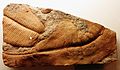
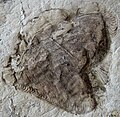
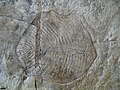
The beds at Nilpena Ediacara National Park contains a diverse, and complex system of Ediacaran organisms, from bilateral forms such as Parvancorina and Kimberella,[9] to the classic Ediacaran forms such as Dickinsonia and Arborea.[9] Due to its notable shallow environment, there is also a wide collection of algae forms, such as Flabellophyton and Longifuniculum, which are commonly referred to as "Bundles of Filaments" (BOF) in literature.[10][9]
Triradial organism. No proper description or image has been published of its record here, as such it remains uncertain if Albumares can also be found here.
123Reid, L. M.; Payne, J. L.; Tucker, N. M.; Jago, J. B. (17 February 2025). "Detrital zircon geochronology and sedimentary provenance of the fossiliferous Ediacara Member, South Australia". Australian Journal of Earth Sciences. 72 (2): 169–181. doi:10.1080/08120099.2025.2485976.
123McMahon, William J.; Liu, Alexander G.; Tindal, Benjamin H.; Kleinhans, Maarten G. (30 November 2020). "Ediacaran life close to land: Coastal and shoreface habitats of the Ediacaran macrobiota, the Central Flinders Ranges, South Australia". Journal of Sedimentary Research. 90 (11): 1463–1499. doi:10.2110/jsr.2020.029.
12345678910Gehling, J. G.; García-Bellido, D. C.; Droser, M. L.; Tarhan, M. L.; Runnegar, B. (30 December 2019). "La transición ediacárico-cámbrica: facies sedimentarias versus extinción". Estudios Geológicos. 75 (2): e099. doi:10.3989/egeol.43601.554.
↑Retallack, Gregory J. (January 2013). "Ediacaran life on land". Nature. 493 (7430): 89–92. doi:10.1038/nature11777.
↑Tarhan, L. G.; Planavsky, N. J.; Wang, X.; Bellefroid, E. J.; Droser, M. L.; Gehling, J. G. (January 2018). "The late‐stage "ferruginization" of the Ediacara Member (Rawnsley Quartzite, South Australia): Insights from uranium isotopes". Geobiology. 16 (1): 35–48. doi:10.1111/gbi.12262.
1234567891011121314151617181920212223Weyland, W. C.; Droser, M. L. (17 February 2025). "The Ediacaran Aquarium: insights from the Nilpena Ediacara National Park 1T-F Marine Ecosystem (Ediacara Member, Rawnsley Quartzite)". Australian Journal of Earth Sciences. 72 (2): 151–168. doi:10.1080/08120099.2025.2462660.
12345678Coutts, Felicity J.; Gehling, James G.; García-Bellido, Diego C. (October 2016). "How diverse were early animal communities? An example from Ediacara Conservation Park, Flinders Ranges, South Australia". Alcheringa: An Australasian Journal of Palaeontology. 40 (4): 407–421. doi:10.1080/03115518.2016.1206326.
↑Coutts, Felicity J. (January 2019). Palaeoecology of Ediacaran communities from the Flinders Ranges of South Australia (PhD thesis). University of Adelaide. doi:10.13140/RG.2.2.27075.96802.
↑Grimes, Kelsey F.; Narbonne, Guy M.; Gehling, James G.; Trusler, Peter W.; Dececchi, T. Alexander (March 2024). "Elongate Ediacaran fronds from the Flinders Ranges, South Australia". Journal of Paleontology. 98 (2): 249–265. doi:10.1017/jpa.2023.45.
↑Droser, M. L.; Evans, S. D.; Dzaugis, P. W.; Hughes, E. B.; Gehling, J. G. (17 August 2020). "Attenborites janeae: a new enigmatic organism from the Ediacara Member (Rawnsley Quartzite), South Australia". Australian Journal of Earth Sciences. 67 (6): 915–921. doi:10.1080/08120099.2018.1495668.
↑Surprenant, Rachel L.; Gehling, James G.; Hughes, Emmy B.; Droser, Mary L. (October 2023). "Biostratinomy of the enigmatic tubular organism Aulozoon soliorum, the Rawnsley Quartzite, South Australia". Gondwana Research. 122: 138–162. doi:10.1016/j.gr.2023.06.010.
Sprigg, R. C. (1947): "Early Cambrian jellyfishes (?) from the Flinders Range, South Australia", Transactions of the Royal Society of South Australia. 71.2, p. 220
↑Droser, Mary L.; Gehling, James G.; Dzaugis, Mary E.; Kennedy, Martin J.; Rice, Dennis; Allen, Michael F. (January 2014). "A new Ediacaran fossil with a novel sediment displacive life habit". Journal of Paleontology. 88 (1): 145–151. doi:10.1666/12-158.
↑Dzaugis, P. W.; Evans, S. D.; Droser, M. L.; Gehling, J. G.; Hughes, I. V. (17 August 2020). "Stuck in the mat: Obamus coronatus , a new benthic organism from the Ediacara Member, Rawnsley Quartzite, South Australia". Australian Journal of Earth Sciences. 67 (6): 897–903. doi:10.1080/08120099.2018.1479306.
This page is based on this Wikipedia article Text is available under the CC BY-SA 4.0 license; additional terms may apply. Images, videos and audio are available under their respective licenses.