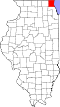
While the retreating Wisconsin glacier left an attractive environment for farmers who entered western Lake County after the Black Hawk War of 1832, the numerous lakes and wet prairies there prevented easy movement to agricultural markets. Farmers traded at stagecoach trail communities such as Hainesville, often exchanging dairy products and eggs for what they could not craft on the farm.
Landowners near Hainesville such as Amarias M. White knew that a railroad station would increase property values. In a classic ploy, White offered the railroad free land in exchange for a station. He also drew up a town plat to show railroad officials that profitable traffic would come through his station site. White succeeded, and Round Lake, named after the nearby lake, not Hainesville, whose inhabitants failed to offer the railroad anything, became the area station on the "Milwaukee Road".
White's promise came true in 1901 when the Armour Company decided to harvest ice from Round Lake for their refrigerator car operations. They erected a massive ice storage building holding over 100,000 tons for shipment in spring and summer months.
In 1908 White and his partners acted to incorporate the station area. The proposed village population was too small to meet incorporation requirements, so area farmers were included in the village with the understanding that, once incorporation was successful, their farms would be disconnected. On January 7, 1909, Round Lake incorporated with White as village president. Soon after, those farmers who wished to disconnect were allowed to do so—an act which prevented present-day residents of the village from having any public access to their namesake lake.
A fire in 1917 destroyed the Armour operation in the village, although a dormitory housing winter ice cutters survived. Noticing vacation resorts which had sprung up around the lake, the Armour Company remodeled its dormitory into a rural summer retreat for company employees. The praise showered on the Round Lake environment by them helped bring a slow trickle of nonagricultural residential growth to the village.
With post–World War II expansion into the suburbs, Round Lake's Armour-era reputation as a rural refuge acted as a magnet for development. People began moving into the unincorporated area around the lake and demanding municipal services. The village of Round Lake failed to make those annexations. As a result, new communities, using the words "Round Lake" in their corporate titles, arose. This resulted in a duplication of political hierarchies and village services which still exists.
Since the 1970s, Round Lake has embarked on an expansive annexation program. With ongoing development of those areas, Round Lake was expected to continue to grow.
Between 2000 and 2010, the village grew by 213.1%, from 5,842 to 18,289. The population growth stalled heavily in the 2010s, and Round Lake's population in 2020 was 18,721.[4]
Geography
Round Lake is located approximately 55 miles northwest of Chicago's Loop.[5]
According to the 2021 census gazetteer files, Round Lake has a total area of 5.72 square miles (14.81km2), of which 5.56 square miles (14.40km2) (or 97.20%) is land and 0.16 square miles (0.41km2) (or 2.80%) is water.[6]
As of the 2020 census[10] there were 18,721 people, 6,073 households, and 4,525 families residing in the village. The population density was 3,272.90 inhabitants per square mile (1,263.67/km2). There were 6,269 housing units at an average density of 1,095.98 per square mile (423.16/km2). The racial makeup of the village was 52.78% White, 6.41% African American, 1.43% Native American, 10.43% Asian, 0.07% Pacific Islander, 13.39% from other races, and 15.49% from two or more races. Hispanic or Latino of any race were 31.50% of the population.
There were 6,073 households, out of which 43.2% had children under the age of 18 living with them, 60.88% were married couples living together, 10.19% had a female householder with no husband present, and 25.49% were non-families. 18.15% of all households were made up of individuals, and 7.03% had someone living alone who was 65 years of age or older. The average household size was 3.50 and the average family size was 3.00.
The village's age distribution consisted of 28.1% under the age of 18, 8.7% from 18 to 24, 26% from 25 to 44, 27.6% from 45 to 64, and 9.6% who were 65 years of age or older. The median age was 37.3 years. For every 100 females, there were 90.5 males. For every 100 females age 18 and over, there were 93.7 males.
The median income for a household in the village was $82,550, and the median income for a family was $96,598. Males had a median income of $50,988 versus $32,450 for females. The per capita income for the village was $33,471. About 6.9% of families and 8.7% of the population were below the poverty line, including 9.8% of those under age 18 and 19.1% of those age 65 or over.
Round Lake village, Illinois – Racial and ethnic composition Note: the US Census treats Hispanic/Latino as an ethnic category. This table excludes Latinos from the racial categories and assigns them to a separate category. Hispanics/Latinos may be of any race.
The Roman Catholic Archdiocese of Chicago operated a Catholic school in Round Lake Called St. Joseph. But the archdiocese decided to close the school after spring 2020.[12]
This page is based on this Wikipedia article Text is available under the CC BY-SA 4.0 license; additional terms may apply. Images, videos and audio are available under their respective licenses.