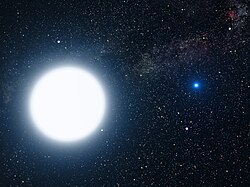
Sirius B (also known as the Pup), is a white dwarf star and the faint companion to Sirius A, the brightest star in Earth's night sky (also known as the "Dog Star"), located in the constellation of Canis Major.[10]
It is a white dwarf, a remnant of an intermediate-mass star that have end its life, being the closest example to Earth. It is the secondary object of the Sirius binary system, of which the 'A' component is the brightest star in the night sky.[11] Sirius B, on the other hand, can't be seen to the naked eye, as its luminosity is only 2% that of the Sun. Sirius is the fifth-nearest star system to the Sun, 8.6 light-years distant.[10]
Like all white dwarfs, Sirius B is massive and dense: While its size is comparable to that of Earth, its mass is equivalent to that of the Sun. It is the residue of a 5M☉ star that existed around 100 million years ago. Sirius B's current temperature is of 25,000K (24,700°C; 44,500°F), 2.5 times hotter than Sirius A and over four times hotter than the Sun. It no longer produce energy via nuclear fusion, and its remaining heat will escape to space over time.
Artistic representation of Sirius star system
Due to its proximity, Sirius B has been the target of many studies in the last decades in attempt to discover extrasolar planets. None of them has detected a planet around Sirius B, though some planetary architethures still cannot be ruled out by current observations.
The evolution of intermediate-mass stars (0.8 to eight times the mass of the Sun.)
White dwarfs are remnants of intermediate-mass stars (such as the Sun) which have end their lifes.[12] Stars produce energy by the nuclear fusion of four hydrogen atoms in one helium atom. The energy released make the star in hydrostatic equilibrium. Eventually, in intermediate-mass stars, the core runs out of hydrogen, the outer layers start to expand and the star becomes a red giant, with dozens to hundreds of times its original size. The core shrinks in size under the star's weight, since it has less atoms. Then, pressure is enough to start nuclear fusion of hydrogen in a shell surrounding the core and, when there is sufficient pressure, helium fusion into carbon is achieved. In its last evolutionary stages, the star ejects its outer layers, and only a degenerate core is left.[13]
These astronomical objects do not produce energy via nuclear fusion and radiate their residual heat, cooling over time.[13] When virtually all heat has escaped, they become black dwarfs, which is expected to take over 10 trillion years, much more than the current age of the universe of 14 billion years. White dwarfs have an enormous density, from 100,000 to 100,000,000 grams per cubic centimeter,[14] so that a teaspoon of white dwarf matter would weigh 5.5 tonnes.[13] One of the smallest and most massive white dwarfs is in the HD 49798 system, which is 1.22 times more massive than the Sun,[15] yet has a radius of a mere 1,600km, smaller than the Moon.[16] Other typical white dwarfs like Procyon B or van Maanen 2 have masses of 0.6 and 0.7 solar masses (M☉) and radii of about 0.011 and 0.012 solar radii (R☉), respectively.
Discovery and observations
The discovery of Sirius B dates from the mid 19th century. In a letter dated 10August 1844, the German astronomer Friedrich Wilhelm Bessel found that the apparent motion of Sirius A varies, something never observed before. This was the first hint that Sirius has an unseen companion.[17] The faint companion, Sirius B, was first observed on 31 January 1862 by the American telescope-maker and astronomer Alvan Graham Clark.[18] This happened during testing of an 18.5-inch (470mm) aperture great refractor telescope for Dearborn Observatory, which was one of the largest refracting telescope lenses in existence at the time, and the largest telescope in the United States.[19] SiriusB's sighting was confirmed on 8March with smaller telescopes.[20]
Due to the close presence of Sirius A, whose light outshine B, observations of Sirius B have been difficult in the XX century. In particular, measuring physical properties such as radius and temperature was extremely hard due to these interferences, while the mass could be relatively easily measured from the binary's orbit. In ultraviolet wavelengths, however, Sirius B is brighter than Sirius A, and with the development of ultraviolet satellites in the second half of the century such as the Extreme Ultraviolet Explorer (EUVE) and the International Ultraviolet Explorer (IUE), precise measurements of such properties were achieved. In 1998, astronomers combining spectroscopic measurements of the EUVE and IUE satellites derived a temperature of 25,000±35K, together with a surface gravity of 108.51±0.04cgs, precisions much higher than those of previous observations. A year before, the Hipparcos mission measured directly the system's distance from parallax, resulting in value of 2.637±0.011 parsecs (8.601±0.036 light-years), a 20% improvement toward previous measurements. Together with the ultraviolet data, this resulted in a radius of 0.0084±0.00025R☉.[7]
Artist's representing comparison between Sirius B and Earth
In 2005, using the Hubble Space Telescope, astronomers determined that SiriusB has nearly the diameter of the Earth, 12,000 kilometres (7,500mi), with a mass 102% of the Sun's.[24]
Characteristics
Since Sirius B is in a binary star system, the mass can be measured using the orbital elements and Kepler's third law. The first measurement, back in 1910, resulted in an value of 0.94M☉,[25] which is not so far from modern measurements, one from 2017 which combine multiple observations yield a value of 1.018±0.011M☉.[26] The mass of Sirius B make it one of the most massive white dwarfs known, almost doubling the average of 0.6M☉.[27]
The radius of Sirius B is 0.008098±1.6% times the Sun's radius,[26] equivalent to 5,635km (3,501mi) or 0.88 times Earth's radius (6,378km). This is significantly smaller than other white dwarfs, such as Procyon B or van Maanen 2. White dwarfs, due to their structure, have the unusual property that how more massive it is, smaller it is, so a smaller white dwarf have more mass than a larger one.[28] The mass and radius can also be measured from its gravitational redshift, which results in values of 1.017M☉ and 0.00803R☉.[29]
As white dwarfs do not produce heat and will cool over time, its age as a white dwarf can be estimated by calculating how long it took to cool to its current temperature, the so-called "cooling age". Sirius B has a mass of 1.02M☉ and a temperature of 25,000K or °C,[8] compared to the 5,772K (5,499°C) of the Sun[30] or 9,845K (9,572°C) of Sirius A.[31] From this method, an age of 126 million years is obtained. This is about half of the total age of the system of 230 million years.[26]
From theorethical calculations, the mass of the progenitor of Sirius B is calculated at 5.0±0.1 times the mass of the Sun,[26] and it is estimated to have been a B-type main-sequence star of class B5V.[32][33] The higher mass mean Sirius B used to be more luminous than Sirius A, so it burned the hydrogen at its core much faster. Higher mass in the system also mean the orbit used to be smaller–the periastron is predicted to have been between 1.5 to 1.6AU. During the red giant phase, Sirius B expanded to a hundreds of times the size of the Sun, potentially transferring mass to Sirius A, albeit it never engulfed its companion.[26]
Sirius B is primarily composed of a carbon–oxygen mixture that was generated by helium fusion in the progenitor star.[8] This is overlaid by an envelope of lighter elements, with the materials segregated by mass because of the high surface gravity.[34] The outer atmosphere of SiriusB is now almost pure hydrogen—the element with the lowest mass—and no other elements are seen in its spectrum.[35]
Search for planets
Sirius B has been the subject of multiple surveys and several studies in search for exoplanets, orbiting it. Detection method includes radial velocity monitoring, direct imaging, and astrometric methods, but no exoplanet have been detected.[36] High-contrast imaging with instruments such as VLT/SPHERE and Hubble Space Telescope has ruled out giant planets with masses greater than approximately 10–35 MJ at separations of a few AU. [37] Multiple exoplanets were found around white dwarfs, the first of such was PSR B1620−26 b.[38]
↑Semi-major axis in AU = semimajor axis in seconds/ parallax = 7.56″/0.37921 = 19.8AU; as the eccentricity is 0.6, the distance fluctuates between 40% and 160% of that, roughly from 8 AU to 32 AU.
12Holberg, J. B.; Barstow, M. A.; Bruhweiler, F. C.; Cruise, A. M.; Penny, A. J. (April 1998). "Sirius B: A New, More Accurate View". The Astrophysical Journal. 497 (2): 935–942. Bibcode:1998ApJ...497..935H. doi:10.1086/305489. ISSN0004-637X.
↑Holberg, J. B. (2005). "How Degenerate Stars Came to be Known as White Dwarfs". Bulletin of the American Astronomical Society. 37 (2): 1503. Bibcode:2005AAS...20720501H.
↑Hanbury Brown, R.; Twiss, R. Q. (1958). "Interferometry of the Intensity Fluctuations in Light. IV. A Test of an Intensity Interferometer on Sirius A". Proceedings of the Royal Society of London. 248 (1253): 222–237. Bibcode:1958RSPSA.248..222B. doi:10.1098/rspa.1958.0240. S2CID124546373.
↑Davis, J.; etal. (October 2010). "The Angular Diameter and Fundamental Parameters of Sirius A". Publications of the Astronomical Society of Australia. 28: 58–65. arXiv:1010.3790. doi:10.1071/AS10010.
↑Siess, Lionel (2000). "Computation of Isochrones". Institut d'Astronomie et d'Astrophysique, Université libre de Bruxelles. Retrieved 24 March 2007.
↑Palla, Francesco (16–20 May 2005). "Stellar evolution before the ZAMS". Proceedings of the international Astronomical Union 227. Italy: Cambridge University Press. pp.196–205. Bibcode:1976IAUS...73...75P.
↑Holberg, J. B.; Barstow, M. A.; Burleigh, M. R.; Kruk, J. W.; Hubeny, I.; Koester, D. (2004). "FUSE observations of Sirius B". Bulletin of the American Astronomical Society. 36: 1514. Bibcode:2004AAS...20510303H.
This page is based on this Wikipedia article Text is available under the CC BY-SA 4.0 license; additional terms may apply. Images, videos and audio are available under their respective licenses.