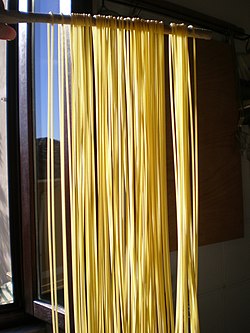
Spaghetti (Italian:[spaˈɡetti]) is a long, thin, solid, cylindrical pasta.[1] It is a staple food of traditional Italian cuisine.[2] Like other pasta, spaghetti is made of flour (sometimes enriched with vitamins and minerals) and water. Italian spaghetti is typically made from durum-wheat semolina.[3] The pasta is usually white because refined flour is used, but whole wheat flour may be added.[4]Spaghettoni is a thicker form of spaghetti, while spaghettini is a thinner form. Capellini is a very thin spaghetti, while vermicelli refers to intermediate thicknesses.
Originally, spaghetti was notably long, but shorter lengths gained in popularity during the latter half of the 20th century and now it is most commonly available in 25–30cm (10–12in) lengths. A variety of pasta dishes are based on it and it is frequently served with tomato sauce, meat or vegetables.
The first written record of pasta comes from the Talmud in the 5th century AD and refers to dried pasta that could be cooked through boiling,[5] which was conveniently portable.[6] Some historians think that Arabs introduced pasta to Europe during a conquest of Sicily. In the West, it may have first been worked into long, thin forms in Sicily around the 12th century, as the Tabula Rogeriana of Muhammad al-Idrisi attested, reporting some traditions about the Sicilian kingdom.[7]
Industrial spaghetti
The popularity of spaghetti spread throughout Italy after the establishment of spaghetti factories in the 19th century, enabling the mass production of spaghetti for the Italian market.[8]
Sparghetti
Japanese-style spaghetti in shirokane
Circa 1845, Italians used the word sparghetti to denote the recently invented pasta shape. The 2013 publication Discovering Words in the Kitchen said the spelling "showed the derivation of the word to be a diminutive of spargo, meaning 'cord'".[9] The term sparghetti continued to be in use throughout the 19th and early 20th century, in association with both the pasta shape and the recipe. In 1845 British recipe guide Modern Cookery, sparghetti is defined as Naples vermicelli.[10] The same definition appears in Robert Ridell's 1852 Indian Domestic Economy and Receipt Book and its reprints.[11][12]
In the 1880 Housekeeper's Guide,Arthur Gay Payne writes, "When macaroni is served with tomato sauce and Parmesan grated cheese, it forms that very well-known dish called "sparghetti". A particular type of macaroni is specially sold for making sparghetti."[13] An 1896 recipe, reprinted in 1909, clarifies, "Sparghetti is a type of fine macaroni".[14] The spelling sparghetti and associated recipe is also described in 1900's Recipe a la Mode,[15] 1901's Recherché Side Dishes,[16]Agnes Marshall's 1902 Larger Cookery book,[17] the 1905 Hints for the Home,[18]Benjamin Farjeon's 1906 fiction novel Mrs. Dimmock's Worries,[19] and 1913's The Treasure Cookery Book.[20]
Its modern term, spaghetti, was introduced in 1888.[21][where?]
In the United States around December 31, 1900, spaghetti was offered in restaurants as Spaghetti Italienne (which likely consisted of noodles cooked pasta al dente (lit.'to the tooth'), and a mild tomato sauce flavored with easily found spices and vegetables such as cloves, bay leaves, and garlic) and it was not until decades later that it came to be commonly prepared with oregano or basil.[22][23][24] Canned spaghetti was also quite popular, being sold by many brands by the early 1910s. In 1911 the Van Camp Company asserted that canned spaghetti was the most popular product it had ever sold.[25]
The Great Eastern Railway magazine of 1914 recommends sparghetti as an alternative to macaroni in its recipe for macaroni and cheese.[26]
Prince Spaghetti was started by 3 Italian immigrants in 1912 in Boston, Massachusetts at 92 Prince Street. It eventually outgrew its location and moved to Lowell, Massachusetts in 1941 after a controlling interest was bought by Giuseppe Pellegrino. At one time, they were the largest American producer of spaghetti and were well known for their 1970s commercials featuring a little boy named Anthony running home for spaghetti dinner while being called by his mother The commercial's tag line was "Wednesday is Prince Spaghetti Day" in Boston. The Pellegrino family sold the company to Borden in 1987 and the plant was closed in 1997 when production was moved to St. Louis, Missouri.[27][28]
Pasta sheeter (c. 1935)
Production
Spaghetti is made from ground grain (flour) and water.[29] Whole-wheat and multigrain spaghetti are also available.[3]
Fresh spaghetti
Fresh spaghetti being prepared using a pasta machine
Pasta can be made at home, cutting sheets of flattened dough with a knife into ribbons,[30] rather than spaghetti with circular cross-section. Some pasta machines have a spaghetti attachment with circular holes that extrude spaghetti, or shaped rollers that form cylindrical noodles.[31]
Spaghetti can be made by hand by manually rolling a ball of dough on a surface to make a long sausage shape. The ends of the sausage are pulled apart to make a long thin sausage. The ends are brought together and the loop pulled to make two long sausages. The process is repeated until the pasta is sufficiently thin. The pasta knobs at each end are cut off leaving many strands which may be hung up to dry.[32]
Fresh spaghetti is usually cooked within hours of being formed. Commercial versions of fresh spaghetti are manufactured.[33]
Dried spaghetti
Seafood spaghetti dish
The bulk of dried spaghetti is produced in factories using auger extruders. While essentially simple, the process requires attention to detail to ensure that the mixing and kneading of the ingredients produces a homogeneous mix, without air bubbles. The forming dies have to be water cooled to prevent spoiling of the pasta by overheating. Drying of the newly formed spaghetti has to be carefully controlled to prevent strands sticking together, and to leave it with sufficient moisture so that it is not too brittle. Packaging for protection and display has developed from paper wrapping to plastic bags and boxes.[34]
A hydraulic press with an automatic spreader by the Consolidated Macaroni Machine Corporation, Brooklyn, New York. This machine was the first to spread long cut alimentary paste products onto a drying stick.
An industrial dryer for spaghetti or other long goods pasta products, also by the Consolidated Macaroni Machine Corporation
An artistic arrangement of dried spaghetti
Dried spaghetti measured with a "spaghetti measure". One portion of dried pasta weighs 116g (4+1⁄8oz), twice the amount of one serving on the package (12mm circle or 60g.). The measure can portion out 1, 2, 3 or 4 servings based on the diameter of the circle.
Variations
Spaghetti biz-Zalza tal-Fenek, deeply rooted in the Maltese tradition of fenkata with rabbit meat
In Naples, spaghetti is thinner than it is in the US.[35]Spaghettoni is a thicker spaghetti and spaghettini is a thinner spaghetti, although it is thicker than the pasta of Naples.[36]
Fresh or dry spaghetti is cooked in a large pot of salted, boiling water and then drained in a colander (Italian: scolapasta). Utensils used in spaghetti preparation include the spaghetti scoop and spaghetti tongs.
In Italy, spaghetti is generally cooked al dente (lit.'to the tooth'), fully cooked but still firm to the bite. It may also be cooked to a softer consistency. Spaghettoni takes more time to cook than regular spaghetti, and spaghettini less time.
In southern Italy, spaghetti is sometimes placed in a dishcloth and broken into pieces to be served with vegetables, beans or in a broth. This originated at a time when the region was very poor, and broken pieces of spaghetti were sold at discount to prevent waste. Offcuts are still sold in parts of Italy, alone and as part of pasta mista (an assortment of pasta shapes), and some factories donate their broken pieces to hospitals and nursing homes.[37]
Spaghetti being placed into a pot of boiling water for cooking
Spaghetti bolognese, very common outside of Italy, but not customary in that country
In the Philippines, a popular variant is the Filipino spaghetti, which is distinctively sweet with the tomato sauce sweetened with banana ketchup or sugar. It typically uses a large amount of giniling (ground meat), sliced hot dogs, and cheese. The dish dates back to the period between the 1940s to the 1960s. During the American Commonwealth Period, a shortage of tomato supplies in the Second World War forced the development of the banana ketchup.[44][45][46] Spaghetti was introduced by the Americans and was tweaked to suit the local Filipino predilection for sweet dishes.[47]
Consumption
By 1955, annual consumption of spaghetti in Italy doubled from 14 kilograms (31lb) per person before World War II to 28 kilograms (62 pounds).[48] By that year, Italy produced 1,432,990 tons of spaghetti, of which 74,000 were exported, and had a production capacity of 3 million tons.[48]
In the 1955 animated movie Lady and the Tramp, the sequence of the title characters sharing a plate of spaghetti—climaxed by an accidental kiss as they swallow opposite ends of the same strand of spaghetti—is considered an iconic scene in American film history.[52]
12Salerno, George (December 13, 1956). "Spaghetti consumption up as national dish in Italy". Wilmington Morning Star. Vol.90, no.52. Wilmington, North Carolina. United Press.
↑"Spaghetti, Enriched, Dry"(PDF). United States Department of Agriculture. October 2012. Archived from the original(PDF) on July 4, 2014. Retrieved December 16, 2014.
↑Gelten, Simon; Lindberg (November 10, 2015). "Introduction". Spaghetti Western Database. Archived from the original on June 30, 2017. Retrieved May 2, 2021.
This page is based on this Wikipedia article Text is available under the CC BY-SA 4.0 license; additional terms may apply. Images, videos and audio are available under their respective licenses.