The Tariff Act of 1789 was the first major piece of legislation passed in the United States after the ratification of the United States Constitution. It had three purposes: to support government, to protect manufacturing industries developing in the nation, and to raise revenue for the federal debt. It was sponsored by Congressman James Madison, passed by the 1st United States Congress, and signed into law by President George Washington. The act levied a 50¢ per ton duty on goods imported by foreign ships, a 30¢ per ton duty on American made ships owned by foreign entities, and a 6¢ per ton duty on American-owned vessels. [1]
In the aftermath of the American Revolution, the weak Congress of the Confederation had been unable to impose a tariff or reach reciprocal trade agreements with most European powers, creating a situation in which the country was unable to prevent a flood of European goods which were damaging domestic manufacturers even while Britain and other countries placed high duties on U.S. goods. The country also faced major debts left over from the Revolutionary War, and needed new sources of funding to maintain financial solvency. One of the major powers granted under the new Constitution was the ability to levy tariffs, and after the 1st Congress was seated, passage of a tariff bill became one of the most pressing issues.
The debates over the purpose of the tariff exposed the sectional interests at stake: Northern manufacturers favored high duties to protect industry; Southern planters desired a low tariff that would foster cheap consumer imports. Ultimately, Madison navigated the tariff to passage, but he was unable to include a provision in the final bill that would have discriminated against British imports. After passing both houses of Congress, President Washington signed the act in law on July 6, 1789 when they used it to pay off the US war debt.
The American Revolution was followed by an economic reorganization, which carried in its wake a period of uncertainty and hard times. During the conflict, labor and investment had been diverted from agriculture and legitimate trade to manufacturing and privateers. Men had gone into occupations that ceased with the end of the war. Lowered prices, resulting from the cessation of war demands, in combination with the importation of the cheaper goods of Europe, were fast ruining such infant manufacturing concerns as had sprung up during the war, some of which were at a comparative disadvantage with the resumption of normal foreign trading relations.[3]
Another factor which made the situation even more distressing was the British Navigation Acts. The only clause in the 1783 Paris peace treaty concerning commerce was a stipulation guaranteeing that the navigation of the Mississippi would be forever free to the United States. John Jay had tried to secure some reciprocal trade provisions with Great Britain but without result. The favorable features of the old Navigation Acts that had granted bounties and reserved the English markets in certain cases to colonial products were gone; the unfavorable ones were left. The British market was further curtailed by the depression there after 1783. Although the French treaty of 1778 had promised "perfect equality and reciprocity" in commercial relations, it was found impossible to make a commercial treaty on that basis. Spain demanded, as the price for reciprocal trading relations, a surrender by the United States for 25 years the right of navigating the Mississippi, a price that the New England merchants would have been glad to pay.[4]
France (1778) and the Netherlands (1782) made treaties but not on even terms; Portugal refused all advances. Only Sweden (1783) and Prussia (1785) made treaties guaranteeing reciprocal commercial privileges.[5]
The weakness of the Continental Congress under the Articles of Confederation prevented retaliation by the central government. Congress repeatedly asked for power to regulate commerce, but was refused by the states upon which rested the execution of such commercial treaties as Congress might negotiate. Eventually, the states themselves attempted retaliatory measures, and from 1783 to 1788, New Hampshire, Massachusetts, Rhode Island, New York, Pennsylvania, Maryland, Virginia, North Carolina, South Carolina, and Georgia levied tonnage dues upon British vessels or discriminating tariffs upon British goods. Whatever effect these efforts might have had were neutralized by the fact that the duties varied 0% to 100%, which simply drove British ships to the free or cheapest ports to flood the market with their goods. Commercial war between the states followed and turned futility into chaos.[5]
Adoption of the Constitution meant the elimination of many of the economic ills under which industry and commerce had struggled since the war. A reorganization was essential and the immediate economic results were salutary. Its most important additions to the power of Congress were those relating to finance and commerce: it enabled the federal government to levy taxes, regulate trade, coin money, protect industry, and direct the settlement of the West, and, as later events proved, to establish credit and redeem its securities. Under it, freedom of trade was ensured throughout the young republic.[6]
In the months leading up to the passage of the Tariff Act, Congress received several petitions from different cities representing manufacturing groups asking for relief from the flood of European imported goods. The United States Congress answered the petitions of these groups for urgent attention, by making the Tariff of 1789 the first major bill to be considered in its first session and passed.[7]
Import duty legislation and American sectional interests
The import fees "represented a compromise between the advocates of a high protective tariff and those who favored a tariff for revenue only [to maintain the central government]."[8] Charges up to fifty percent were imposed on selected manufactured and agricultural goods, including "steel, ships, cordage, tobacco, salt, indigo [and] cloth." On the majority of items subject to duty, a five percent fee was levied, ad valorem.[8] Molasses, an indispensable ingredient for Northeastern rum producers, was lowered from 6¢ per gallon to 2.5¢.
Representative James Madison, presiding over the tariff debates in Congress, attempted to introduce discriminatory provisions into the tonnage legislation that would favor France and its colonial possessions and shift American trade away from Great Britain.[9] Madison modified the terms of the tariff to balance sectional conflicts[8] but conceded that articles subject to high duties "were pretty generally taxed for the benefit of the manufacturing part of the northern community."[9] He acknowledged the South, the main wealth-producing part of the nation, would inevitably "shoulder a disproportionate share of the financial burden involved in the transforming the United States into a commercial, manufacturing, and maritime power."[10]
Madison's proposals were intended to unify politically the agricultural and manufacturing interests in support of that commercial realignment at the national level, damaging to Great Britain and beneficial to revolutionary France.[11] Many representatives of northern business were wary of abandoning Great Britain as their primary trading partner and merchant marine and questioned whether France could ever act "as the principle supplier and market for the United States."[10]
William Pitt, in 1783, introduced a bill into the British Parliament providing for free trade between the United States and the British colonies. But instead of passing the bill, Parliament enacted the British Navigation Act of 1783, which admitted only British built and manned ships to the ports of the West Indies, and imposed heavy tonnage dues upon American ships in other British ports. It was amplified in 1786 by another act designed to prevent the fraudulent registration of American vessels and by still another in 1787, which prohibited the importation of American goods by way of foreign islands.[12][13]
The Eden Agreement was a treaty signed between Great Britain and France in 1786, named after the British negotiator William Eden, 1st Baron Auckland (1744–1814). The French side was represented by Joseph Matthias Gérard de Rayneval. It effectively ended, for a brief time, the economic war between France and Great Britain and set up a system to reduce tariffs on goods from either country. It was spurred on in Britain by the secession of the thirteen American colonies, and the publication of Adam Smith's Wealth of Nations. British Prime Minister William Pitt was heavily influenced by the ideas of Smith, and was one of the key motivators of the treaty.[14]
Obstinancy in negotiations on the part of the British made the commercial agreement almost wholly beneficial to the British, and the unequal protection on certain industries ended up hurting the French economy. This treaty is often considered to be one of the grievances of the French people that sparked the French Revolution. The treaty collapsed in 1793, following claims in the National Convention that the Aliens Act 1793 breached the terms of the treaty and the outbreak of war in early February between Great Britain and France ended any chance of a compromise.[15]
Dutch merchants, especially those from Amsterdam, became involved in the supply of arms and munitions to the American rebels soon after the outbreak of American Revolutionary War. This trade was mainly conducted via the Caribbean entrepôt of Sint Eustatius, an island colony of the Dutch West India Company. There, American colonial wares, such as tobacco and indigo, were imported (in contravention of the British Navigation Acts) and re-exported to Europe. For their return cargo, the Americans bought arms, munitions, and naval stores brought to the island by Dutch and French merchants. In 1778, France declared war on Britain, while the Dutch Republic chose to remain neutral.[16]
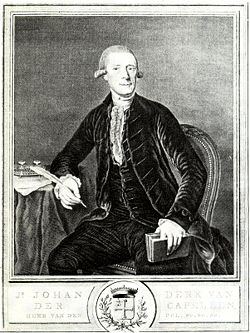
In 1781 Congress appointed Robert Morris (financier) as Superintendent of Finance after the US went bankrupt. In 1782, brothers Nicolaas and Jacob van Staphorst led discussions with John Adams over a Dutch loan to the new nation of the United States of five million guilders, at that time a considerable sum. A syndicate was formed to organize the U.S.'s first foreign loan between the Staphorst brothers, the Willink brothers, and De la Lande & Fijnje. Joan van der Capellen tot den Pol was marked down for 12.000 guilders. Three other loans followed: in 1784, 1787, and 1788. Simon Schama noted: "Part of the attraction of this stock was, doubtless, the possibility of buying cheap and selling at a quick profit to investors less well informed than the brokers as to the state of American credit."[17][18]
As far as the Dutch were concerned, the war in the West Indies was over almost before it had begun. Admiral George Rodney, the commander of the Leeward Islands station of the Royal Navy, attacked the Dutch colonies in that part of the Caribbean: St. Eustatius, Saba, and Saint Martin, as soon as he had received word of the declaration of war, in the process surprising a number of Dutch naval and merchant ships, which were still unaware of the start of hostilities. St. Eustatius (captured on 3 February 1781), that had played such a large role in the supply of the American rebels with arms, was completely devastated by him.[19]
The signing of the Peace of Paris (1783) made Negapatnam, in India, a British colony. The British gained the right of free trade with part of the Dutch East Indies, which had been a major war aim for British merchants. The French also returned the other Dutch colonies they had recaptured from the British, including the ones in the West Indies. Sint Eustatius had been taken by Admiral Rodney in February 1781, but was retaken by the French Admiral De Grasse on 27 November 1781.[20]
The Fourth Anglo-Dutch War proved a disaster for the Dutch Republic, particularly economically. In the immediate aftermath of the war, the bad result was blamed on the stadholder's mismanagement by his opponents. These managed for a while to roll back a number of the reforms of the revolution of 1747, strongly diminishing his powers.[21]
However, the Patriot Revolt was suppressed by the Prussian invasion of Holland in September to October 1787, which reinstated William V of Orange as hereditary stadtholder in the Dutch Republic. Its causes and its denouement in the Prussian intervention were of great interest to James Madison. This can be seen in Federalist No. 20.[23] After a description and analysis of the constitution of the Dutch Republic, the paper characterizes it as an example to avoid:
Such is the nature of the celebrated Belgic[Note 1] confederacy, as delineated on parchment. What are the characters which practice has stamped upon it? Imbecility in the government; discord among the provinces; foreign influence and indignities; a precarious existence in peace, and peculiar calamities from war.
The paper explicitly refers to the Prussian invasion of Holland.[24] Apparently the news of its success had not yet reached the U.S. by the time of the paper's publication, as the wording leaves the hope open that the Patriots will prevail:
The first wish prompted by humanity is, that this severe trial may issue in such a revolution of their government as will establish their union, and render it the parent of tranquillity, freedom and happiness.
In its final form, the tariff erected "an American navigation system," superseding the individual state sanctioned fees designed to protect domestic shipping during the Articles of Confederation period from 1781 to 1789.[9][25]
The act established tonnage rates favorable to American carriers by charging them lower cargo fees than those imposed on foreign boats importing similar goods. Coastal trade was reserved exclusively for American flag vessels.[9] These provisions were consistent with mercantilist policies practice by European powers at the time.[26]
Dating from the Treaty of Paris, ending the War for Independence in 1783, Great Britain had declined to seek a commercial treaty with the United States.[27] In addition, provisions of the treaty had gone unfulfilled, including compensation to slaveholders for slaves emancipated by the British Navy during the War and the failure to abandon military posts in the Northwest Territory.[9][28] Still, Great Britain remained the dominant trading partner for the United States, the countries reverting to an essentially colonial-era trade relationship.
To effect this, Madison called for a 60¢ per ton fee upon foreign carriers lacking a commercial agreement with the United States, while France, which possessed a treaty, would be charged tonnage at 30¢. This measure alone "was equivalent to levying economic war" upon Great Britain.[29]
The House of Representatives, nevertheless, initially passed Madison's "controversial" legislation,[9] with the discriminatory provision intact. The Senate, however, removed it from the bill and sent it back to the House, where it was passed, without amendment, 31 to 19, on July 4, 1789.[30] President Washington signed the act into law on July 4, 1789.[31] The final bill extracted concessions from both interests, but delivered a distinct advantage to maritime and manufacturing regions of the country.[32][33]
The Tariff of 1789 placed France and Great Britain on an equal footing with regard to shipping, manufactures, and raw products delivered to American ports. All foreign-owned or foreign-built ships paid 50¢ per ton duty; American-owned vessels were charged 6¢ per ton.[30]
To enable the federal government to collect the import duties, Congress also passed the Collection Act of 1789, which established the United States Customs Service and designated ports of entry.[7] The tariffs established by this and later acts would make up the vast majority of government revenue; more than 87 percent of the federal government's revenue between 1789 and 1800 came from import duties.[34] The tariff would continue to make up the bulk of federal revenue until the 20th century.[35]
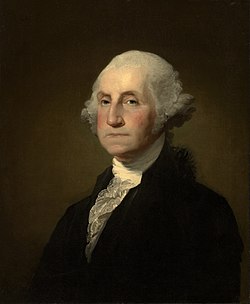
George Washington signed the Tariff of 1789, the first major piece of legislation signed in the United States.
The framers of the United States Constitution gave Congress the power to "lay and collect taxes, duties, imposts and excises, pay the debts and provide for the common defense and general welfare of the United States" and also "to regulate Commerce with foreign Nations, and among the several States, and with the Indian Tribes."[36]
The Congress shall have Power To lay and collect Taxes, Duties, Imposts and Excises, to pay the Debts and provide for the common Defence and general Welfare of the United States; but all Duties, Imposts and Excises shall be uniform throughout the United States;
There was a consensus among the Founding Fathers that tariffs were the most efficient way of raising revenue as well as the most politically acceptable.[37] Tariffs between states are prohibited by the U.S. Constitution, per the Import-Export Clause, and all domestically made products must be imported or exported to another state tax-free.[38] The Export Clause (Art. I, §9, clause 5) prohibits the federal government from imposing any "tax or duty ... on articles exported from any state." The clause was proposed by southern states, which feared that northern states would control Congress and raise a disproportionate amount of revenue for the federal government from southern states through taxes on exports.[39]
No State shall, without the Consent of the Congress, lay any Imposts or Duties on Imports or Exports, except what may be absolutely necessary for executing it's[sic] inspection Laws: and the net Produce of all Duties and Imposts, laid by any State on Imports or Exports, shall be for the Use of the Treasury of the United States; and all such Laws shall be subject to the Revision and Controul [sic] of the Congress.
—United States Constitution Article I, § 10, Clause 2
Madison's attempt to enlist northern merchants and businessmen in supporting an economic contest with Great Britain elicited a cool response.[40] Firstly, British capital and markets contributed to the general prosperity of the North, and secondly, a shift towards France would mean aligning the United States with a revolutionary government that exhibited what Federalist leadership regarded as "an excess of democracy."[41][42]Alexander Hamilton, soon to enter the executive branch as Secretary of the Treasury, declined to support Madison's proposal and warned that economic warfare with Great Britain would drastically reduce the import duty revenue that the tariff legislation called for, placing at risk the funds anticipated to run the new federal government and finance the national debt.[10]
This dispute between Madison and Hamilton marked "the first important breach" between these two Federalist leaders,[30] which would deepen when Hamilton, as Treasury Secretary, launched his fiscal and economic programs, ending their long collaboration.[43] The legislation produced the first sectional strains within "the Federalist coalition of northern businessmen and southern planters."[42] In the South, "agricultural interests" viewed the high tariff and tonnage rates as a triumph for northern merchants and manufacturers, the burden of which fell on southern staple crop exporters.[40]
This early application of constitutional authority highlighted north-south social and economic differences and presaged the dissolution of the Federalist coalition, the formation of an agrarian alliance,[42][44] and the rise of the First Party System.[45][46]
12Harold Underwood Faulkner, American Economic History, Harper & Brothers, 1938, p. 182
↑Harold Underwood Faulkner, American Economic History, Harper & Brothers, 1938, p. 190
12Bordewich, Fergus M. (2016). The First Congress: How James Madison, George Washington, and a Group of Extraordinary Men Invented the Government. Simon & Schuster. pp.102–103. ISBN9781451692136.
↑Hoh-Cheung; Mui, Lorna H. (1961). "William Pitt and the Enforcement of the Commutation Act, 1784-1788". The English Historical Review. 76 (300): 447–465. doi:10.1093/ehr/LXXVI.CCC.447. JSTOR558296.
↑Tomas, Evan. "From Mercantilism to Liberalism." Introduction to European Economics.: , . . Print. (p. 1)
↑Dewey, Financial History of the United States (5th ed. 1915) ch. 4–5
↑Brown v. Maryland,12Wheat.419, 445(United States Supreme Court1827)("The States are forbidden to lay a duty on exports, and the United States are forbidden to lay a tax or duty on articles exported from any State. There is some diversity in language, but none is perceivable in the act which is prohibited.").
↑United States v. International Business Machines Corp.,517U.S.843, 859-860(United States Supreme Court1996).
Brock, W.R. 1957. "The Ideas and Influence of Alexander Hamilton" in Essays on the Early Republic: 1789–1815. Ed. Leonard W. Levy and Carl Siracusa. New York: Holt, Rinehart and Winston, 1974.
Burstein, Andrew and Isenberg, Nancy. 2010. Madison and Jefferson. New York: Random House
Edler, F. (2001) [1911], The Dutch Republic and The American Revolution, Honolulu, Hawaii: University Press of the Pacific, ISBN0-89875-269-8
Hofstadter, Richard. 1957. The United States: the History of a Republic. Englewood Cliffs, N.J.,: Prentice-Hall
Hofstadter, Richard. 1948. The American Political Tradition and the Men Who Made It. New York: A. A. Knopf.
Malone, Dumas and Rauch, Basil. 1960. Empire for Liberty: The Genesis and Growth of the United States of America. Appleton-Century Crofts, Inc. New York.
Miller, John C. 1960. The Federalists: 1789–1801. Harper & Row, New York. ISBN9781577660316
Staloff, Darren. 2005. Hamilton, Adams, Jefferson: The Politics of Enlightenment and the American Founding. Hill and Wang, New York. ISBN0-8090-7784-1
External links
English Wikisource has original text related to this article:
This page is based on this Wikipedia article Text is available under the CC BY-SA 4.0 license; additional terms may apply. Images, videos and audio are available under their respective licenses.