Fremontodendron, with the common names fremontia and flannelbush or flannel bush, is a genus of three known species of shrubs native to the Southwestern United States and northwest Mexico.

The ecology of the Sierra Nevada, located in the U.S. states of California and Nevada, is diverse and complex. The combination of climate, topography, moisture, and soils influences the distribution of ecological communities across an elevation gradient from 500 to 14,500 feet. Biotic zones range from scrub and chaparral communities at lower elevations, to subalpine forests and alpine meadows at the higher elevations. Particular ecoregions that follow elevation contours are often described as a series of belts that follow the length of the Sierra Nevada. There are many hiking trails, paved and unpaved roads, and vast public lands in the Sierra Nevada for exploring the many different biomes and ecosystems.

Aesculus californica, commonly known as the California buckeye or California horse-chestnut, is a species of buckeye native to California and southwestern Oregon.
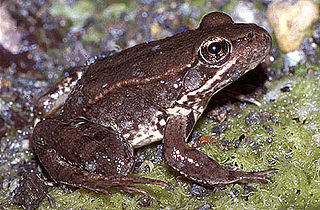
The California red-legged frog is a species of frog found in California (USA) and northern Baja California (Mexico). It was formerly considered a subspecies of the northern red-legged frog. The frog is an IUCN near-threatened species as of 2021, has a NatureServe conservation status of Imperiled as of 2015, and is a federally listed threatened species of the United States that is protected by law.

Verbena brasiliensis, the Brazilian verbena or Brazilian vervain, is a flowering plant species from the vervain family (Verbenaceae). It is native to parts of South America, namely Brazil, but has spread its range in recent times and has occasionally become an invasive weed. It is an annual plant with purple flowers, and it has been introduced outside of its native range as an ornamental plant, and is now largely considered an invasive weed in these regions.
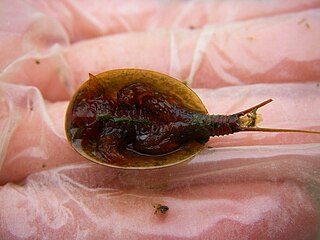
Lepidurus packardi, the vernal pool tadpole shrimp, is a small, rare species of tadpole shrimp (Notostraca) found in temporary ponds of the western United States.
Erythronium pluriflorum is a rare species of flowering plant in the lily family Liliaceae which is known by the common names manyflower fawn lily,golden fawn-lily, and Shuteye Peak fawn lily.
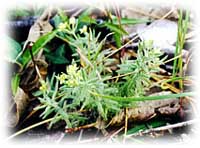
Galium californicum is a species of flowering plant in the coffee family known by the common name California bedstraw.

Arctostaphylos myrtifolia is a rare species of manzanita known by the common name Ione manzanita. It is endemic to the Sierra Nevada foothills of California. It grows in the chaparral and woodland plant community on a distinctive acidic soil series, an oxisol of the Eocene-era Ione Formation, in western Amador and northern Calaveras counties. There are only eleven occurrences, of which three have not been recorded since 1976. This is a federally listed threatened species.
The Red Hills are a mountain range in Tuolumne County, California. Elevations within the Red Hills vary between 750 and 1,750 feet above sea level. Slopes of the hills themselves vary from about 30% to 75%.

Brodiaea pallida is a rare species of flowering plant in the cluster-lily genus known by the common name Chinese Camp brodiaea.
Calyptridium pulchellum, synonym Cistanthe pulchella, is a rare species of flowering plant in the family Montiaceae. It is known by the common name Mariposa pussypaws. It is endemic to the Sierra Nevada foothills of central California, where it is known from only a few scattered occurrences. It grows on barren patches of granite gravel in woodland and grasslands. It is a federally listed threatened species.
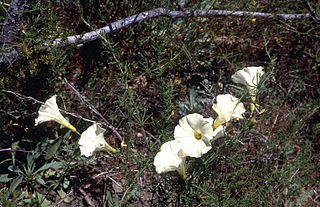
Calystegia stebbinsii is a rare species of morning glory known by the common name Stebbins' false bindweed. It is endemic to the Sierra Nevada foothills of California, where it is known from only two spots in El Dorado and Nevada Counties. It grows in unique habitat in chaparral on gabbro soils. It is a federally listed endangered species.

Ceanothus roderickii is a rare species of shrub in the family Rhamnaceae known by the common name Pine Hill ceanothus. It is endemic to western El Dorado County, California, where it grows in the chaparral and woodlands of the Sierra Nevada foothills, such as the Pine Hill Ecological Reserve. It is named after 20th century California flora explorer, botanist, and arboretum director Wayne Roderick.

Chorizanthe pungens is a species of flowering plant in the buckwheat family known by the common name Monterey spineflower. It is endemic to California, where it is known from the San Francisco Bay Area south along the Central Coast.

Pine Hill Ecological Reserve is a nature reserve of 403 acres (1.63 km2) located due east of Folsom Lake in the Sierra Nevada foothills, in El Dorado County, California. The reserve was established in 1979, and is managed by the Bureau of Land Management.
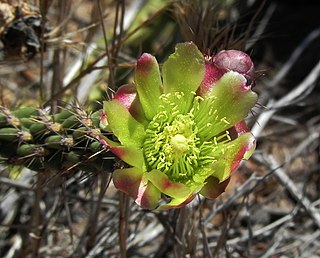
Cylindropuntia californica is a species of cholla cactus known by the common name snake cholla. It is primarily found in Baja California, Mexico and the southernmost part of California in the United States. It is characterized by a short, decumbent habit, yellow-green flowers, elongated stems, and short spines. It is mostly found in coastal sage scrub and coastal chaparral habitats, but two varieties in Baja California can be found in foothills and deserts. In California, variety californica is regarded as a rare and threatened plant, with a California Native Plant Society listing of 1B.1, in part due to its limited number of occurrences and threats from development. It formerly was considered to have a larger range due to the inclusion of Cylindropuntia bernardina within it as the variety parkeri.
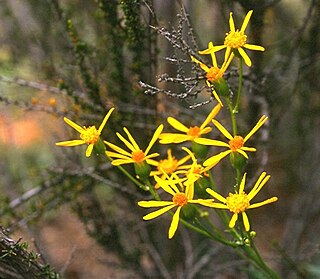
Packera layneae, known by the common name Layne's ragwort and Layne's butterweed, is a rare species of flowering plant in the aster family.

Sidalcea stipularis is a rare species of flowering plant in the mallow family, known by the common name Scadden Flat checkerbloom.
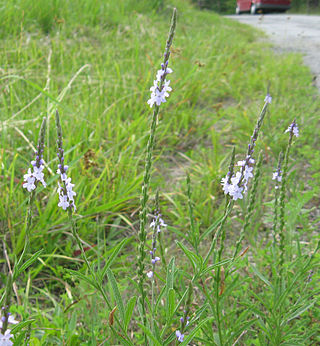
Verbena simplex, commonly known as narrowleaf vervain, is a perennial herbaceous plant in the Verbenaceae (vervain) family. It is native to central and eastern North America where it is found in open, dry, habitats on calcareous soil. It produces lavender flowers in the summer.