Particle values
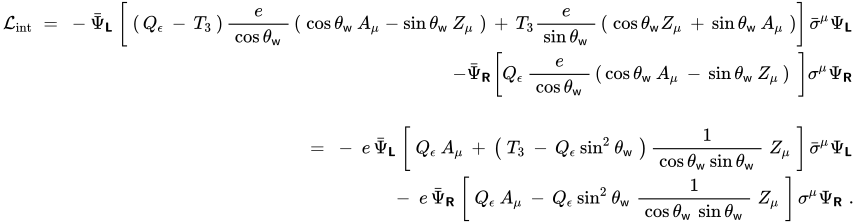
This table gives the values of the electric charge (the coupling to the photon, referred to in this article as [a] ). Also listed are the approximate weak charge (the vector part of the Z boson coupling to fermions), weak isospin (the coupling to the W bosons), weak hypercharge (the coupling to the theoretical B boson) and the approximate Z boson coupling factors ( and in the "Theoretical" section, below).


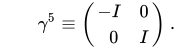
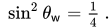
If the variable correction terms shown for different values are omitted, then the table's constant values for weak charge are only approximate: They happen to be exact for particles whose energies make the weak mixing angle with This value is very close to the typical approximately 29° angle observed in particle accelerators. The embedded formulas give more accurate values for those cases when the Weinberg angle, is known.



Electroweak charges of Standard Model particles Spin
JParticle(s) Weak
chargeElectric
chargeWeak
isospinWeak
hyperchargeZ boson coupling
2 QL+ 2 QR
Left
Right
Left
Right
Left
Right 1 /2 e−, μ−, τ−
electron, muon, tau [i]−1 + 4 sin2θw
≈ 0−1 −+ 1 /2 0 −1 −2 −1 + 2 sin2θw
≈ −+ 1 /22 sin2θw
≈ ++ 1 /2 1 /2 u, c, t
up, charm, top [i]+1 − 8 /3 sin2θw
≈ ++ 1 /3++ 2 /3 ++ 1 /2 0 ++ 1 /3 ++ 4 /3 1 − 4 /3 sin2θw
≈ ++ 2 /3−+ 4 /3 sin2θw
≈ −+ 1 /3 1 /2 d, s, b
down, strange, bottom [i]−1 + 4 /3 sin2θw
≈ −+ 2 /3−+ 1 /3 −+ 1 /2 0 ++ 1 /3 −+ 2 /3 −1 + 2 /3 sin2θw
≈ −+ 5 /6++ 2 /3 sin2θw
≈ ++ 1 /6 1 /2 νe, νμ, ντ
neutrinos [i]+1
0
++1/2
0
[ii] [b]−1
0
[ii] [b]+1
0
[ii] [b]1 g, γ, Z0,
gluon [iii] , photon, [iv]
and Z boson [iv]0 [iv] 1 W+
W boson [v]+2 − 4 sin2θw
≈ +1+1 +1 0 +2 − 4 sin2θw
≈ +10 H0
Higgs boson−1 0 −+ 1 /2 +1 −1


- 1 2 3 4 Only (regular, non-anti-) fermion charges are listed. For the matching antifermions, the electric charge, Qϵ, has the same magnitude, but opposite sign; other charges, such as weak isospin, T3, and weak hypercharge, Yw, that have columns subtitled "Left" and "Right", are left-right swapped as well as sign-reversed.
- 1 2 3 Although "sterile neutrinos" are not included in the Standard Model and have not been confirmed experimentally, if they did actually exist, giving the value zero for electric charge and weak isospin, as shown, is a simple way to annotate their non-participation in any electroweak interaction, and does so in a manner consistent with all the other elementary fermions.
- ↑ Gluons only have color charges of the strong force and spin: Their electroweak charges are all zero, although their color charges give them distinct antiparticles (see Gluon for details). Strictly speaking, gluons are out-of-context among of the electroweak-interacting particles described by this table. However, since each of the three electrically neutral elementary vector bosons' electroweak charges all are zero, they can all be accommodated by the same row in this table, hence allowing the table to show a complete list of all elementary particles currently incorporated in the Standard Model.
- 1 2 3 The quantum charges of every kind for photons and Z bosons are all zero, so the photon and Z boson are their own antiparticles: They are "truly neutral particles"; in particular, they are truly neutral vector bosons. Whilst not having charge themselves, photons and Z bosons none the less do interact with particles carrying the relevant quantum charge: electrical charge ( Qϵ) for photons (γ), and left and right weak charges (QL, QR) for Z bosons (Z0). They cannot interact with other γ or Z0 directly, and except at extremely high energies, usually do not interact with other γ or Z0 at all. However, because of quantum uncertainty even low energy versions of either particle occasionally might briefly split into a particle-antiparticle pair, each of which happens to have the electrical charge needed to interact with a γ, or the left or right weak charge needed to interact with Z0, or both. After that interaction has happened, the particle-antiparticle pair recombines into the same γ or Z0 particle that originally split, precluding the intermediate pair – whatever it may have been – from ever being observed: The only observed effect is the change in the recombined particle's momentum. This disappearing-act makes it appear the same as if a direct Z0-Z0 or Z0-γ or γ-γ interaction had occurred. Because at normal, low energies, it depends on a fortuitous and ephemeral pair creation event, this kind of interaction of a neutral vector boson with another neutral vector boson is so rare that even though technically very slightly possible, it is treated as effectively impossible and ignored. Hence the blanket zero value for the neutral weak bosons' (γ, Z0) row in the table are all almost exactly zero, but some are not precisely zero as shown.
- ↑ Only the W+ boson's charges are listed; values for its antiparticle W− have reversed sign (or remain zero). The same rule applies as for all particle-antiparticle pairs: Their "charge"-like quantum numbers are equal and opposite. W bosons can interact with both photons and Z bosons, since they carry both electric charge and weak charge; for the same reason, they can also self-interact.
For brevity, the table omits antiparticles. Every particle listed (except for the uncharged bosons the photon, Z boson, gluon, and Higgs boson [c] which are their own antiparticles) has an antiparticle with identical mass and opposite charge. All non-zero signs in the table have to be reversed for antiparticles. The paired columns labeled "Left" and "Right" for fermions (top four rows), have to be swapped in addition to their signs being flipped.
All left-handed (regular) fermions and right-handed antifermions have and therefore interact with the W boson. They could be referred to as "proper"-handed (that is, they have the "proper" handedness for a W± interaction). Right-handed fermions and left-handed antifermions, on the other hand, have zero weak isospin and therefore do not interact with the W boson (except for electrical interaction); they could therefore be referred to as "wrong"-handed (i.e. they have the wrong handedness to participate in W± interactions). "Proper"-handed fermions are organized into isospin doublets, while "wrong"-handed fermions are represented as isospin singlets. While "wrong"-handed particles do not interact with the W boson (no charged current interactions), all "wrong"-handed fermions known to exist do interact with the Z boson (neutral current interactions), excepting perhaps sterile neutrinos, if they exist. [d]

"Wrong"-handed neutrinos (sterile neutrinos) have never been observed, but may still exist since they would be invisible to existing detectors. [8] Sterile neutrinos, assuming they exist, are speculated to play a role in a few theoretical mechanisms that might provide neutrinos with mass (see Seesaw mechanism). The statement above, that the Z0 interacts with all fermions, will need an exception inserted for sterile neutrinos, if they are ever detected experimentally.
Massive fermions – except (perhaps) neutrinos [d] [b] – always exist in a superposition of left-handed and right-handed states, and never in pure chiral states. This mixing is caused by interaction with the Higgs field, which acts as an infinite source and sink of weak isospin and / or hypercharge, due to its non-zero vacuum expectation value (for further information see Higgs mechanism).