1998 South Carolina Amendment 4

Last updated

AMENDMENT No. 4
Flag of South Carolina.svg
November 3, 1998
Shall Section 33, Article III of the Constitution of this State be amended by deleting the following sentence from the Constitution: 'The marriage of a white person with a Negro or mulatto, or person who shall have one-eighth or more of Negro blood, shall be unlawful and void'.
Results
Choice
Votes%
Check-71-128-204-brightblue.svgYes565,80561.95%
Light brown x.svgNo347,53338.05%

1998 South Carolina Amendment 4 results map by county.svg
Source: Dave Leip's Atlas of U.S. Presidential Elections [1]

1998 South Carolina Amendment 4 was a proposed amendment to the Constitution of South Carolina to repeal the state's defunct constitutional ban on interracial marriage. The amendment was symbolic, as interracial marriage had already been legal nationwide since Loving v. Virginia in 1967. The ballot measure was approved in a 61.95% to 38.05% vote, with every county except Cherokee, Chesterfield, Dillon, Lancaster, Saluda, and Union having a majority vote in favor.

Contents

Background

The interracial marriage ban clause in South Carolina's constitution dated back to 1895, when the document was rewritten "as part of a sometimes violent backlash against Reconstruction." The ban included only white and black people, mentioning no other races. [2] The 1895 constitution was written under Gov. Ben Tillman , whose administration was run on the idea that control of the state government should be held by white people. [3]

In 1967, the Supreme Court of the United States ruled interracial marriage bans to be in violation of the Equal Protection and Due Process clauses of the Fourteenth Amendment, thereby striking down all state laws that had banned such marriages. South Carolina's defunct laws remained on the books. [4] [5] [6]

After the ruling, South Carolina's Attorney General urged for license bureaus to issue marriage licenses to interracial couples. [7]

In 1970 and 1972, following an opinion issued by the then South Carolina Attorney General Daniel McLeod in 1969 that the ban was unconstitutional, South Carolina repealed its statutory anti-miscegenation provisions. However, section 33 of article 3, the interracial marriage ban clause of South Carolina's constitution, still remained in place. [6] [5] [8]

In 1998, at the time of repeal of the constitutional ban, South Carolina was the second-to-last state to have a defunct ban on interracial marriage; the final state to repeal its ban was Alabama in 2000. [9]

Bill 4303 from the 112th Session, 1997-1998 of the South Carolina General Assembly placed the question on the ballot. The bill was authored by State Rep. Brad Jordan; however, Jordan allowed for State Rep. Curtis Inabinett to be the bill's introducer and chief sponsor. [10] [11] [12] In the State House, the bill received 99 votes in favor, 4 votes against, and had 20 representatives not vote. The 4 opposition votes came from State Rep. John Graham Altman, State Rep. Dan Cooper, State Rep. Larry Koon, and State Rep. Margaret Gamble. [13] [11] In the State Senate, 45 votes were in favor, and none were in opposition. [14]

Support and opposition

Support

Legislators

  • Governor David Beasley applauded the State House's passage of the bill, according to spokesman Gary Karr. [5]
  • State House Majority Leader Bobby Harrell supported repeal of the ban, simply saying, "It's the right thing to do." [5]
  • House Speaker Pro-Tempore Terry Haskins attempted to repeal the provision a few years prior to the successful bill; however, legislative bill-writers deterred him. Haskins said, "Their reaction was, 'Everyone knows that's not enforceable, and it's too much trouble to bother making everybody go through the vote on it.'" [15]
    State Democratic Party Chairman Richard Harpootlian, a supporter of repealing the ban. Harpootlian-campaign.jpg
    State Democratic Party Chairman Richard Harpootlian, a supporter of repealing the ban.
  • State Democratic Party Chairman Richard Harpootlian , in criticizing those who opposed the amendment, said, "I think they are stupid. When Republicans are all over African-American polling places with signs and video cameras and when you use race as a wedge issue, it trickles on down." [16]
  • State Rep. Jerry Govan, in response to suggestions that lawmakers in support of the measure had caved in to political correctness, said, "I think it is a slap in the face to all members of the General Assembly to imply that when people sign onto bills that they were sucked in." In response, State Rep. John Graham Altman, a representative who opposed the amendment, said, "Some legislators make it part of their strategy to be offended. Most black people don't care about this sort of thing." [10]
  • State Rep. Jeff Young, who led the subcommittee that studied the bill, said the subcommittee found that the ban should be removed and was "offensive to the people of South Carolina." Young also said, "It's an antiquated law. We ought to always strive to make our constitution a living document that accurately reflects society today, not society as it was 50 or 100 years ago. Things are outdated in there and I have no objection to someone having a study committee going through and updating all parts that are totally antiquated and determined to be illegal by the U.S. Constitution. Then we'll have a document that is current." [10] [17]
  • State Rep. Curtis Inabinett, the bill's introducer and chief sponsor, said, "We should be beyond this. In years to come, we should at least let history reflect that we did something about it." [18] Inabinett also said that he believed the language was offensive to people of all races. "I think it's a substantive matter." Inabinett then said that his intent was not on cleaning out of all of the outdated provisions in the constitution, just the most egregious parts. He denied that his goal was to stir up racial divisiveness. "I wasn't thinking of the flag when I introduced it. I'm glad he's alluding to the fact that it needs to be cleaned up." Inabinett's reference was to State Rep. John Graham Altman, who opposed the amendment. [10] Inabinett also said, "There is a lot of terrible evil in this country with reference to race. Somebody had intentions years ago for enacting this legislation." He grew up in Colleton County and attended segregated schools. "I've been called all kinds of names from time to time." He also felt that the interracial marriage ban was hypocritical because many Southern white men had children with black women. "Maybe I shouldn't say this, but I've always felt the first deadbeat dads weren't black folks." [11] Inabinett questioned how the ban was enforced, saying, "How can you look at a person and tell that they are one-eighth Negro or not? What kind of test did our legislators use? How would you know?" [15]
  • State Rep. Olin Phillips voted in favor of the amendment; however, he personally opposed interracial marriage, saying, "It's just my Christian belief that a good Southern Baptist ought not to do that. I'm a Baptist, and this is a really strong, hard-shell religious belief." Phillips felt that repealing the ban meant condoning interracial marriage and turning away from God's word. However, he did not know which passage in the Bible said that black people and white people should not marry. He wondered why people of different races would want to marry, and he especially wondered about the attraction of white women to black men, saying, "I don't know what prompts it. Is it the athletics in the blacks? Or is it just curiosity?" He also believed that interracial marriage invited trouble for both parents and children. "It's a social stigma that follows all the families. When it does happen, you hear about it quick. Word gets around." Though, Phillips said that he did not believe in white supremacy. But, he said, "I just believe in the sanctity of the white race. I just can't condone interracial marriage." Phillips also thought that black people who had pure African lineage would have the same feelings on interracial marriage. "I don't believe the real African-Americans, the real black people, want that." Nevertheless, despite personal opposition, Phillips voted in favor "to let the people decide." [19] [11]
  • State Rep. Fletcher Smith: "If you can say people can't marry in a constitutional structure, it is a race issue. It can't be anything other than a race issue." Smith also said that if a racial belief is cloaked in religion, "that means that the religious belief is a racist religious belief." He questioned the logic of those who opposed interracial marriage, saying, "If they had thought it through, they would see that the idea would be a white-supremacy idea right out of the pages of the Klu Klux Klan and the White Citizen's Council, because they had a religious belief for what they were doing, as well. I think most of the folks are probably reasonable on other issues. But when you get to primary social relationships such as marriage, they get to be unreasonable." [11]
  • State Rep. John Scott , in response to State Rep. Olin Phillips' claim about African-Americans, said, "I can't find those people. I don't know of any Americans, if they are Americans, that are what he would describe as being African. If he says 'real black people,' we are all 'real black people.' It is impossible to separate the bloodlines of 200 years of slavery. People need to face up to what we are in America, that most of what we see in America is a product of interracial mingling." Scott said that he called Phillips his friend. "Some of what people believe is so indoctrinated in them as young people and has been passed from generation to generation, when you cross-examine the information that is given, then the Bible becomes a scapegoat....People don't marry because of their color. They marry people because of how they feel about them." [11]
  • State Senator Darell Jackson , who, at the time of being asked his views on interracial marriage had recently married an interracial couple, said, "Race was not the issue. Their love and caring for each other was the issue." Jackson said if he were debating the issue on the floor of the Senate, he "would tell them to look at no other than the face of Jesus Christ. I would say, 'If Jesus was sitting where you are in the General Assembly and he had to vote on this issue, how would he vote, based on the gospel?' Maybe their own personal visions have become paramount to their religious convictions. To do that under the umbrella of religion is an insult to Christianity and to all religions." [11]
  • State Rep. Chip Campsen : "I just don't think that it's appropriate for the state to prohibit that. I think people may have objections to that personally, and if they do, they do not need to interracially marry. It's another thing for a state to say it is inappropriate." [15]
  • State Rep. Joe Neal , when speaking of the proposal, said, "It's a beginning." He brought up how he feels that racial healing would not come to South Carolina until the state's laws also reflected that priority. Neal, a pastor, officiated about a half-dozen marriages with interracial couples at the time of being questioned in 1997. He believed that marriage was not an issue of race, but instead of how well-prepared for racial divisiveness in the world the couple is. "Marriage is between two people. Race doesn't play a part in that, and it's not appropriate for it to." [15]
  • State Rep. Brad Jordan, after learning about the provision still being a part of the constitution, said, "I was dumbfounded. I said we need to do something about that." Jordan, who was an active member of the Evangelical Christian men's organization Promise Keepers, immediately thought of an interracial couple that he knew in his church after learning of the defunct clause. The female in the marriage was dying of cancer. "I realized this young lady would actually probably pass away in a state where her marriage is constitutionally illegal." Although Jordan was unable to repeal the law before the woman passed away, he did set the wheels into motion. [15] Jordan also said, "It symbolizes an inequality that I think we need to end, and it needs to end now." [20] He described the ban as "a sad commentary that has remained." [12] He later further affirmed his backing of the repeal, describing the language as "cruel and hateful" and that he felt "a very strong call for racial healing in our state." [21] Jordan authored the repeal bill, though allowed State Rep. Curtis Inabinett to introduce the legislation and be its chief sponsor. [12]
  • State Rep. Tom Keegan supported the repeal, saying, "There's enough racial division in the country as it is, and to have that kind of language in the 20th century only serves to foster racial division. We don't need it." [22]
  • State Rep. Robert Ford , after bringing up that there were 12,000 interracial couples in South Carolina, said, "Unless we're going to put all these folks in jail," the law should be amended. Ford, a black politician, also joked about the archaic language of the clause, saying, "What's a negro?" [22]
  • State Rep. Mike Baxley, after a debate occurred in the State House with State Rep. John Graham Altman opposing the repeal, said, in a written statement, "With all due respect to Mr. Altman, it's our duty as a legislature to remove socially repugnant and antiquated laws from our founding document so that all citizens can be proud of our state constitution." [23]

Editorials

The Herald released an editorial in favor of the measure, describing the ban as "an unsavory relic of the past" and "a stain on the constitution." [24] The newspaper, days after the election had taken place, released an opinion section affirming support for the measure, and described the fact that more than one-third of the state opposed the measure as "a black eye for the state." [25]

The Sun News also released an editorial after the amendment vote had occurred, saying that their concern lied with the fact that six counties had voted against the measure. The newspaper went on to say, "The times, they are a'changing, but not fast enough." [26]

The State released an opinion paper expressing support for the repeal, describing the provision as "offensive and hateful" and "a surviving relic of brutally enforced laws — now void — that once banished blacks to the back of the bus, to separate and inferior schools, to separate accommodations and even separate drinking fountains." The newspaper went on to say, "It reminds one of Adolf Hitler's rules for racial purity" and that "we should take this wording out of our constitution for the same reason we would pick up trash in our front yard: it doesn't look good, and it says something about us if we leave it lying around." [27]

The Beaufort Gazette supported all amendments on the ballot in 1998, including the interracial marriage amendment, saying that the state's constitution "should be a sacred document that reflects the ideals of a state" and that the amendment "would purge a race-purity test from the Constitution." [28]

The Greenville News backed deletion of the ban, saying that it "serves only as a painful reminder of an earlier time." [29]

Opposition

Other/unclear viewpoints

State House Minority Leader Gilda Cobb-Hunter, who did not cast a vote on the measure. Gilda Cobb-Hunter (12-5-24).jpg
State House Minority Leader Gilda Cobb-Hunter, who did not cast a vote on the measure.

Contents

The following question and explanation was shown to voters for Amendment 4:

"Shall Section 33, Article III of the Constitution of this State be amended by deleting the following sentence from the Constitution: 'The marriage of a white person with a Negro or mulatto, or person who shall have one-eighth or more of Negro blood, shall be unlawful and void'.

Yes []

No []

Those voting in favor of the question shall deposit a ballot with a check or cross mark in the square after the word 'Yes', and those voting against the question shall deposit a ballot with a check or cross mark in the square after the word 'No'."

Explanation of above: This amendment, if approved, will remove the part of the Constitution that makes marriage between whites and blacks illegal. [32] [a]

Pre-decision polling

Before the election in which the amendment was voted on took place, a poll conducted by Mason-Dixon was released; the poll found that 48 percent of South Carolina registered voters favored a repeal of the state's constitutional ban, while 29 percent opposed it. The poll surveyed 820 registered voters between December 9 and December 11, 1997, based on statewide telephone interviews, and had a 3.5 percent margin of error. [34]

In an August 1998 poll by Mason-Dixon, conducted with 806 registered voters over telephone, two-thirds favored deletion of the ban, 22 percent opposed it, and around 11 percent were undecided. The poll had a 4 percent margin of error. [35]

Results

40 counties voted in favor of the measure, and 6 voted against. No county had more than 75.3% vote in favor (Beaufort County), and none had less than 44.7% (Cherokee County).

CountyYesNo
#%#%
Abbeville 3,21850.83,12149.2
Aiken 20,05363.811,38736.2
Allendale 88256.966843.1
Anderson 21,69054.018,47846.0
Bamberg 1,49155.71,18744.3
Barnwell 2,30153.51,99746.5
Beaufort 22,21375.37,27224.7
Berkeley 14,74362.48,89137.6
Calhoun 2,39153.52,07446.5
Charleston 52,28774.118,24125.9
Cherokee 5,05644.76,25455.3
Chester 3,79254.63,15445.4
Chesterfield 4,16948.74,39551.3
Clarendon 3,77254.13,19445.9
Colleton 4,07352.83,64347.2
Darlington 7,32754.86,03745.2
Dillon 2,47246.92,79653.1
Dorchester 13,73965.97,12034.1
Edgefield 3,27161.02,08839.0
Fairfield 3,14663.51,80736.5
Florence 15,30555.912,07044.1
Georgetown 6,96059.44,76240.6
Greenville 63,30663.636,26536.4
Greenwood 8,31959.35,71840.7
Hampton 2,61852.52,37247.5
Horry 27,66163.615,81636.4
Jasper 2,04861.81,26638.2
Kershaw 7,64856.15,99543.9
Lancaster 7,05649.47,22550.6
Laurens 8,08552.47,33347.6
Lee 2,71453.02,40447.0
Lexington 37,14962.522,31837.5
McCormick 1,64162.399237.7
Marion 3,28659.92,19940.1
Marlboro 3,14557.12,36742.9
Newberry 5,06552.14,65747.9
Oconee 10,12758.77,11241.3
Orangeburg 12,36459.88,30840.2
Pickens 13,70957.310,22842.7
Richland 59,28474.120,67125.9
Saluda 2,67450.02,67950.0 [b]
Spartanburg 29,23656.522,52043.5
Sumter 12,87863.07,57537.0
Union 4,00944.94,91255.1
Williamsburg 4,57854.63,80045.4
York 22,85465.312,16534.7
State total565,80562.0347,53338.0 [32]

Analysis and aftermath

The amendment required a subsequent vote by the legislature in order to be ratified; the ratification, following approval by both the state House and Senate, took effect during the week of February 14, 1999, officially removing the state's marriage ban, which had been unenforceable for over 31 years. [36]

Based on the percentage of participants by race in the 1998 general election, all six counties that opposed the amendment had a majority-white percentage of people who voted. [37] Data gathered in the 2000 census shows that all six counties that opposed the amendment had a majority-white population in total. [38] An estimated 40% of white voters opposed the ballot measure. [39]

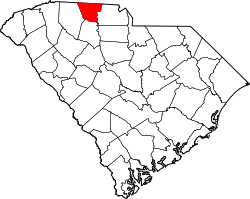
A map depicting Cherokee County, South Carolina, which voted against both gay and interracial marriage by the highest margins of any county in the state. Map of South Carolina highlighting Cherokee County.svg
A map depicting Cherokee County, South Carolina, which voted against both gay and interracial marriage by the highest margins of any county in the state.

The six counties in opposition later voted in favor of the state's constitutional ban on gay marriage referendum, with Cherokee County, one of the six, being the only county to have more than 90% of its vote be in favor of the ban. [40] The amendment was also later compared to the gay marriage referendum, with The Times and Democrat saying that targeting same-sex couples was "no less vicious than targeting interracial couples was in another era." [41]

See also

References

  1. "1998 Referendum General Election Data Graphs - South Carolina". Dave Leip's Atlas of U.S. Presidential Elections. Archived from the original on August 31, 2025. Retrieved August 31, 2025.
  2. Bray, Chad (October 29, 1998). "Lifting interracial marriage ban one of four questions on ballot". Newspapers. The Greenville News. Archived from the original on November 25, 2025. Retrieved November 24, 2025.
  3. "Alabama's interracial marriage ban may be last to go". Newspapers. The State. December 20, 1998. Archived from the original on November 25, 2025. Retrieved November 24, 2025 via Cox News Service.
  4. "Loving v. Virginia". Oyez. Archived from the original on October 3, 2025. Retrieved November 24, 2025.
  5. 1 2 3 4 5 Holland, Jesse J. (February 6, 1998). "Interracial marriage bill OK'd". Newspapers. Associated Press. Archived from the original on November 25, 2025. Retrieved November 23, 2025 via Anderson Independent-Mail.
  6. 1 2 Newbeck, Phyl. "Virginia Hasn't Always Been for Lovers: Interracial Marriage Bans and the case of Richard and Mildred Loving". Google Books. Archived from the original on November 25, 2025. Retrieved November 22, 2025.
  7. Ferguson, Harry (February 16, 1968). "Mixed Marriage Bans Falling Like Dominoes". Newspapers. United Press International. Archived from the original on November 25, 2025. Retrieved November 24, 2025 via Bucyrus Telegraph-Forum.
  8. "Skerritt". Newspapers. The Herald. March 8, 1998. Retrieved November 24, 2025.
  9. Blake, Aaron. "Alabama was a final holdout on desegregation and interracial marriage. It could happen again on gay marriage". The Washington Post. Archived from the original on March 17, 2025. Retrieved August 31, 2025.
  10. 1 2 3 4 5 Taylor, Jay (January 28, 1998). "House to get bill removing interracial-marriage ban". Newspapers. The State. Archived from the original on November 25, 2025. Retrieved November 17, 2025.
  11. 1 2 3 4 5 6 7 8 9 10 11 12 "RACE FROM PAGE A1". The State . February 6, 1998. Archived from the original on November 25, 2025. Retrieved November 23, 2025.
  12. 1 2 3 Sealover, Ed (January 11, 1998). "Legislators to press hot-button issues". Newspapers. Anderson Independent Mail. Archived from the original on November 25, 2025. Retrieved November 24, 2025.
  13. "Session 112 - (1997-1998)". South Carolina Legislature. Archived from the original on April 24, 2025. Retrieved August 31, 2025.
  14. "Tuesday, April 7, 1998 (Statewide Session)". South Carolina Legislature. Archived from the original on July 20, 2025. Retrieved November 24, 2025.
  15. 1 2 3 4 5 "MARRIAGE FROM PAGE A1". Newspapers. The State. October 13, 1997. Archived from the original on November 25, 2025. Retrieved November 24, 2025.
  16. Smith, Bruce (November 4, 1998). "Repeal of interracial marriage ban passes". Newspapers. Anderson Independent-Mail. Archived from the original on November 25, 2025. Retrieved November 17, 2025.
  17. 1 2 Gilbert, Marsha (February 27, 1998). "LAW FROM PAGE 1B". Newspapers. The Greenville News . Retrieved November 18, 2025.
  18. 1 2 3 Pressley, Sue Anne (November 3, 1998). "SOUTH CAROLINA'S RACIAL RELIC". The Washington Post. Archived from the original on July 26, 2024. Retrieved August 31, 2025.
  19. Taylor, Jay (February 6, 1998). "Bedroom doors, battle lines". Newspapers. The State . Retrieved November 23, 2025.
  20. "Panel moves to eliminate interracial marriage ban". The Times and Democrat . January 15, 1998. Retrieved November 24, 2025.
  21. Scoppe, Cindi Ross (January 20, 1998). "Interracial marriage ban is about our heritage of hate". Newspapers. The State . Retrieved November 25, 2025.
  22. 1 2 3 4 Wilson, Zane (February 6, 1998). "Conway pair abstain on race vote". Newspapers. The Sun News . Retrieved November 25, 2025.
  23. 1 2 3 Hammond, James T. (January 28, 1998). "State House panel OKs vote on interracial marriage ban". Newspapers. The Greenville News . Retrieved November 25, 2025.
  24. "Ban is embarrassment". Newspapers. The Herald. February 12, 1998. Retrieved November 25, 2025.
  25. Speizer, Jayne; Sovde, Roger; Plumb, Terry C.; Rassmann, Richard R.; Werrell Jr., James (November 5, 1998). "Controversial amendments". Newspapers. The Herald. Retrieved November 23, 2025.
  26. Ellis, Paula; Deans, Sue; Ausband, Jerry; Willis, Bill (November 11, 1998). "Catching up?". Newspapers. The Sun News . Retrieved November 23, 2025.
  27. "Strike from constitution section on marriage ban". Newspapers. The State. October 20, 1997. Retrieved November 24, 2025.
  28. "The amendments". Newspapers. The Beaufort Gazette. October 31, 1998. Retrieved November 25, 2025.
  29. "Amendments on the ballot". Newspapers. The Greenville News. October 29, 1998. Retrieved November 25, 2025.
  30. Gilbert, Marsha (February 27, 1998). "Debate still swirls around amendment". Newspapers. The Greenville News . Retrieved November 18, 2025.
  31. "Professor finds South Carolinians disapproving of interracial couples". Newspapers. Associated Press. September 26, 1998. Retrieved November 24, 2025 via The Island Packet.
  32. 1 2 "SOUTH CAROLINA ELECTION REPORT 1997 & 1998" (PDF). South Carolina Election Commission. Archived (PDF) from the original on June 13, 2025. Retrieved August 31, 2025.
  33. Holland, Jesse J. (August 13, 1998). "Interracial marriage question to include explanation". Newspapers. Associated Press . Retrieved November 25, 2025 via The Greenville News.
  34. "Poll: S.C. residents split on video poker". Newspapers. Associated Press. December 19, 1997. Retrieved November 23, 2025 via Florence Morning News.
  35. Pratt, Mark (September 26, 1998). "Interracial couples say discrimination prevalent". Newspapers. Florence Morning News . Retrieved November 24, 2025.
  36. "Interracial marriage ban becomes history". Newspapers. Associated Press. February 23, 1999. Retrieved November 24, 2025 via The Greenville News.
  37. "Voter History Results". MySCVotes. Archived from the original on May 31, 2025. Retrieved November 24, 2025.
  38. "Census 2000". South Carolina Revenue and Fiscal Affairs Office. Archived from the original on February 12, 2025. Retrieved November 22, 2025.
  39. Herman, Melissa R.; Campbell, Mary E. (November 18, 2011). "I wouldn't, but you can: Attitudes toward interracial relationships". ScienceDirect . Retrieved November 28, 2025.
  40. "ELECTION REPORT 2005-2006" (PDF). South Carolina Election Commission. Archived (PDF) from the original on July 22, 2025. Retrieved November 22, 2025.
  41. Richard, Nunan (November 3, 2006). "Dark side of same-sex marriage ban". Newspapers. The Times and Democrat . Retrieved November 22, 2025.

Notes

  1. The amendment included the explanation because state legislators were afraid that voters would not understand the meaning of the ballot question. [33]
  2. Percentage including hundredths decimal is 49.95% in favor, and 50.05% opposed.

1998 South Carolina Amendment 4 at Ballotpedia