Paulo Dias de Novais founded Luanda in 1576 and hostilities broke out three years later when the king of Ndongo had the Portuguese merchant community in his capital massacred.[1] Conflict then gradually drew in every neighbouring power along with the Dutch West India Company. Though few in number, the Portuguese fielded heavier equipment but more importantly were able to mobilize large numbers of African auxiliaries to their cause, and their support proved vital to the success of operations in the harsh African hinterland.[2][3]Queen Nzinga distinguished herself by forging "the largest coalition of angolan states in the 17th century" against the Portuguese, who ultimately emerged as the main power in the region in spite of severe adversity.[4]
These conflicts radically altered the balance of power in the region and marked it deeply. They were recorded primarily by António de Oliveira Cardornega in General History of the Angolan Wars, an epic narrative in three volumes that followed the style of Portuguese chronicles of Asian and American conquest.[5]
Context
The Portuguese reached Angola in 1482 during the reign of King John II. Portuguese explorer Diogo Cão contacted the Kingdom of Kongo and established friendly relations between the two realms. In 1491, the king of Kongo converted to Catholicism, and his kingdom henceforth became frequented by Portuguese ambassadors, missionaries and merchants, some of whom settled in the country. Relations remained stable and in 1568 Portugal dispatched an expeditionary corps to help king Álvaro I suppress an uprising or invasion of the "Jagas" in Kongo, which greatly strengthened relations between the two kingdoms and earned the Portuguese high regard by the kings of Kongo.[6] Kongo henceforth paid Portugal a fifth of all nzimbu fished at the Island of Luanda as tribute.[7]
To the south of Kongo, the Kingdom of Ndongo had sought to establish direct contact with Portugal as early as 1518.[8] Ndongo seems to have been created from Kongo, and the rulers of Kongo claimed overlordship over the kingdom, but had little real control.[8] Portugal dispatched a first diplomatical mission to Ndongo in 1520 and although it was unsuccessful, Ndongo sent another to Portugal in 1549, which resulted in Paulo Dias de Novais being dispatched to Ndongo at the head of a second mission.[8] Upon his return, he obtained a grant to establish a colony in Angola.[8] Ndongo sent another embassy to Lisbon in 1575, headed by Dom Pedro da Silva Manuel, an ethnic Kongolese raised in Portugal.[9] He bore gifts of copper, silver, slaves and portions of Kikongo wood. Silva Manuel was well received, admitted to the Order of Santiago as a knight and given grants for his support.[9]
In 1576 Paulo Dias de Novais founded the city of Luanda.[10] Novais hoped to obtain access to the legendary silver mines that were purported to exist at Cambambe in the kingdom of Ndongo and he had orders from King Sebastian to follow a policy of peaceful bilateral relations.[11] He therefore signed an alliance with the ngola ("king") of Ndongo, Nzinga Ngola Kilombo Kia Kasenda.[12][13] Novais offered his services to Ndongo and fought several times for the ngola against rebels.[12] In exchange for this military aid, Kia Kasenda would sell rebels, prisoners of war and his subjects sentenced to death for theft or adultery as slaves to the Portuguese, thus earning him great profits.[14]
Relations between Ndongo and Portugal were so amicable that Kia Kasenda requested an ambassador for his capital of Kabasa and Novais dispatched Pero da Fonseca with a guard of 20 men for the task.[15]
The Ndongo Wars, 1579-1622
Notwithstanding the friendly relations with the king of Ndongo, Novais was considered an unwelcome intruder by the numerous freelance Portuguese traders already in the region, and some sought to disrupt relations between the two.[16]
The experienced and influential trader Francisco Barbudo d'Aguiar quarreled with Pero da Fonseca at Kabasa and so he claimed to king Kia Kasenda in a private audience that Novais was preparing to invade his kingdom and seize its mines, and also that Fonseca was a spy and his entourage a fifth column.[16][17] The following day, Kia Kasenda had the Portuguese community assemble before him to hear the allegations of Barbudo, which they denied in astonishment but the king disregarded their arguments.[17] After consulting with his advisors therefore, the ngola was persuaded to have all the Portuguese at Kabasa massacred.[1][16][18][19] Barbudo however was also executed, because the king believed that "it was not right that one should live who had caused the death of his countrymen".[17] The same fate befell the Portuguese merchants scattered throughout the country and their property was seized.[17] Kia Kasenda also massacred almost a thousand kongolese who were then at Kabasa, which further damaged relations between Kongo and Ndongo.[20]
The betrayal of the king of Ndongo as it became known marked the beginning of hostilies between Ndongo and Portugal.[19][18] The outbreak of the war also stranded ambassador Dom Pedro da Silva Manuel in Lisbon, and for the following eighty years Ndongo ceased trying to have diplomatic relations with Europe directly.[20]
After the massacre at Kabasa, Kia Kasenda began assembling an army to destroy Luanda.[1][18][19] Novais was camped with 60 Portuguese soldiers and 200 Africans near the Kwanza river at that time and he received an envoy from the ngola with a message not to proceed any further into Ndongo.[21] Out of suspicion, the Portuguese commander relocated his troops to Anzele, in Ilamba, between the rivers Cuanza and Bengo, ten or twelve leagues from Luanda, where he erected a timber fort, equipped with two cannon.[21][1][18][19] Only twenty days later did he receive news of the massacre and the approaching Ndongo army.[21][19][18] Far from being intimidated, Novais inspired his men with the hope of avenging the massacre.[21] Anzele was encircled by 12,000 warriors but a well executed sortie by the Portuguese threw the Ambundu into disarray and they were forced to withdraw.[19][18][1][22] Kia Kasenda then requested peace, but Novais denounced him and rejected terms, upon which the king of Ndongo executed his advisors.[22][21]
The Cuanza river system.
Meanwhile, on 23 February 1580 a fleet arrived from Portugal with reinforcements and among their number were two Jesuit fathers, one of which, Father Baltasar Barreira, promptly travelled to Kongo to request military aid.[19] With his forces now numbering 1200 men among Europeans and Africans, Novais sailed up the Cuanza on two galliots, one small caravel and two batels, and for two months he fought agains hostile lords along its banks and reduced several to vassalage, under the tropical rain.[19][18] Ndongo was divided in hundreds of small regions ruled by local tribal lords, called sobas.[23] Novais established a new fortified camp at Mocumbe on November 16, and for the following eight months he remained there with his forces scouting the sorrounding territory, skirmishing with hostile sobas, and baptizing others who sided with Portugal.[19][18] Still in 1581, soba Songa of Quissama converted to Catholicism along with 400 others after being defeated, and he adopted the name Dom Paulo de Novais, in deference to Paulo Dias de Novais.[19]
As a result of Father Barreiras efforts, on early 1581, Kongo marched to the aid of Novais with a 60,000 man army that included 120 Portuguese but the battle they fought with the forces of Ndongo by the river Bengo proved indecisive.[24] By July, Novais was already running low on provisions and many of his comrades had been decimated by tropical disease, but Father Barreira exhorted the Portuguese at Luanda to organize a relief expedition that reached Mocumbe on the 24th.[19][18]
The Fortress of Massangano.
For the following eight years, Novais fought several battles against Ndongo, vassalized and converted numerous sobas and founded Massangano in 1582.[19][18] Kia Kasendas reputation for cruelty led many sobas to side with the Portuguese.[25] In 1585 captain André Ferreira Pereira scored an important victory with 130 Portuguese soldiers and as many as 10,000 auxiliaries against an Ndongo army with a considerable part of its nobility.[26]
In 1586, Paulo Novais was attacked by an immense force, estimated to number about 600,000 men. Even though he was very outnumbered, only having at his disposal about 100 Portuguese and a number of African soldiers, he was able to achieve victory against the attackers, mainly due to the bravery of his men and how well he conducted the defence.[27][28]
Novais died on May 9, 1589, and was buried in a simple tomb in front of the church of Massangano.[19][18] He had funded the Angola venture out of his own pocket and died bankrupt.[29] His successors decided to proceed with the war against Ndongo until the mines of Cambambe had been secured.
For the next fifteen years the few but heavily armed Portuguese undertook several campaigns against Ndongo with the support of a great number of auxiliary warriors supplied by vassal or allied African lords, established new settlements and forts in the interior, captured the valuable salt mines of Quissama, which deprived Ndongo of its most valuable export, and finally secured the region of Cambambe, where a fort was built.[26][19][18] The silver mines rumoured to exist there however, were found to contain only lead.[19][18]
Shortly after the construction of the Fort of Cambambe just 70 kilometers from the capital of Ndongo, the successor of Kia Kasenda, Ambandi Angola, requested peace and governor Manuel Cerveira Pereira proceeded to vote the matter in a council with his closest men. His officers voted to end hostilities and a peace was signed in 1604.[19][18]
The second Ndongo-Portuguese War, 1611-1622
Governor Luís Mendes de Vasconcelos.
In 1611 the king of Ndongo Ambandi Angola began attacking the market fairs in the interior and the Portuguese merchants that took part in them. Governor Bento Banha Cardoso prepared a new campaign against Ndongo and signed a pact of alliance with a number of Imbangala warlords, who would henceforth serve the Portuguese as mercenaries.[30][31] Cardoso managed to temporarily pacify the region, build a fort at Ambaca and bring the number of Ambundu sobas under Portuguese suzerainty to a total of 78.[30]
The second war against Ndongo reached new heights in 1617. Early in this year Ambandi Angola was succeeded on the throne by Angola Ambandi, who violently persecuted political rivals, killed a half-brother, his half-brothers' mother, her siblings, the Court major-domo, numerous officials and their families, forcibly sterilized his three sisters, Quifunge, Mucambo and Nzinga, and killed the latters son.[32][33][34] Angola Ambandi also rejected diplomacy with the Portuguese and gathered an army to attack them.[34] In Luanda meanwhile, the Portuguese governor was succeeded in office by Luís Mendes de Vasconcelos, who had proposed to connect Angola and Mozambique by land and annex Ndongo, a project for which he had the support of many dissatisfied Ambundu lords that voluntarily joined his forces.[34][33] Among them was a rival claimant to the throne: Hari a Kiluanje, lord of Pungo Andongo.[35]
Ambaca was besieged by an army commanded by Caita Calabalanga, the last powerful soba still loyal to Angola Ambandi but this time the forces of Ndongo were decisively routed in battle by the Imbangala mercenaries and Vasconcelos then marched on Kabasa practically unopposed.[33][32][36] The campaign in Ndongo continued for the next four years and caused catastrophic devastation, 190 sobas became tributary vassals of Portugal, the Portuguese captured important people close to Angola Ambandi and the ngola himself fled with his Court to the Islands of Quindonga, in the Kwanza River.[33][32][34] Vasconcelos also secured the allegiance of the lords of the hilly and densely forested Dembos region, which had been disputed by Kongo and Ndongo.[37]
The baptism of Queen Nzinga.
Vasconcelos was succeeded in office by João Correia de Sousa, who considered the war with Ndongo inexpedient and began peace talks.[33][32] Angola Ambandi dispatched his sister Nzinga as an ambassador and while in Luanda she converted to Catholicism, adopting the name Ana de Sousa.[32]
War against Kasanje
The terms negotiated by Nzinga included a military expedition against the Imbangala kingdom of Kasanje.[38][32] They had been allowed to settle in Ndongo but had since declared independence and now sheltered bandits and attacked the trade caravans and vassal sobas of both Portugal and Ndongo.[39]
Imbangalas.
The cannibal Imbangala were routed in battle by the Portuguese and their African auxiliaries, who then laid siege to the capital of the kingdom.[39] The siege proved proved difficult but after the Portuguese completed the encirclement and closed off the path to a nearby freshwater lagoon, the Imbangala surrendered, while the kasanje himself was captured.[39]
The Imbangala leader was publicly executed at Luanda on May 22, 1622.[39] The survivors elected a new kasanje and migrated to the lowlands between the Kwango River and the Lui, which would later be known as Baixa de Cassanje.[40] Angola Ambandi tried to convince the Portuguese to attack the Imbangala here too, but to no avail.[40]
War with Kongo
While the Portuguese campaign against Kasanje was successful, many Imbangala refugees and escaped POWs sought refuge within Kongo. The Marquis of Pemba took in Imbangala warriors, runaway slaves and stole Portuguese cattle and as King Álvaro III refused to address Portuguese complaints the governor decided to declare war on Kongo, notwithstanding the protests of both the missionaries and the residents of Luanda.[41]
The Kingdom of Kongo in 1648.
A Luso-African army 30,000 men strong with numerous detachments of Imbangala mercenaries overran Nambuangongo in the Dembos region.[42][41] King Álvaro died shortly afterwards without a clear heir and just as civil-war seemed about to erupt between rival aristocratic factions, they agreed to elect the capable Pedro II as king. He mustered the royal Kongo army and marched out to face the Portuguese in battle personally. Meanwhile, the Portuguese had already invaded Kongo and defeated the Duke of Bamba and the Marquis of Pemba at the Battle of Bumbi.[41] At the Battle of Ambanda-Cassi however, the Luso-African army was routed by king Pedro II.[41] Pedro also intervened in the Dembos and captured the region from Portugal.[37]
Once news of the debacle reached Luanda, governor João Correia de Sousa was deposed in a mutiny and replaced with Bishop Simão de Mascarenhas, who favored reconciliation with Kongo.[41] King Pedro II however decided instead to appeal to the Dutch Republic for an alliance against the Portuguese and on his command the Count of Soyo wrote letters to the Dutch States-General.[41][43] Pedro II died however on April 13, 1624, before the arrival of a Dutch fleet and his son Garcia I was elected in his place, while civil-war loomed once more.[44]
The era of Queen Nzinga, 1624-1656
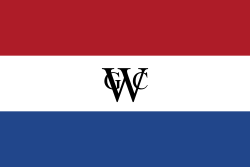
Flag of the Dutch West India Company.
After signing a peace with Portugal, the king of Ndongo fell into a deep depression. He and his heir were both poisoned by the popular Nzinga, which she admitted to in the later years of her life.[45] Nzinga then usurped power and executed anyone who did not accept her authority.[45][46] She kept the bones of Angola Ambandi in a silver chest on the Island of Imbilas ("graves" in Ambundu) for the purpose of xinguila ("spiritual mediumship"), towards which she conducted human sacrifice under the pretext of satisfying the hunger of the dead Ngola Mbandis spirit, and through a network of spies and informants she promoted the belief among her subjects that she was a major seer able to metamorphose.[45] Queen Nzingas seizure of the throne however caused a rift in Ndongo between her supporters and those of a relative of Ngola Ambandi, Hari a Kiluanje, lord of Pungo Andongo, who had sought the protection of Portugal since 1617.[35]
Meanwhile, the new Portuguese governor of Angola Fernão de Sousa took office that same year in July but spent the first six months of his tenure fortifying Luanda and defending it from attacks by the Dutch West India Company.[40] A Dutch fleet commanded by Piet Heyn attacked the city in October 30 but by November 6 it had been driven off.[47] The Dutch then sailed to Soyo hoping to find the Kongo land army ready to move against Luanda but to their shock count António Manuel of Soyo claimed to be a friend of the Portuguese, a loyal Catholic and refused to acknowledge Piet Heyns letters or support him.[47]
Relations between Luanda and Quindonga were tense as Sousa demanded that Nzinga stop inciting the Ambundu farmers in Portuguese territory to join her army, while the queen demanded that the governor relinquish Ambaca and return prisoners of war.[40] As negotiations with Nzinga stalled, Sousa prepared for war and sought new Imbangala allies, as those of Vasconcelos had mostly defected or gone rogue.[48] He recruited the band of Kinda and the band of Zanza, who was instructed to attack the hostile lord Cafuxi Cambari and obtain control of salt mines.[48] Sousa however dismissed the idea of annexing Ndongo and turned to Hari a Kiluanje, whose claim to the throne he would support in the Ndongo civil-war.[48] The governor met with Hari a Kiluanje at Ambaca and afterwards Queen Nzinga sieged Pungo Andongo, in early 1626.[40]
War between Queen Nzinga and Portugal, 1626-1641
Queen Nzinga.
Pungo Andongo was relieved by an army commanded by former governor Bento Banha Cardoso, who forced Nzingas forces to withdraw. Cardoso then marched on all of Ndongo gathering the formal submission of the lords of the region and delivered the kingdom to Hari a Kiluanje.[40][37] The Quindonga Islands were sieged in April but an epidemic broke out and after two months Queen Nzinga managed to slip through the lines with her supporters.[40] Hari a Kiluanje fell victim to the plague but on October 12, 1626, governor Fernão de Sousa personally crowned at Pungo Andongo as king of Ndongo a brother of Hari a Kiluanje, who took the name of Dom Filipe de Sousa.[40]
Queen Nzinga lived on the run with her supporters between 1626 and 1629, frequently relocating to avoid capture by Portuguese forces.[4] Kongo recognized Nzinga as queen of Ndongo in 1627 and sent her gifts.[37] Captain-major Bento Banha Cardoso died in August 1628 and he was replaced by Paio de Araújo de Azevedo, who abandoned pursuit on May 29, 1629, once he heard that Queen Nzinga had fled east through the cliff of the Quina Grande das Ganguelas with the aid of the Songo people and had sought refuge in the Imbangala kingdom of Matamba, whose king, Kaza, she married.[4] Henceforth the queen partook in the same cannibal rituals and child sacrifices typical of Imbangala society.[4]
After she succeeded on the throne of Matamba, the queen forged the largest alliance of Angolan states of the 17th century, initially formed by Matamba, Kasanje and the Ndongo still loyal to her.[4] It later included the tribes of Quissama, some in the Dembos and even the Kongo itself.[4] The Portuguese now faced attacks from Queen Nzinga to the east, Kongo to the north, the Dutch to the west and the Quissama tribes to the south, who attacked their strongholds between the Kwanza and Bengo rivers with increasing persistence after 1635.[4] In 1639 the Portuguese signed a treaty of peace and alliance with the Kingdom of Kasanje.[49]
Dutch occupation of Luanda and Benguela, 1641-1648
Benguela was occupied by a fleet of the Dutch West India Company on February 2, 1641, but its residents evacuated to Caconda further inland.[4] Two months later Luanda rejoiced with the news of the Restoration of Portuguese Independence but although Portugal was no longer part of Spain the city was nevertheless attacked by a Dutch fleet commanded by Cornelis Jol on August 23.[4] Governor Pedro César de Menezes ordered its evacuation and led most of the residents to Massangano, which they reached in December after an extremely perilous trek.[4] From Massangano, but also from Muxima and Ambaca, the Portuguese continued to resist against the Dutch and hostile African states from all sides.[4]
With Luanda in Dutch hands, Nzinga quickly signed an alliance with the Dutch West India Company. She received some firearms in return.[50] King Garcia of Kongo also concluded an alliance with the Dutch on March 28, 1642.[51] Garcia then led his army south and with the support of the Dutch routed the Portuguese in battle on September 24, 1642.[51] Meanwhile, king Nzinga camped her forces in Portuguese territory at Cavanga and they were soon in contact with Kongo.[52]
Notwithstanding official hostility, many Portuguese still travelled to Luanda to trade, while the Dutch were unable make inroads because the Portuguese blocked their advance inland and controlled the surrounding river waters.[53] Kongo and Queen Nzinga also had difficulties supplying the Dutch with sufficient slaves, while the Portuguese kept contact with allied African lords in the hinterland and with the outside world through the rivers Bengo and Kwanza, at the mouth of which their ships could anchor, which helped fund their war-effort.[53] Thus director Cornelius Nieulant signed a truce with the Portuguese on January 30, 1643.[53] This outraged king Garcia, who withdrew from the alliance to focus on internal issues, namely the rising tensions with Soyo that threatened civil-war.[52] The truce did not last four months however and the Dutch resumed hostilities once they suspected of a Portuguese plot to overthrow the Company in Luanda.[53]
View of Luanda.
In early 1644 Queen Nzinga intensified her attacks on Portuguese strongholds.[4] With the assistance of king Filipe of Ndongo and the Imbangala, the Portuguese routed Queen Nzingas troops at the Battle of Xila in March 1646.[54] Nzinga escaped once again however, but the Portuguese captured her sister, Dona Bárbara.[54] Over the next two years the Portuguese suffered great hardship isolated in the interior and in 1647 they were routed at the Battle of Kombi by a coalition of forces of Queen Nzinga and the Dutch.[54] After the battle of Kombi, Nzinga pressed on and encircled the three Portuguese strongholds of Ambaca, Massangano and Muxima.[55]
Just as Portuguese fortunes seemed at their lowest in Angola, a Portuguese fleet of 11 ships and 1100 men dispatched from Lisbon and commanded by Salvador Correia de Sá recaptured Luanda on August 21, 1648, after a brief action.[56][57] Sá's rapid recapture of Luanda was due to ‘his uncompromising and disruptive tactics, the enemy's lack of command and the markedly mercenary character of Dutch troops, indignant at poor pay’.[58] Still in 1638, Salvador Correia de Sá brought all the sobas still loyal to the Dutch back under Portuguese fold, began pacifying others who remained hostile to Portugal and signed a peace with Kasanje.[59] He did not however agree to a peace with Queen Nzinga, as she demanded the return of her sister Dona Bárbara, kept in Luanda as a valuable prisoner.[59] After the recapture of Luanda, Nzinga lifted the sieges of Ambaca, Muxima and Massangano and withdrew to Matamba.[55]
Difficult campaigns to the region of Sumbes and the Mabus Islands followed, lasting from 1648 to 1649. In January 1649, a short campaign up the Kwanza river on canoes succeeded in driving away hostile lords that had settled along its banks and preyed on river navigation.[60] Two years later, Salvador Correia de Sá dispatched captain-major Jorge da Silva with a force of 400 soldiers and thousands of African auxiliaries to Ambuíla and the Dembos, whose sobas had been attacking Portuguese traders and merchant caravans.[61] This campaign resulted in the construction of a stockade fort with a large moat on the left bank of the Dande River and the recapture of the Dembos, among other things.[61]
Garcia II of Kongo accepted peace after realizing the impossibility of marching on Luanda due to the Portuguese troops stationed on the Dande, and on 13 April 1649 he signed a treaty with Salvador Correia de Sá, in which the Portuguese returned the Dembos in exchage for a mining concession in the same region, among other things.[59] Kongo lost the Island of Luanda, and with it their supply of nzimbu shells, used as currency.[62] An embassy from Queen Nzinga followed and, on 12 October 1656, peace was sealed with Matamba.[63]
Civil-war in Kongo, the end of Ndongo and the submission of Matamba, 1656-1683
King Garcia II of Kongo.
King Garcia refused to comply with the peace treaty, charged heavy taxes on Portuguese merchants, and he harassed Portuguese merchants and Capuchin friars in Kongo, which strained relations with Luanda.[64]
Kongo was by then already embroiled in civil-war between King Garcia, the count of Soyo and the Marquis of Pemba. When a request for help from the Marquis of Pemba reached Luanda, governor Luís Martins de Sousa Chichorro declared war on Kongo on 9 June 1657.[64][65] Kongo was by then weakened due to internal strife and the Luso-African army commanded by Diogo Gomes de Morales inflicted a defeat on the marquis of Manilumbo.[64] They reached as far as the city of Bamba but at that point the troops refused to march beyond the River Loge as they believed it was the legendary "river of forgetfulness" and anyone who would cross it would never return.[64][65] Furthermore, the Marquis of Pemba was found to have already been executed.[65][64] When an envoy from King Garcia reached Luanda promising to comply with the treaty, the governor had the army withdrawn.[64][65]
That same year, the king of Kasanje, Kasanje ka Kinguri, converted and adopted the name Pascoal Machado, however, none of his subjects agreed to follow Christian rites aside from the Portuguese already residing in his kingdom.[66] The following year during the tenure of governor João Fernandes Vieira, Bartolomeu Vasconcelos da Cunha moved to subsue the notorious Quissama lord Angolomem-a-Caita in 1658, with an army of around 400 soldiers and thousands of auxiliaries led by king Filipe of Ndongo and the Imbangala warlord Cabuco.[67] In the region of Axila, within the district of Massangano, Angolomem-a-Caita ordered a retreat to heavily fortified strongholds and the campaign degenerated into a series of lengthy siege operations.[67] After six months, the besieged surrendered, severely weakened by famine.[67]
A new religious mission to Kasanje in 1660 yielded no results.[66] The missionary Giovanni Cavazzi da Montecuccolo encouraged the authorities of Kasanje to ban infanticide, cannibalism, human sacrifice and expel the traditional shamans but the imbangala elite refused to, aside from banning cannibalism in times of peace.[66] King Pascoal Machado told Cavazzi that "we conquered these provinces of Ganguela and others without this Zambi of yours called Deus and without Him we shall do the same in the future as we have done in the past."[66]
The Battle of Ambuíla
King Garcia did not follow through with his promises and he died in 1660. He was succeeded by António I, who likewise refused provide access to mines or pay tribute.[68] He also entered talks with Spain seeking an alliance and the support of a Spanish fleet to invade Portuguese Angola.[69]
In late 1664, a succession dispute broke out in the Dembos and king António evicted the regent of Bamba-Ambuíla Dona Isabel along with the lord of Ambuíla, both of whom then turned to the Portuguese.[70] They provided Luanda with letters revealing that António was preparing to block roads and instigate a revolt in Portuguese Angola.[70] Subsequently, governor André Vidal de Negreiros declared war on Kongo.[71]
Portuguese battle-standard with the Cross of the Order of Christ.
At the Battle of Ambuíla full military capacity was displayed by both sides but the Portuguese were better equipped and more experienced as they and the Imbangala had been almost continuously on campaign since 1648.[71] The larger royal army of Kongo was catastrophically routed, and king António himself fell in combat leading a frontal assault against the gun-lines of the Portuguese infantry square.[71][62] The silver crown and scepter of the king of Kongo were taken as war-trophies, as was his severed head, which was buried at Luanda with great pomp.[62]
The Battle of Ambuíla is the most famous of the set piece battles of conquest in West Central Africa.[62] It had profound repercussions, as it aggravated the civil war in Kongo, which would last for another five decades and launch the kingdom on a spiral of decline from which it would never recover.
The Battle of Quitombo
In 1670, the Count of Sonyo Dom Estevão da Silva deposed Rafael I of Kongo, who then appealed to Luanda for military aid. Rafael offered Luanda money, mineral concessions and authorization to build a fort in Soyo to keep out the Dutch.[62] In June, governor Francisco de Távora dispatched the Luso-African army composed of 400 musketeers, a detachment of horsemen, artillery, contingents of Imbangala mercenaries and Ambundo auxiliaries.[62] The Portuguese scored a victory against Soyo at the Battle of Ambriz in June.
King João Hari had succeeded on the throne of Ndongo ever since the death of king Filipe de Sousa of Ndongo in 1664.[72] After the Battle of Kitombo, king António Carrasco of Matamba persuaded João Hari to turn on the Portuguese, cut off communications between Luanda and the kingdom of Kasanje and attack their merchant caravans.[73] King João was encouraged by his brother Dom Diogo, chief-commander of his army, who incited neighbouring lords to revolt against the Portuguese and unite under his banner "with his natural and excessive ferociousness and intrepity" according to a report to Lisbon.[74][73]
Governor Francisco de Távora reacted swiftly to the debacle in Quitombo and the about-face in Ndongo, requesting reinforcements from Portuguese Brazil and dispatching a small contingent in advance to the fortress of Ambaca on the frontier. The Portuguese skirmished with the warriors of Ndongo even before the arrival of substantial reinforcements from Brazil. A great number of Imbangala mercenaries from the garrisons of Ilamba, Lumbo, Massangano, Cambambe, Muxima and elsewhere were assembled. It was the largest campaign undertaken by the Portuguese until that point.
The Portuguese army left Ambaca on 2 August under the command of Luís Lopes de Sequeira, who had previously distinguished himself at the Battle of Ambuíla. Ndongo warriors skirmished with the Portuguese army on the march in an effort to stop it from reaching the capital, Pungo Andongo.[75] Sequeira however managed to set up a fortified camp nearby and sieged it.[76] On August 27, the Portuguese repulsed a strong attack on their lines led by Dom Diogo.[77] After a three-month siege, the Portuguese commander decided to storm Pungo Andongo when news arrived that Matamba was preparing a relief army to aid besieged. On the night of 18 November 1671, the town was stormed and captured. The entire royal family of Ndongo was also captured.[78][79] King João Hari tried to flee but he was captured by a hostile lord, delivered to the Portuguese and beheaded.[74] Some of the prisoners were protected from captivity by prior agreements, which the Portuguese respected.[79] The kingdom of Ndongo was thus dissolved and its territory annexed to Portuguese Angola.
Throughout all of 1679 Luís Lopes de Sequeira distinguished himself commanding operations against the Kingdom of Libolo south of Kwanza, which was also annexed.[80]
The submission of Matamba
The region of Angola.
When Nzinga died she was succeeded in Matamba by her sister Bárbara, who supported Christianity but her husband António Carrasco defended Imbangala tradition.[81] He usurped the throne and violently persecuted several political rivals.[82] Horrified by the brutality of Carrasco, queen Bárbara herself fled from the capital but died shortly afterwards.[82] Carrasco was in turn beheaded in 1674 by a rival, Dom Francisco Guterres, who took the throne with Portuguese support.[82]
Governor João da Silva e Sousa however wished to develop trade with the Lunda Empire further east and so he favoured relations with the kingdom of Kasanje, through which Portuguese trade caravans would have to pass.[82] Resentful of this, in 1680 king Francisco allied with a rebellious lord of Kasanje, attacked the kingdom and raided Portuguese caravans.[82] King Pascoal Machado of Kasanje died shortly after repelling a Matamba incursion but as the election for his successor was disputed, civil-war erupted.[83] Matamba forcibly placed Luís Ndala Kingo a Hanga on the throne but he was overthrown by Kinguri Kia Kasanje in a counter-rebellion soon after the withdrawal of king Francisco and his troops from Kasanje.[83] The governor of Angola João da Silva e Sousa declared war on Matamba in August 1681 and dispatched a 40,000 men army which was joined by Kinguri kia Kasanje.[82][83]
At the Battle of Katole, the Portuguese were ambushed and Luís Lopes de Sequeira was killed in combat by an arrow but the Portuguese officers managed to rally the troops and secure victory through a counter-attack.[82] King Francisco Guterres also died in battle and was succeeded by his sister Verónica Guterres, who signed a pact of vassalage to Portugal two years later on 7 September 1683, in effect putting an end to the Angolan Wars.[82][83]
Aftermath
The Angolan Wars had a profound impact in the region. Kongo suffered a severe demographic loss as a result of conflict and civil-war, as did Ndongo, which was annexed by Portugal. Ndongo was the first African kingdom to be annexed by Europeans.[84] Popular memory of the depredations of the cannibal Imbangala in particular lingered long in Kongo.[85]
Portuguese territory in Angola.
The victories of captain-major Luís Lopes de Sequeira at Ambuíla in 1665, Ndongo in 1671, Libolo in 1679 and Katole in 1681, decisively broke the resistance of the African kingdoms and paved the way for the gradual expansion of Portuguese influence north of the Central Angolan Plateau.[86] Conflict in Angola did not cease entirely after the peace with Matamba in 1683 but it subsided greatly. The Portuguese Crown enforced a strict policy of trade and non-intervention and henceforth the commercial rivalry with France, the Netherlands and England over trade became Portugals main concern in the region until the Campaigns of Pacification and Occupation, over 150 years later.
12345"In 1579, Portuguese renegades along with local factions convinced the Ndongo king to massacre the Portuguese representatives living in his capital and destroy their colony. Subsequently, a 12,000-strong Ndongo army attacked the Portuguese fort at Nzele, 50 kilometers inland from Luanda, which was successfully defended by a garrison of 60 Europeans and 200 Africans." in Timothy J. Stapleton: A Military History of Africa, ABC-CLIO, p. 165.
↑Mariana Bracks Fonseca: "Rainha nzinga mbandi, imbangalas e portugueses: as guerras nos kilombos de Angola no século XVII" in Cad. Pesq. Cdhis, Uberlândia, v.23, n.2, jul./dez. 2010, pp. 392-393.
↑Allison Butler Herrick: "The success of the Portuguese venture in Angola rested on military conquest, which in turn rested upon the guerra preta, or African auxiliary, especially useful in bush warfare." in Area Handbook for Portuguese Angola, U.S. Government Printing Office, 1967, pp. 30-31.
↑"This was an epic narrative of the wars of conquest undertaken by the Portuguese against King N'Gola. Cadornega followed the model of Portuguese chronicles of Asian and Brazilian conquest." in Antonella Romano, Borbála Zsuzsanna Török, L. Kontler, Silvia Sebastiani: Negotiating Knowledge in Early Modern Empires: A Decentered View, 2014, Palgrave Macmillan.
↑Ralph Delgado, História de Angola volume I, Banco de Angola, 1973-1978, pp. 260-261.
1234"Ndongo." in Appiah, Kwame Anthony & Gates Jr, Henry Louis: Encyclopedia of Africa, Oxford University Press, 2010, pp. 223-224.
12Sweet, James H., in Mancall, Peter C: The Atlantic World and Virginia, 1550-1624,The Omohundro Institute of Early American History and Culture and University of North Carolina Press, 2007, p. 208.
12"In 1575 Paulo Dias de Novais returned to Ndongo with a royal grant from Portugal to create a colony on the coast, south of the Kwanza. He offered his services to Ndongo and fought for Ndongo in several campaigns against rebels." in John K. Thornton: "Ndongo, Kingdom of" in Encyclopedia of African History, volume 1, 2005, Routledge, p. 1079.
123Anthony Disney: "Portuguese Expansion, 1400-1800: Encounters, Negotiations and Interactions" in Diogo Ramada Curto, Francisco Bethencourt: Portuguese Oceanic Expansion, Cambridge University Press, 2007, p. 299.
1234Monteiro, Joachim John (1875). Angola and the River Congo. Macmillan. p.5.
1234567891011121314Ralph Delgado: História de Angola, volume I, Banco de Angola, 1973-1978, pp. 288-400
12345678910111213141516Alberto Oliveira Pinto: História de Angola: Da Pré-História ao Início do Séc. XXI, 2019, Mercado de Letras Editores, pp. 256-306.
12Sweet, James H., in Mancall, Peter C.: The Atlantic World and Virginia, 1550-1624,The Omohundro Institute of Early American History and Culture and University of North Carolina Press, 2007, p. 209.
12345Monteiro, Joachim John (1875). Angola and the River Congo. Macmillan. p.6.
12José Augusto Duarte Leitão: "A Missão do Padre Baltasar Barreira" in Lusitania Sacra 2a Série - Tomo 5 (1993), p. 53.
↑John K. Thornton: "Ndongo, Kingdom of" in Encyclopedia of African History, volume 1, 2005, Routledge, p. 1079.
↑John Thornton: A History of West Central Africa to 1850 Cambridge University Press, 2020, p. 114.
123456Alberto Oliveira Pinto: História de Angola: Da Pré-História ao Início do Séc. XXI, 2019, Mercado de Letras Editores, pp. 316-330.
12345Ralph Delgado: História de Angola, volume II - Continuação do Segundo Período (1607 a 1648), Edição do Banco de Angola, 1973-1978, pp. 51-55.
1234Linda M. Heywood: Njinga of Angola: Africa’s Warrior Queen, Harvard University Press, 2019, pp. 45-48.
12"...upon his death she took the title of queen and began to rule in her own name. Njinga's succession triggered a civil war that pitted her faction, descended from Dembo a Pe, primarily against the faction of Hari a Kiluanje with its base and Mpungu a Ndongo, who along with Mubanga, had supported the initial Portuguese-Imbangala invasion and swore vassalage to Portugal in its aftermath." in Thornton, John K: A History of West Central Africa, 2020, Cambridge University Press, p. 151.
↑John Thornton: "First African Americans, The" in Africana: The Encyclopedia of the African and African American Experience, 2005, Oxford University Press, pp. 647-652.
↑Thornton, John: "Kasanje" in Encyclopedia of Africa, 2010, Oxford University Press, pp. 633.
1234Alec Ichiro Ito: "O Combate ao Jaga Casanze Na Angola Portuguesa de João Correia de Sousa (1620-1623)" in XVI Encontro Estadual de História ANPUH-RS, 2022.
↑"Nzinga subsequently seized power in Ndongo ruling from 1624-1663." Hettie V. Williams: "Queen Nzinga (Njinga Mbande)" in Encyclopedia of African American History Volume 3, 2010, pp. 82-84.
12Thorton, "The Kingdom of Kongo and the Thirty Years' War", 2016, p. 203.
123Thornton, John K: A History of West Central Africa, 2020, Cambridge University Press, p. 151.
↑John Thornton: "Kasanje" in Africana: The Encyclopedia of the African and African American Experience, 2005, p. 435.
↑Miguel Geraldes Rodrigues: "The Portuguese Conquest of Angola" in The First World Empire: Portugal, War and Military Revolution, Taylor & Francis, p. 179.
12Thorton, "The Kingdom of Kongo and the Thirty Years' War", 2016, p. 209.
123"Full military capacity on both sides was displayed at the Battle of Mbwila and the armies resembled each other. Both had a core of regular musketeers supported by a large assembly of irregulars. Although Kongo forces outnumbered the Portuguese, the latter were better prepared." in Timothy J. Stapleton: Encyclopedia of African Colonial Conflict ABC-CLIO, 2016, p. 460.
12Gastão de Sousa Dias: Os Portugueses Em Angola, Agência Geral do Ultramar, 1959, p. 156.
12José Lingna Nafafé: Lourenço Da Silva Mendonça and the Black Atlantic Abolitionist Movement in the Seventeenth Century, Cambridge University Press, pp. 189-190.
1234"Luís Ndala Kingo a Hanga had but little time in office, for a counter-rebellion overthrew him and placed Kinguri kia Kasanje on the throne. Angola's governor, João da Silva e Sousa, brought a large Portuguese force, which Kinguri kia Kasanje joined to attack Francisco in 1681. In a major battle fought at Katole, the Kasanke-Portuguese allied army was victorious, but at such a high cost they had to withdraw, and Francisco was killed in battle." in John K. Thornton: A History of West Central Africa to 1850, Cambridge University Press, 2020, pp. 208-209.
↑David Birmigham: The Portuguese Conquest of Angola, Oxford University Press, 1965 p. 62.
↑David Birmingham: Central Africa to 1870, Zambezia, Zaire and the South Atlantic, Cambridge University Press, 1981, p. 59.
This page is based on this Wikipedia article Text is available under the CC BY-SA 4.0 license; additional terms may apply. Images, videos and audio are available under their respective licenses.
 Portuguese Empire
  Kongo (till 1622)
  Ndongo
  Dutch West India Company