Purusha is a complex concept whose meaning evolved in Vedic and Upanishadic times. Depending on source and historical timeline, it means the cosmic man or Self, Consciousness, and Universal principle.
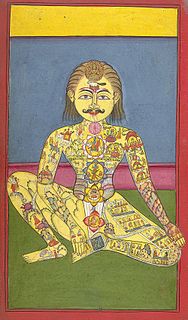
A subtle body is one of a series of psycho-spiritual constituents of living beings, according to various esoteric, occult, and mystical teachings. According to such beliefs each subtle body corresponds to a subtle plane of existence, in a hierarchy or great chain of being that culminates in the physical form.

Anahata or heart chakra is the fourth primary chakra, according to Hindu Yogic, Shakta and Buddhist Tantric traditions. In Sanskrit, anahata means "unhurt, unstruck, and unbeaten". Anahata Nad refers to the Vedic concept of unstruck sound. Anahata is associated with balance, calmness, and serenity.
Prakṛti, also Prakriti or Prakruti, means "nature". It is a key concept in Hinduism, formulated by its Samkhya school, and refers to the primal matter with three different innate qualities (Guṇas) whose equilibrium is the basis of all observed empirical reality. Prakriti, in this school, contrasts with Purusha which is pure awareness and metaphysical consciousness. The term is also found in the texts of other Indian religions such as Jainism, and Buddhism.

Vishishtadvaita is one of the most popular schools of the Vedanta school of Hindu philosophy. Vedanta literally means the end of the Vedas.VishishtAdvaita is a non-dualistic school of Vedanta philosophy. It is non-dualism of the qualified whole, in which Brahman alone exists, but is characterized by multiplicity. It can be described as qualified monism or qualified non-dualism or attributive monism. It is a school of Vedanta philosophy which believes in all diversity subsuming to an underlying unity.

Narayana, is known as Nirgun Bhram and is the creator of Tridevas-Bhrama(Divya Rajas),Vishnu(Divya Satya),and Mahesh(Divya Tamas). He is sometimes considered same as God Vishnu but is different as he is Nirguna and God Vishnu has Divya Satva Guna. He is also known as "The Purusha" and is considered Supreme in Yogic Tradition. He is also "Guru of the Universe". The Bhagavata Purana and Veda declares Narayana as a part of the Trimurti who creates unlimited universes and enters each one of them..
Paramatman or Paramātmā is the Absolute Atman, or supreme Self, in various philosophies such as the Vedanta and Yoga schools in Hindu theology, as well as other Indian religions like Sikhism. The Paramatman is the “Primordial Self” or the “Self Beyond” who is spiritually practically identical with the Absolute, identical with the Brahman. Selflessness is the attribute of Paramatman, where all personality/individuality vanishes.
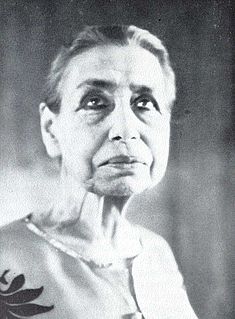
Integral yoga, also called supramental yoga, is the yoga-based philosophy and practice of Sri Aurobindo and The Mother. Integral yoga finds all life conscious or subconscious a yoga, defines the term yoga as a methodised effort towards self-perfection by the expression of the secret potentialities latent in the being and highest condition of victory in that effort - a union of the human individual with the universal and transcendent existence which is seen partially as expressions in humans and in the cosmos. As a yoga idea, that Spirit manifests itself in a process of involution. The reverse process of evolution is driven toward a complete manifestation of spirit.

Purusha sukta is hymn 10.90 of the Rigveda, dedicated to the Purusha, the "Cosmic Being".

The Mudgala Upanishad is a medieval era Sanskrit text and a minor Upanishad of Hinduism. It is classified as a Samanya Upanishad and attached to the Rigveda.
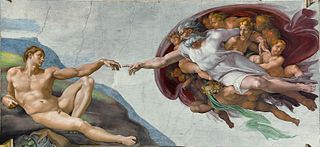
Hinduism includes a range of viewpoints about the origin of life, creationism and evolution. There is no single story of creation, due to dynamic diversity of Hinduism, and these are derived from various sources like Vedas, some from the Brahmanas, some from Puranas; some are philosophical, based on concepts, and others are narratives. The Rigveda mentions the Hiranyagarbha as the source of the creation of the Universe, similar to the world egg motif found in the creation myths of many other civilizations. It also contains a myth of proto-Indo-European origin, in which the creation arises out of the dismemberment of a cosmic being who is sacrificed by the gods. As for the creation of the primordial gods themselves, the Nasadiya Sukta of Rigveda takes a near-agnostic stand, stating that the Gods came into being after the world's creation, and nobody knows when the world first came into being. In the later Puranic texts, the creator god Brahma is described as performing the act of 'creation', or more specifically of 'propagating life within the universe'. Some texts consider him equivalent to the Hiranyagarbha or the Purusha, while others state that he arose out of these. Brahma is a part of the trinity of gods that also includes Vishnu and Shiva, who are responsible for 'preservation' and 'destruction' respectively.
Ānanda literally means bliss or happiness. In the Hindu Vedas, Upanishads and Bhagavad gita, ānanda signifies eternal bliss which accompanies the ending of the rebirth cycle. Those who renounce the fruits of their actions and submit themselves completely to the divine will, arrive at the final termination of the cyclical life process (saṃsāra) to enjoy eternal bliss (ānanda) in perfect union with the godhead. The tradition of seeking union with God through passionate commitment is referred to as bhakti, or devotion.
According to Sarira Traya, the Doctrine of the Three bodies in Hinduism, the human being is composed of three sariras or "bodies" emanating from Brahman by avidya, "ignorance" or "nescience". They are often equated with the five koshas (sheaths), which cover the atman. The Three Bodies Doctrine is an essential doctrine in Indian philosophy and religion, especially Yoga, Advaita Vedanta and Tantra.
The Sanskrit word, Chaitanya, means 'consciousness' or 'spirit' or 'intelligence' or 'sensation'. It is the pure Consciousness or the cosmic intelligence, the consciousness that knows itself and also knows others. It also means energy or enthusiasm. In the Rig Veda (R.V.IV.XL.5) Nrishad is the dweller amongst men; Nrishad is explained as Chaitanya or 'Consciousness' or Prana or 'vitality' because both dwell in men.
Jivatva means – the state of life or the state of the individual soul. Jivatva is the state of life of the Jiva, the living entity, which is a particular manifestation of Atman, the embodied being limited to psycho-physical states, and the source of avidya that suffers (repeated) transmigration as result of its actions. Until ignorance ceases the Jiva remains caught in experience of the results of actions bringing merit and demerit, and in the state of individuality (jivatva), and so long as the connection with the intellect as conditioning adjunct lasts, so long the individuality and transmigration of soul lasts.

The Avyakta Upanishad is a Sanskrit text and a minor Upanishad of Hinduism. It is one of 16 Upanishads attached to the Samaveda, and classified under the 17 Vaishnava Upanishad.

The Sita Upanishad is a medieval era Sanskrit text and a minor Upanishad of Hinduism. It is attached to the Atharva Veda, and is one of the nine Shakta Upanishads. It is categorized as a late Upanishad, in which goddess Sita is extolled as the Ultimate Reality of the Universe (Brahman), the ground of Being (Spirituality), and material cause behind all manifestation. The Upanishad identifies Sita with primordial Prakriti (nature) and her three powers, asserts the text, are manifested in daily life as will (ichha), action (kriyā) and knowledge (jnana).

The Sariraka Upanishad is one of the minor Upanishads and is listed at 62 in the modern era anthology of 108 Upanishads. Composed in Sanskrit, it is one of the 32 Upanishads that belongs to the Krishna Yajurveda, and is classified as one of the Samanya (general), and is one of several dedicated mystical physiology Upanishads.

The Paingala Upanishad is an early medieval era Sanskrit text and is one of the minor Upanishads of Hinduism. It is one of the 22 Samanya (general) Upanishads, and its manuscripts survive in modern times in two versions. The shorter version of the manuscript is found attached to the Atharvaveda, while the longer version is attached to the Shukla Yajurveda. It presents a syncretic view of Samkhya and Vedanta schools of Hindu philosophy.

The Subala Upanishad, also called Subalopanishad (सुबालोपनिषत्), is a Upanishad written in Sanskrit. It is attached to the Shukla Yajurveda, and classified as one of the Samanya Upanishads of Hinduism.