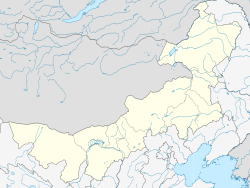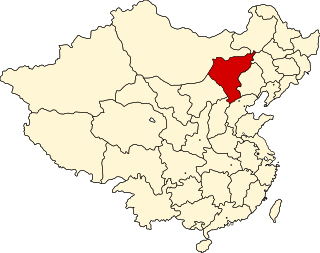
Chahar, also known as Chaha'er, Chakhar, or Qahar, was a province of the Republic of China in existence from 1912 to 1936, mostly covering territory in what is part of eastern Inner Mongolia. It was named after the Chahar Mongolians.
A banner is an administrative division of the Inner Mongolia Autonomous Region in the People's Republic of China, corresponding to the county level.
The Chahar People's Anti-Japanese Army (察哈尔民众抗日同盟军) consisted mostly of former Northwestern Army units under Feng Yuxiang, troops from Fang Zhenwu's Resisting Japan and Saving China Army, remnants of the provincial forces from Jehol, Anti-Japanese volunteers from Manchuria and local forces from Chahar and Suiyuan. Even the Japanese puppet Liu Guitang switched sides, joining the Chahar People's Anti-Japanese Army, as did the Suiyuan bandit leader Wang Ying.
The Roman Catholic Diocese of Xiwanzi/Chongli is a diocese located in the city of Xiwanzi in the Ecclesiastical province of Suiyuan in China.
Hongort is a town (镇) of the Chahar Right Back Banner, which in turn is part of Ulanqab prefecture-level city in Inner Mongolia, China. It is located about 30 km northwest of Shangdu county. In 2000, when it was still classified as township (乡), it had 11860 inhabitants.

Ergun, formerly Ergun Right Banner, is a county-level city in Inner Mongolia, containing the autonomous region's northernmost point. Administratively, Ergun is part of the prefecture-level city of Hulunbuir. It occupies 28,400 km2 (11,000 sq mi) on the right (south-eastern) bank of the Argun River, which forms China's border with Russia's Zabaykalsky Krai.
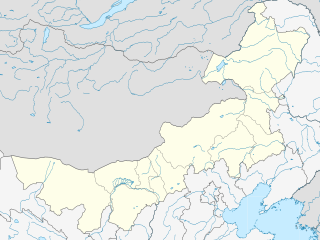
Bairin Right Banner is a banner of eastern Inner Mongolia, China. It is under the administration of Chifeng City, 143 kilometres (89 mi) to the south-southeast. Baarin Mongols live here. The distinct Mongolian dialect of this region is Baarin Mongolian.

Horqin Left Middle Banner, formerly known as Darhan hoshuu, is a banner of eastern Inner Mongolia, People's Republic of China, bordering Jilin province to the east. It is under the administration of Tongliao City, 101 kilometres (63 mi) to the southwest. The local Mongolian dialect is Khorchin Mongolian.
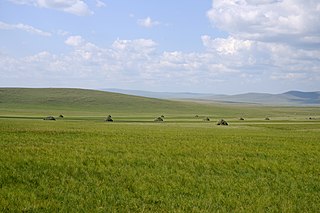
New Barag Right Banner, also romanized as Xin Barag Youqi, is a banner of northern Inner Mongolia, People's Republic of China, bordering Mongolia in all directions but the east. It is also located not too far from the shores of Hulun Lake, and is under the administration of Hulunbuir City.
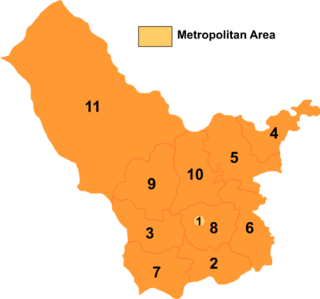
Chahar or Qahar Right Front Banner is a Banner of Inner Mongolia, People's Republic of China, surrounding Jining District and bordering Xinghe County to the east, Fengzhen City to the south, Zhuozi County to the west, and Chahar Right Back Banner to the north. Its territory includes Lake Huangqi. It is under the administration of Ulaan Chab City. Its most important settlement is Tuguiwula, where Tuguiwula Railway Station is located.

Chahar Right Rear Banner is a banner of Inner Mongolia, People's Republic of China, bordering Shangdu County to the northeast, Xinghe County to the southeast, Chahar Right Front Banner to the south, Zhuozi County to the southwest, Chahar Right Rear Banner to the west, Siziwang Banner to the northwest, and Xilin Gol to the north. It is under the administration of Ulaan Chab City, which lies to the south along the G55 Erenhot–Guangzhou Expressway. The most important settlement in the banner is Baiyinchagan.
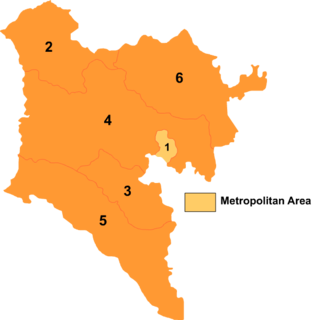
Horqin Right Front Banner is a banner in the east of Inner Mongolia, China, bordering Jilin province to the southeast. It is under the administration of Hinggan League. The local Mongolian dialect is Khorchin Mongolian.
Horqin Right Middle Banner is a banner in the east of Inner Mongolia, China, bordering Jilin province to the east. It is under the administration of Hinggan League. The local Mongolian dialect is Khorchin Mongolian.
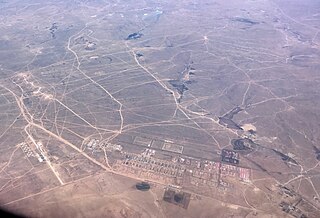
Sonid Right Banner is a banner of Inner Mongolia, China, bordering Dornogovi Province of the Republic of Mongolia to the northwest. It is under the administration of Xilin Gol League. Sunud Mongols live here.

Alxa Right Banner is a banner in the southwest of Inner Mongolia, China, bordering Gansu province to the south and southwest. It is under the administration of Alxa League.
Alxa Right Banner Badanjilin Airport is a regional airport serving the town of Badanjilin, the seat of Alxa Right Banner in Inner Mongolia, China.
Ejin–Hami railway or Eha railway, is a railway in western China between Ejin Banner in Alxa League of western Inner Mongolia and the city of Hami in the eastern part of the Xinjiang Uyghur Autonomous Region. The line runs 644 km (400 mi) through the deserts near the Mongolian border. Apart from Inner Mongolia and Xinjiang, the line also crosses the Subei Mongol Autonomous County, the sliver of Gansu Province that extends to the Mongolian border. Construction began on June 30, 2014 and was slated to take three years, but the line opened only 17 months later on December 1, 2015. The opening of this rail line shortened the distance by rail from Hohhot, Inner Mongolia's capital, to destinations in Xinjiang and Kazakhstan by over 800 km.
Heilongjiang Crane City Football Club is an amateur Chinese football club. The team is based in Qiqihar, Heilongjiang.
Xinbarag Youqi Baogede Airport is a general aviation airport serving New Barag Right Banner in Hulunbuir, Inner Mongolia, China. It is located northeast of the Baogede Wula Mountains, after which it is named. It is 13.5 kilometres (8.4 mi) from Alatan'emole Town, the seat of the banner, and 83 kilometres (52 mi) from the tri-border area of China, Mongolia, and Russia.
Sanchakou Township is a township under the administration of Qahar Right Front Banner in Inner Mongolia, China. As of 2018, it has 18 villages under its administration.