Siziwang Banner

Last updated

Coordinates: 41°31′59″N111°42′24″E / 41.53306°N 111.70667°E / 41.53306; 111.70667

Geographic coordinate system Coordinate system

A geographic coordinate system is a coordinate system that enables every location on Earth to be specified by a set of numbers, letters or symbols. The coordinates are often chosen such that one of the numbers represents a vertical position and two or three of the numbers represent a horizontal position; alternatively, a geographic position may be expressed in a combined three-dimensional Cartesian vector. A common choice of coordinates is latitude, longitude and elevation. To specify a location on a plane requires a map projection.

Contents

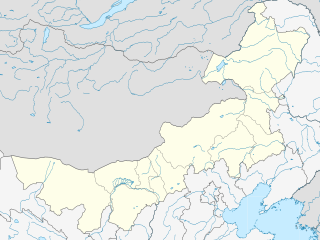
Dorbod (Siziwang) Banner (Mongolian: ᠳᠥᠷᠪᠡᠳᠬᠣᠰᠢᠭᠤDörbed qosiɣu, Дөрвөд хошуу, Dörwöd hoşú; Chinese :四子王旗; pinyin :Sìzǐwáng Qí) is a banner (county equivalent) in the Ulanqab region of Inner Mongolia, China, which is located about 80 km (50 mi) north of Hohhot, the capital of Inner Mongolia.

Mongolian language language spoken in Mongolia

The Mongolian language is the official language of Mongolia and both the most widely-spoken and best-known member of the Mongolic language family. The number of speakers across all its dialects may be 5.2 million, including the vast majority of the residents of Mongolia and many of the Mongolian residents of the Inner Mongolia Autonomous Region. In Mongolia, the Khalkha dialect, written in Cyrillic, is predominant, while in Inner Mongolia, the language is dialectally more diverse and is written in the traditional Mongolian script. In the discussion of grammar to follow, the variety of Mongolian treated is Standard Khalkha Mongolian, but much of what is to be said is also valid for vernacular (spoken) Khalkha and for other Mongolian dialects, especially Chakhar.

Chinese language family of languages

Chinese is a group of related, but in many cases not mutually intelligible, language varieties, forming the Sinitic branch of the Sino-Tibetan language family. Chinese is spoken by the Han majority and many minority ethnic groups in China. About 1.2 billion people speak some form of Chinese as their first language.

Hanyu Pinyin, often abbreviated to pinyin, is the official romanization system for Standard Chinese in mainland China and to some extent in Taiwan. It is often used to teach Standard Mandarin Chinese, which is normally written using Chinese characters. The system includes four diacritics denoting tones. Pinyin without tone marks is used to spell Chinese names and words in languages written with the Latin alphabet, and also in certain computer input methods to enter Chinese characters.

Administration

The county seat is Wulanhua Town, which has a population of about 200,000. Administratively, Siziwang is within the jurisdiction of Ulaan Chab prefecture-level city.

Wulanhua Town in Inner Mongolia, China

Ulan Hua or Wulanhua is the county seat of the Siziwang Banner in Inner Mongolia. The town is often incorrectly referred to as Siziwang, but Wulanhua is the correct name, Siziwang being the name of county it is in. It is the main transport hub for the region, and a necessary stop for independent travelling by public transport further north to the Gegentala area.

Prefecture-level city Peoples Republic of China prefecture-level subdivision

A prefectural-level municipality, prefectural-level city or prefectural city; formerly known as province-administrated city from 1949 to 1983, is an administrative division of the People's Republic of China (PRC), ranking below a province and above a county in China's administrative structure. Prefectural level cities form the second level of the administrative structure. Administrative chiefs (mayors) of prefectural level cities generally have the same rank as a division chief of a national ministry. Since the 1980s, most former prefectures have been renamed into prefectural level cities.

History

Chinese siziwang literally means "four princes", while Mongolian dorbed means "of four". The name comes from four Mongol brothers, Sengge (僧格), Suonuobu (索諾布), Emubu (鄂木布) and Yi'erzhamu (伊爾扎木), who were descendants of Hasar, a brother of Genghis Khan. They led their tribe in participating in the Manchu Qing Dynasty's conquest of Ming China in the early 17th century. In recognition of their service, the Qing court made Emubu the Duoluo Commandery Prince (多羅郡王) in 1649 and settled their tribe in the area of modern Siziwang Banner. The title was hereditary and passed through fourteen of his descendants before communist China abolished all hereditary titles in Inner Mongolia in 1949. The last prince, Sudanamuchaogeji (蘇達那木朝格吉), died as a private citizen in 1957. There is a sculpture of the four original princes in Wulanhua, erected in 2003.

Spacecraft landing site

About 60 km (37 mi) north of Wulanhua is pasture land called Amugulang in Honggor sum. This is the primary landing site for manned Shenzhou spacecraft. A specially constructed 64.69 km (40.20 mi) road runs from Wulanhua to Honggor. It was built to support the recovery of the Shenzhou spacecraft. This road shortened the journey between the two towns from two hours to just 40 minutes.

Chinese space program recovery team (with SUV and recovery trucks) will track the progress of re-entry near the landing site and arrive shortly after landing. [1]

A small recovery truck with a crane will lift the capsule and place on the rear to transport it back to the space centre.

See also

Notes

  1. ^ All of the names presented here are transcribed from Chinese language sources using Hanyu Pinyin into the Roman alphabet. However, as these names are Mongolian and/or Manchu in origin, it would be much more accurate to transcribe them directly from those languages. These transcriptions are, however, unavailable as of now.

Related Research Articles

Inner Mongolia Autonomous region

Inner Mongolia or Nei Mongol, officially the Inner Mongolia Autonomous Region or Nei Mongol Autonomous Region (NMAR), is one of the autonomous regions of the People's Republic of China, located in the north of the country. Its border includes most of the length of China's border with Mongolia. The rest of the Sino–Mongolian border coincides with part of the international border of the Xinjiang autonomous region and the entirety of the international border of Gansu province and a small section of China's border with Russia. Its capital is Hohhot; other major cities include Baotou, Chifeng, and Ordos.

Chahars subgroup of the Mongol people

The Chahars are a subgroup of Mongols that speak Chakhar Mongolian and predominantly live in southeastern Inner Mongolia, China.

Jinong was a title of the Mongols. It was derived from Chinese Jinwang although some historians have suggested it originates from Qinwang. Whatever its relation with the Chinese title, the Mongol title was rendered in Chinese as "jinong" or "jinang".

Jiaqing Emperor Qing dynasty emperor

The Jiaqing Emperor, personal name Yongyan, was the sixth emperor of the Manchu-led Qing dynasty, and the fifth Qing emperor to rule over China proper, from 1796 to 1820. He was the 15th son of the Qianlong Emperor. During his reign, he prosecuted Heshen, the corrupt favourite of his father, and attempted to restore order within the Qing Empire and curb the smuggling of opium into China.

Hong Taiji Emperor of the Qing Dynasty

Hong Taiji, sometimes written as Huang Taiji and formerly referred to as Abahai in Western literature, was an Emperor of the Qing dynasty. He was responsible for consolidating the empire that his father Nurhaci had founded and laid the groundwork for the conquest of the Ming dynasty, although he died before this was accomplished. He was also responsible for changing the name of his people from Jurchen to Manchu in 1635, as well as that of the dynasty from Later Jin to Qing in 1636. The Qing dynasty lasted until 1912.

Shenzhou 6

Shenzhou 6 was the second human spaceflight of the Chinese space program, launched on October 12, 2005 on a Long March 2F rocket from the Jiuquan Satellite Launch Center. The Shenzhou spacecraft carried a crew of Fèi Jùnlóng (费俊龙) and Niè Hǎishèng (聂海胜) for five days in low Earth orbit. It launched three days before the second anniversary of China's first human spaceflight, Shenzhou 5.

A banner is an administrative division of the Inner Mongolia Autonomous Region in the People's Republic of China, corresponding to the county level.

Shenzhou 9

Shenzhou 9 was the fourth manned spacecraft flight of China's Shenzhou program, launched at 18:37:24 CST, 16 June 2012. Shenzhou 9 was the second spacecraft and first manned spacecraft to dock with the Tiangong 1 space station, which took place on 18 June. The Shenzhou 9 spacecraft landed at 10:01:16 CST on 29 June in Inner Mongolia Autonomous Region. The mission's crew included the first Chinese female astronaut, Liu Yang. The next mission was Shenzhou 10, which launched on 11 June 2013.

Clan Nara Manchu clan

Nara is a clan name shared by a number of royal Manchu clans. The four tribes of the Hūlun confederation (扈倫四部) – Hada, Ula, Hoifa and Yehe – were all ruled by clans bearing this name.

The Qing dynasty (1644–1912) of China developed a complicated peerage system for royal and noble ranks.

Sengge Rinchen Chinese general

Sengge Rinchen or Senggelinqin was a Mongol nobleman and general who served under the Qing dynasty during the reigns of the Daoguang, Xianfeng and Tongzhi emperors. He is best known for his role at the Battle of Baliqiao during the Second Opium War and his contributions in helping the Qing Empire suppress the Taiping and Nian rebellions.

Mongolia under Qing rule

Mongolia under Qing rule was the rule of the Qing dynasty of China over the Mongolian steppe, including the Outer Mongolian 4 aimags and Inner Mongolian 6 leagues from the 17th century to the end of the dynasty. "Mongolia" here is understood in the broader historical sense. The last Mongol Khagan Ligden saw much of his power weakened in his quarrels with the Mongol tribes and was defeated by the Manchus, he died soon afterwards. His son Ejei Khan gave Hong Taiji the imperial authority, ending the rule of Northern Yuan dynasty then centered in Inner Mongolia by 1635. However, the Khalkha Mongols in Outer Mongolia continued to rule until they were overrun by the Dzungars in 1690, and they submitted to the Qing dynasty in 1691.

The Mongolian nobility arose between the 10th and 12th centuries, became prominent in the 13th century, and essentially governed Mongolia until the early 20th century.
Honggor Sumu, Siziwang Banner Ethnic sumu in Inner Mongolia, China

Honggor Sumu is a sumu in the Siziwang Banner of Ulanqab, Inner Mongolia, China. In 2000, it had 2594 inhabitants. It is about 134 kilometres (83 mi) north-northwest of Hohhot, the capital of Inner Mongolia.

Nurhaci Jurchen chieftain

Nurhaci was a Jurchen chieftain who rose to prominence in the late 16th century in Manchuria. Nurhaci was part of the Aisin Gioro clan, and reigned from 1616 to his death in September 1626.

Jodbajab Chinese politician

Jodbajab was a military officer and government official in the Inner Mongolia area under China's late Qing Dynasty and Mengjiang governments. He was an ethnic Mongol belonging to the Plain and Bordered White Banner of Xilin Gol League.

Darijaya Mongolian noble and politician

Darijaya (1904–1968) was an Inner Mongolian nobleman of Alxa League and a politician under the Republic of China and People's Republic of China governments.

Altanochir (1882–1949) Inner Mongolian prince, politician, and general under the Republic of China

Altanochir (1882–1949) was an Inner Mongolian prince, politician, and general under the Republic of China and Mengjiang governments. He served as deputy head of Yeke-juu League. An ethnic Mongol, he was a native of Right-Wing Rear Banner, Ordos.

Shenzhou 11 planned manned spaceflight of the Shenzhou program of China

Shenzhou 11 was a manned spaceflight of the Shenzhou program of China, launched on 17 October 2016 from the Jiuquan Satellite Launch Center. It was China's sixth manned space mission. Two days after launch, it docked with the Tiangong-2 space laboratory, which had been launched on September 15, 2016.

Yanfu Temple (Alxa League)

Yanfu Temple, more commonly known as Prince Temple, is a Buddhist temple located in Alxa Left Banner, Alxa League, Inner Mongolia China. Yanfu Temple is considered one of the Three Great Buddhist Temples in Alxa League, alongside Fuyin Temple and Guangzong Temple.

References

Citations

News