Gamma Hydrae

Last updated
γ Hydrae
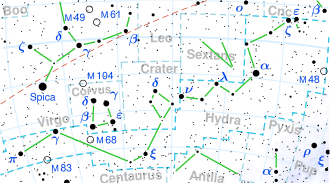
Hydra constellation map.svg
Red circle.svg
Location of γ Hydrae (circled)
Observation data
Epoch J2000.0        Equinox J2000.0
Constellation Hydra
Right ascension 13h 18m 55.29719s [1]
Declination −23° 10 17.4514 [1]
Apparent magnitude  (V)+2.993 [2]
Characteristics
Spectral type G8 III [3]
U−B color index +0.645 [2]
B−V color index +0.920 [2]
Astrometry
Radial velocity (Rv)−5.4 [4] km/s
Proper motion (μ)RA: +68.99 [1] mas/yr
Dec.: −41.85 [1] mas/yr
Parallax (π)24.37±0.15  mas [1]
Distance 133.8 ± 0.8  ly
(41.0 ± 0.3  pc)
Absolute magnitude  (MV)−0.15 [3]
Details [5]
A
Mass 2.90±0.29  M
Radius 12.47 ± 0.63 [a]   R
Luminosity 96.8+9.1
−8.3
  L
Surface gravity (log g)2.94±0.05  cgs
Temperature 5,127±30  K
Metallicity [Fe/H]+0.02±0.02  dex
Rotational velocity (v sin i)8 [6]  km/s
Age 372 [3]   Myr
B
Mass 0.61+0.12
−0.14
[7]   M
Orbit [7]
PrimaryA
CompanionB
Semi-major axis (a)67.5±0.6 or 159±7  AU
Other designations
γ Hya, 46 Hya, NSV 6180, BD−22 3554, FK5 495, HD 115659, HIP 64962, HR 5020, SAO 181543 [8]
Database references
SIMBAD data

Gamma Hydrae is a binary star in the equatorial constellation of Hydra. It has an apparent visual magnitude of 3.0, [2] placing it second in brightness among the members of this generally faint constellation. Based upon parallax measurements made during the Hipparcos mission, this star is at a distance of around 133.8 light-years (41.0 parsecs ) from Earth. [1]

Contents

Nomenclature

Gamma Hydrae (Latinized from γ Hydrae, abbreviated γ Hya) is the star's Bayer designation.

In Chinese astronomy, γ Hydrae forms with π Hydrae the asterism Ping (), representing a judge. [9] The Chinese name for γ Hydrae itself is Ping yī (平一), the first star of Ping. [10] R. H. Allen's 1899 book Star Names instead claimed the Chinese name Ping Sing, translated as "a Tranquil Star", for ι Hydrae (Ukdah). [11]

Characteristics

The stellar spectrum of the primary matches a stellar classification of G8 III, [3] with the luminosity class of III indicating it has evolved into a giant star after exhausting the supply of hydrogen at its core. It has nearly three times the mass of the Sun and 12.5 times the Sun's radius. [a] The star is radiating 97 times the Sun's luminosity from its outer atmosphere at an effective temperature of 5,127 K. [5] This heat gives it the yellow glow of a K-type star. [12] Despite having reached an advanced stage in its evolution, it is considerably younger than the Sun with an age of around 372 million years. This is because higher mass stars consume their nuclear fuel at a more rapid rate. [3]

The secondary component, named Gamma Hydrae B, shares a common proper motion with the primary star. Radial velocity observations confirmed it to be physically bound to Gamma Hydrae A. It has around 60% the mass of the Sun and is located at 1.6" from the primary. The physical separation is either 67.5 or 159 astronomical units. [7]

In culture

γ Hya appears on the flag of Brazil, symbolising the state of Acre. [13]

Notes

  1. 1 2 Calculated, using the Stefan-Boltzmann law and the star's effective temperature and luminosity, with respect to the solar nominal effective temperature of 5,772  K:

References

  1. 1 2 3 4 5 6 van Leeuwen, F. (November 2007), "Validation of the new Hipparcos reduction", Astronomy and Astrophysics, 474 (2): 653–664, arXiv: 0708.1752 , Bibcode:2007A&A...474..653V, doi:10.1051/0004-6361:20078357, S2CID   18759600
  2. 1 2 3 4 Gutierrez-Moreno, Adelina; et al. (1966), "A System of photometric standards", Publications of the Department of Astronomy University of Chile, 1, Publicaciones Universidad de Chile, Department de Astronomy: 1–17, Bibcode:1966PDAUC...1....1G
  3. 1 2 3 4 5 Takeda, Yoichi; Sato, Bun'ei; Murata, Daisuke (August 2008), "Stellar Parameters and Elemental Abundances of Late-G Giants", Publications of the Astronomical Society of Japan, 60 (4): 781–802, arXiv: 0805.2434 , Bibcode:2008PASJ...60..781T, doi:10.1093/pasj/60.4.781
  4. Wielen, R.; et al. (1999), "Sixth Catalogue of Fundamental Stars (FK6). Part I. Basic fundamental stars with direct solutions", Veroeffentlichungen des Astronomischen Rechen-Instituts Heidelberg, 35 (35), Astronomisches Rechen-Institut Heidelberg: 1, Bibcode:1999VeARI..35....1W
  5. 1 2 Rosas-Portilla, F.; Schröder, K.-P.; Jack, D. (2022-04-26), "On the physical nature of the Wilson-Bappu effect: revising the gravity and temperature dependence", Monthly Notices of the Royal Astronomical Society, 513 (1): 906–924, arXiv: 2203.16593 , doi: 10.1093/mnras/stac929 , ISSN   0035-8711
  6. Bernacca, P. L.; Perinotto, M. (1970), "A catalogue of stellar rotational velocities", Contributi Osservatorio Astronomico di Padova in Asiago, 239 (1): 1, Bibcode:1970CoAsi.239....1B
  7. 1 2 3 Ryu, Tsuguru; Sato, Bun’ei; Kuzuhara, Masayuki; Narita, Norio; Takahashi, Yasuhiro H.; Uyama, Taichi; Kudo, Tomoyuki; Kusakabe, Nobuhiko; Hashimoto, Jun; Omiya, Masashi; Harakawa, Hiroki; Abe, Lyu; Ando, Hiroyasu; Brandner, Wolfgang; Brandt, Timothy D. (July 2016), "High-Contrast Imaging of Intermediate-Mass Giants With Long-Term Radial Velocity Trends", The Astrophysical Journal, 825 (2): 127, arXiv: 1603.02017 , Bibcode:2016ApJ...825..127R, doi: 10.3847/0004-637X/825/2/127 , ISSN   0004-637X, PMC   7402361 , PMID   32753766
  8. "gam Hya". SIMBAD . Centre de données astronomiques de Strasbourg . Retrieved 2012-02-23.
  9. Ridpath, Ian. "Star Tales – Hydra" . Retrieved 22 February 2026.
  10. "AEEA 天文教育資訊網" [Activities of Exhibition and Education in Astronomy] (in Chinese). Archived from the original on 21 May 2011.
  11. Allen, R. H. (1899), Star Names: Their Lore and Meaning, p. 249
  12. "The Colour of Stars", Australia Telescope, Outreach and Education, Commonwealth Scientific and Industrial Research Organisation, December 21, 2004, archived from the original on 2012-03-18, retrieved 2012-01-16
  13. Astronomy of the Brazilian Flag, FOTW Flags Of The World website