Goniocheton arborescens

Last updated

Mossman mahogany
Dysoxylum-arborescens-SF22088-06.jpg
Fruiting tree in Cairns, QLD,
March 2022
Scientific classification OOjs UI icon edit-ltr.svg
Kingdom: Plantae
Clade: Tracheophytes
Clade: Angiosperms
Clade: Eudicots
Clade: Rosids
Order: Sapindales
Family: Meliaceae
Genus: Goniocheton
Species:
G. arborescens
Binomial name
Goniocheton arborescens
Synonyms [3]
List
  • Aglaia halmaheirae(Blume) Miq.
  • Aglaia macrophylla Teijsm. & Binn.
  • Alliaria arborescens Kuntze
  • Alliaria halmaheiraeKuntze
  • Alliaria kunthianaKuntze
  • Alliaria maingayiKuntze
  • Alliaria nernstiiKuntze
  • Dysoxylum arborescensMiq.
  • Dysoxylum arborescens f. ceramicumMiq.
  • Dysoxylum arborescens var. timorense (Miq.) C.DC.
  • Dysoxylum arborescens f. timorenseMiq.
  • Dysoxylum forsythianum Warb.
  • Dysoxylum gjellerupiiC.DC.
  • Dysoxylum halmaheirae(Miq.) C.DC.
  • Dysoxylum halmaheirae var. subobovatumC.DC.
  • Dysoxylum insulare Pierre
  • Dysoxylum kunthianum(A.Juss.) Miq.
  • Dysoxylum maingayi Hiern
  • Dysoxylum nernstii F.Muell.
  • Dysoxylum novohebridanumC.DC.
  • Dysoxylum rubrum Merr.
  • Dysoxylum sibuyanense Elmer
  • Epicharis kunthianaA.Juss.
  • Goniocheton insularisPierre
  • Hartighsea acuminataMiq.
  • Hartighsea sumatranaMiq.
  • Trichilia arborescens(Blume) Spreng.

Goniocheton arborescens, commonly known in Australia as Mossman mahogany, is a small tree in the mahogany family Meliaceae. It is native to rainforests of Malesia, Papuasia, Queensland and nearby islands.

Contents

Description

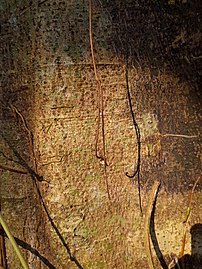
The Mossman mahogany usually grows to around 20 m (70 ft) high, occasionally to 30 m (100 ft), [4] [5] [6] [7] but it may flower and fruit when only 1 m (3 ft 3 in) high. [7] [8] The trunk can reach a diameter of up to 45 centimetres (18 in), and may be fluted or possess buttresses up to 1 m (3 ft) tall. [4] [5] [6] [7] It has bark that is grey-brown, smooth or with mild cracking, [4] [6] [7] and which bears large conspicuous lenticels. [5] The leafy twigs are also grey-brown and lenticellate. [4] [5] [6] [7]

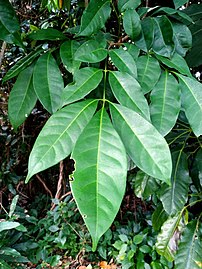
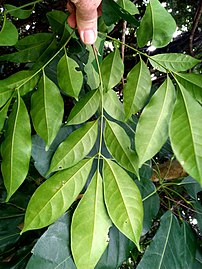
The compound leaves are arranged in whorls or spirals and are pinnate with 5 to 9 leaflets, usually with a terminal leaflet. [4] [5] [6] [7] The petioles are glabrous, about 7 cm (3 in) long, and swollen at the junction with the twig. The leaves have 5 to 9 glabrous leaflets which are dark green above and lighter below, and measure up to 18 by 7 cm (7 by 3 in). [4] [5] [6] [7] The proximal leaflets (i.e. the ones closest to the twig) are the smallest, with successive leaflets getting larger, and the terminal leaflet is the largest. [7]

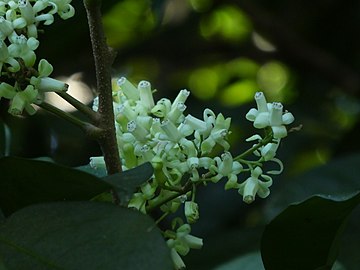
The inflorescence is an axillary thyrse measuring up to 8 cm (3.1 in) long which is covered in minute tawny hairs. The sweetly scented flowers measure around 10 mm (0.39 in), and are creamy-green to white with usually 5 petals up to 10 by 2.2 mm (0.4 by 0.1 in). [4] [5] [6] [7] A staminal tube rises from the base of the petals, and has 10 anthers about 1 mm (0.039 in) long inserted close to the distal end. [4] [6] [7]

The fruits are slightly flattened globular capsules up to 3 cm (1 in) in diameter. They are glabrous, bright pink-red in colour and usually contains 5 seeds. [4] [6] [7]

Taxonomy

This species was originally described as Goniocheton arborescens in 1825 by the German-Dutch botanist Carl Ludwig Blume, but was transferred to the genus Dysoxylum in 1868 by the Dutch botanist Friedrich Anton Wilhelm Miquel. It was published in his paper Monographia Meliacearum Archipelagi Indici, in Annales Musei Botanici Lugduno-Batavi Vol 4 p.24 [5] [6] In 2021 a wide ranging review of Dysoxylum found that the genus was polyphyletic (i.e. the most recent ancestor of the members was not the same for all members. As a result this species was placed back in its original genus Goniocheton. [9]

Etymology

The species epithet is from the Latin word arborescens , meaning "tree-like", which may be a reference to its relatively small stature. [10]

Ecology

This tree is the host for larvae of the orange emperor butterfly. [11]

Cultivation and uses

The Australian botanist David L. Jones wrote in his 1986 book Rainforest Plants of Australia that this species "has good potential as a garden plant and is of manageable dimensions". [12]

Distribution and habitat

Goniocheton arborescens is native to the Andaman and Nicobar Islands, Taiwan, Malaysia, Borneo, Indonesia, New Guinea the Bismark Archipelago, Queensland, the Solomon Islands and Vanuatu. It is a common species, growing in a variety of rainforest habitats from sea-level to 1,500 metres (4,900 ft) elevation. [5] [6] [7]

Conservation

This species is listed by Queensland's Department of Environment, Science and Innovation as least concern. [1] As of 17 February 2024, it has not been assessed by the IUCN.

Related Research Articles

<span class="mw-page-title-main">Meliaceae</span> Family of plants commonly known as the Mahogany family

Meliaceae, the mahogany family, is a flowering plant family of mostly trees and shrubs in the order Sapindales.

<i>Dysoxylum</i> Genus of plants in the family Meliaceae

Dysoxylum is a genus of rainforest trees and shrubs in the flowering plant family Meliaceae. About 34 species are recognised in the genus, distributed from India and southern China, through southeast Asia to New Guinea, Solomon Islands, and Australia. The name Dysoxylum derives from the Greek word ‘Dys’ meaning "bad" referring to "ill-smelling" and ‘Xylon’ meaning "wood".
<span class="mw-page-title-main">Kohekohe</span> Species of tree

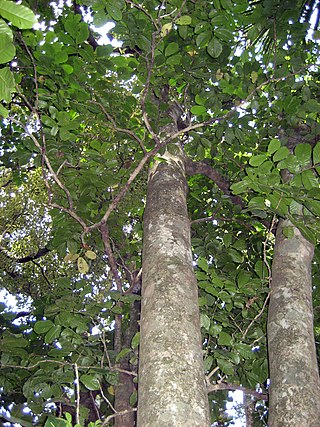
Kohekohe is a medium-sized tree in the Meliaceae family, native to New Zealand. It is found in lowland and coastal forests throughout most of the North Island and also occurs in the Marlborough Sounds in the north of the South Island. Mature trees grow up to 15 metres (49 ft) in height, with a trunk up to a metre in diameter.

<i>Didymocheton fraserianus</i> Species of tree

Didymocheton fraserianus, commonly known as rosewood or rose mahogany, is a medium-sized to large tree native to New South Wales and Queensland. It is widely used with the purpose of street design and to provide shade in the eastern suburbs of Sydney. Rosewood ranges from the rainforest around eastern Australia from Bundaberg in Queensland to Wyong in New South Wales. At maturity, it can reach a height of 57 metres (200 ft). It is generally known for its strong scent of rose from its bark.

Goniocheton is a genus of flowering plants in the family Meliaceae. It includes four species which range from Indochina to south-central China, Taiwan, Malesia, Papuasia, Vanuatu, and Queensland.

<i>Didymocheton muelleri</i> Subspecies of tree

Didymocheton muelleri, the red bean or Miva mahogany, is a rainforest tree in the family Meliaceae. It occurs in tropical, sub-tropical and littoral rainforests in eastern Australia, from the Bellinger River in New South Wales in the south, to the wet tropics of north-eastern Queensland. A signposted red bean tree may be seen near the car park of Victoria Park Nature Reserve in north-eastern New South Wales.

<i>Alchornea ilicifolia</i> Species of plant in the family Euphorbiaceae

Alchornea ilicifolia, commonly known as the native holly, is a bush of eastern Australia. It grows in or on the edges of the drier rainforests in coastal parts of New South Wales and Queensland.
<i>Didymocheton rufus</i> Species of tree

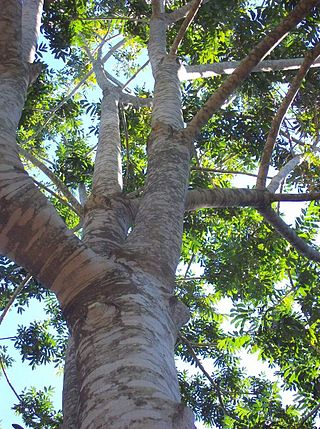
Didymocheton rufus is a rainforest tree in the family Meliaceae, found in eastern Australia. It occurs on a variety of different soils and rainforest types. From as far south as Bulahdelah, New South Wales to the McIlwraith Range in far north eastern Australia. The specific epithet rufus refers to the rusty red of the leaf, fruit and flower hairs of this species.

<i>Didymocheton pettigrewianus</i> Species of tree in the family Meliaceae

Didymocheton pettigrewianus, commonly known as spur mahogany, spurwood, or Cairns satinwood, is a large tree in the family Meliaceae. It is native to the rainforests of Malesia, Papuasia and Queensland. In Queensland it occurs only in a small part of the northeast coast.

<i>Toona sureni</i> Species of tree

Toona sureni is a species of tree in the mahogany family. It is native to South Asia, Indochina, Malesia, China, and Papua New Guinea. It is commonly known as the suren toon, surian, limpaga, iron redwood or the red cedar. It is also known as the Indonesian mahogany or the Vietnamese mahogany. The species is a valuable timber tree.

Prasoxylon alliaceum is a tree in the family Meliaceae. The specific epithet alliaceum is from the Latin meaning "onion-like", referring to the smell of the inner bark.
<i>Dysoxylum macrocarpum</i> Species of tree

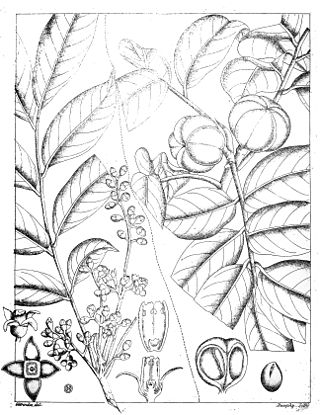
Dysoxylum macrocarpum is a tree in the family Meliaceae. The specific epithet macrocarpum is from the Greek meaning "large fruit".

Dysoxylum oppositifolium is a tree in the family Meliaceae. The specific epithet oppositifolium is from the Latin meaning "opposite leaf", referring to the leaves being on opposite sides of the twig.

Dysoxylum rugulosum is a tree in the family Meliaceae. The specific epithet rugulosum is from the Latin meaning "small wrinkles", referring to the surface of the leaflets.

<i>Epicharis parasitica</i> Species of plant in the family Meliaceae

Epicharis parasitica, commonly known as yellow mahogany, is a species of rainforest tree in the family Meliaceae native to Taiwan, parts of Malesia, Papuasia, and northeast Queensland.

Epicharis densiflora is a tree in the family Meliaceae. The specific epithet densiflora is from the Latin meaning "dense flowers".

Dysoxylum cyrtobotryum is a tree in the family Meliaceae. The specific epithet cyrtobotryum is from the Greek meaning "curved fruits".

Prasoxylon excelsum is a tree in the family Meliaceae. The specific epithet excelsum is from the Latin meaning "tall".

<i>Didymocheton gaudichaudianus</i> Species of tree in the family Meliaceae

Didymocheton gaudichaudianus, commonly known as ivory mahogany, is a species of rainforest tree in the family Meliaceae, native to Malesia, Papuasia, Queensland, and some southwest Pacific islands.

Dysoxylum acutangulum is a species of flowering plant in the mahogany family, Meliaceae. It is a tree native to Peninsular Thailand, Malesia, New Guinea and the Solomon Islands, and the Northern Territory and Queensland in Australia.

References

  1. 1 2 "Species profile—Dysoxylum arborescens". Queensland Department of Environment and Science. Queensland Government. 2022. Retrieved 5 December 2022.
  2. ↑ "Goniocheton arborescens". Australian Plant Name Index (APNI). Centre for Australian National Biodiversity Research, Australian Government . Retrieved 17 February 2024.
  3. 1 2 "Goniocheton arborescens Blume". Plants of the World Online . Royal Botanic Gardens, Kew. 2024. Retrieved 17 February 2024.
  4. 1 2 3 4 5 6 7 8 9 "Dysoxylum arborescens Miq". World Flora Online . World Flora Online Consortium. Retrieved 5 December 2022.
  5. 1 2 3 4 5 6 7 8 9 F.A.Zich; B.P.M.Hyland; T.Whiffen; R.A.Kerrigan (2020). "Dysoxylum arborescens". Australian Tropical Rainforest Plants Edition 8 (RFK8). Centre for Australian National Biodiversity Research (CANBR), Australian Government . Retrieved 6 December 2022.
  6. 1 2 3 4 5 6 7 8 9 10 11 Mabberley, D.J. (2021). Kodela, P.G.; Busby, John R. (eds.). "Dysoxylum arborescens". Flora of Australia . Australian Biological Resources Study, Department of Agriculture, Water and the Environment: Canberra. Retrieved 6 December 2022.
  7. 1 2 3 4 5 6 7 8 9 10 11 12 Mabberley, David J.; Sing, Anne M. (March 2007). "Dysoxylum arborescens (Blume) Miq.". In Soepadmo, E.; Saw, L. G.; Chung, R. C. K.; Kiew, Ruth (eds.). Tree Flora of Sabah and Sarawak. (free online from the publisher, lesser resolution scan PDF versions). Vol. 6. Forest Research Institute Malaysia. pp. 152–154. ISBN   978-983-2181-89-7. Archived from the original (PDF) on 27 September 2013. Retrieved 6 November 2022.
  8. ↑ "Dysoxylum arborescens". Flora Malesiana. Retrieved 8 December 2022.
  9. ↑ Holzmeyer, Laura; Hauenschild, Frank; Mabberley, David J.; Muellner-Riehl, Alexandra N. (2021). "Confirmed polyphyly, generic recircumscription and typification of Dysoxylum (Meliaceae), with revised disposition of currently accepted species". Taxon. 70 (6): 1248–1272. doi: 10.1002/tax.12591 .
  10. ↑ Cooper, Wendy; Cooper, William T. (June 2004). Fruits of the Australian Tropical Rainforest. Clifton Hill, Victoria, Australia: Nokomis Editions. p. 287. ISBN   9780958174213.
  11. ↑ Robinson, Gaden S.; Ackery, Phillip R.; Kitching, Ian; Beccaloni, George W.; Hernández, Luis M. (2023). "HOSTS - The Hostplants and Caterpillars Database at the Natural History Museum". Natural History Museum. The Trustees of The Natural History Museum, London. doi:10.5519/havt50xw . Retrieved 7 December 2022.
  12. ↑ Jones, David L. (1986). Rainforest Plants of Australia. Bowgowlah, NSW, Australia: Reed Books. p. 171. ISBN   0-7301-0381-1.