
The Third Battle of Panipat took place on 14 January 1761 between the Maratha Confederacy and the invading army of the Durrani Empire. The battle took place in and around the city of Panipat, approximately 97 kilometres (60 mi) north of Delhi. The Afghans were supported by three key allies in India: Najib ad-Dawlah who persuaded the support of the Rohilla chiefs, elements of the declining Mughal Empire, and most prized the Oudh State under Shuja-ud-Daula. The Maratha army was led by Sadashivrao Bhau, who was third-highest authority of the Maratha Confederacy after the Chhatrapati and the Peshwa. The bulk of the Maratha army was stationed in the Deccan Plateau with the Peshwa.

Balaji Baji Rao, often referred to as Nana Saheb I, was the 8th Peshwa of the Maratha Confederacy. He was appointed as Peshwa in 1740 upon the death of his father, the Peshwa Bajirao I.

Mirza Aziz-ud-Din Muhammad, better known by his regnal name Alamgir II, was the fifteenth Mughal emperor from 1754 to 1759. He was the son of Jahandar Shah.

Bhupinder Singh Hooda is an Indian National Congress politician, who has served as the Chief Minister of Haryana from 2005 to 2014. He was the Leader of the Opposition in Haryana Legislative Assembly from 2019 to 2024.

Maharaja Suraj Mal, simply known as Suraj Mal, was a Jat ruler of Bharatpur State in the present-day state of Rajasthan. Under him, Bharatpur State, a tributary of the House of Scindia, covered the present-day districts of Agra, Alwar, Aligarh, Bharatpur, Dholpur, Etawa, Hathras, Mainpuri, Meerut, Ghaziabad, Mathura, and Rohtak, Sonipat, Jhajjar, Nuh, Palwal, Faridabad, Kasganj, Mainpuri, Firozabad, Bulandshahr.

Ranbir Singh Hooda was an Indian freedom fighter, parliamentarian and administrator from Haryana. He is known for taking up the cause of poor and backward people and peasants. He actively participated in the freedom struggle, and was jailed several times. He served as the Member of Parliament in Lok Sabha as well as Rajya Sabha. He holds a national record of having remained a member of seven different Houses and it is recorded in Limca book of Records.
Dabas is an exogamous, patrilineal Jat gotra (clan) of India. Among their locales are the Haryana state and Delhi.
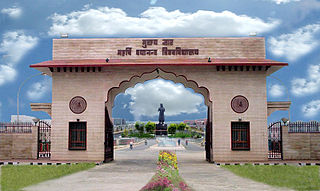
Rohtak is a city and the administrative headquarters of the Rohtak district in the Indian state of Haryana. It lies 70 kilometres (43 mi) north-west of New Delhi and 250 kilometres (160 mi) south of the state capital Chandigarh on NH 9. Rohtak forms a part of the National Capital Region (NCR) which helps the city in obtaining cheap loans for infrastructure development from the NCR Planning Board.

Sonipat is a planned industrial city & administrative headquarter in Sonipat district of Haryana state of India. It comes under the National Capital Region and is around 44 kilometres (27 mi) from New Delhi. It lies 214 km southwest of Chandigarh, the state capital. The Yamuna River runs along its eastern boundary. Sonipat was historically known as Sonprastha.

Malhar Rao Holkar was a noble subedar of the Maratha Empire, in present-day India. He was one of the early officers along with Ranoji Scindia to help spread the Maratha rule to northern states and was given the estate of Indore to rule by the [chhatrapati's Pradhan, during the reign of the Maratha emperor Shahu I. He was founder of the Holkar dynasty that ruled Malwa.
A Khap is a community organisation representing a clan or a group of North Indian castes and clans. They are found mostly in northern India, particularly among the village people of Haryana and Western Uttar Pradesh, especially Jats. But also amongst states like Rajasthan and Madhya Pradesh although historically the term has also been used among other communities. A Khap Panchayat is an assembly of Khap elders, and a Sarv Khap is an assembly of many Khap Panchayats and usually of different castes.
Rania is a town and a municipal committee in Sirsa district located on the upper bank of Ghaggar River in the Indian state of Haryana. Rania Town is a grain market in Sirsa district. Nearby cities to Rania includes Sirsa and Ellenabad. It shares its RTO office with Ellenabad which is also has its headquarters in Ellenabad. Earlier it was a part of Ellenabad subdivision but later carved out separately as a subdivision in Sirsa district of Haryana. It is at a distance of 22 km each from Sirsa and Ellenabad in opposite direction on Haryana State Highway 32A i.e. Bhambhoor-Jiwan Nagar Road which connects to Haryana State Highway 32 in Jiwan Nagar on one end and Haryana State Highway 23 in Bhambhoor on the other end.

Sadashivrao Bhau Bhatt was son of Chimaji Appa and Rakhmabai and the nephew of Baji Rao I. He was a finance minister during the reign of Maratha king Rajaram II. He led the Maratha army at the Third Battle of Panipat.
Gochhi is a large village in the Jhajjar district and erstwhile Rohtak district of Haryana, India.

Feroze Jung III or Nizam Shahabuddin Muhammad Feroz Khan Siddiqi Bayafandi also known by his sobriquet Imad-ul-Mulk, was the grand vizier of the Mughal Empire.
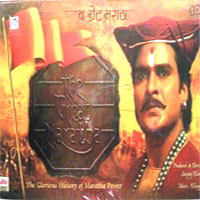
The Great Maratha is an Indian historical drama television series directed by Sanjay Khan and produced by Numero Uno International Limited. The drama aired on DD National. The series is based on the life of Mahadaji Shinde. The show comprised 47 episodes. The music was composed by Mohammed Zahur Khayyam.

The Jat reservation agitation was a series of violent protests in February 2016 by the Jats of North India, especially those in the state of Haryana, which "paralysed" the state for 10 days. The protestors sought inclusion of their caste in the Other Backward Class (OBC) category, which would make them eligible for affirmative action benefits. Besides Haryana, the protests also spread to the neighbouring states, such as Uttar Pradesh, Rajasthan, and the National Capital Region.
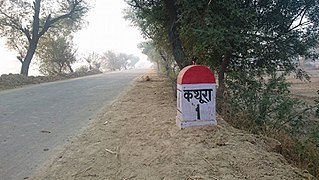
Kathura is a large village in Sonipat district in Haryana state, India. It is located 13.2 kilometres (8.2 mi) south east of Gohana on state highway 16-A connecting Gohana and Meham and 50.2 kilometres (31.2 mi) from Sonepat. The Headquarter of Kathura Barah and Akhil Bhartiya Narwal Khap is here.
Mehar Singh Dahiya (1916-1945) commonly known as Fauji Mehar Singh and Jat Mehar Singh, was a Haryanavi poet. He was born in the Dahiya clan of Jats in the village Barona in the Kharkhoda tahsil, in the district of Sonipat. In addition to Haryana, his ragnis are still popular in Delhi, Western Uttar Pradesh and Rajasthan. According to the records of the Jat Regiment, he was born on 15 February 1916. His father, Nand Ram, was a farmer. Due to the economic conditions of the house, his education ended after Class-III. From Childhood, he was fond of singing ragnis. His father was irritated by his son's propensity of singing ragnis, but he was unable to dissuade him from this pastime. He was married to Prem Kaur. In 1937, Mehar Singh joined the army where he kept singing and recording ragnis. During the Second World War, he and his army colleagues allied with the Azad Hind Fauj. In 1945, he died while fighting for the cause of India's freedom.
Israna is a village panchayat and tehsil in Panipat district in Haryana, India. It lies in the panipat Division. It is located 18 kilometres (11 mi) towards south from district headquarters Panipat and 188 kilometres (117 mi) from state capital Chandigarh towards north.


