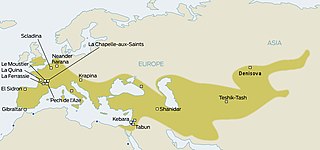
The Mousterian is an archaeological industry of stone tools, associated primarily with the Neanderthals in Europe, and to the earliest anatomically modern humans in North Africa and West Asia. The Mousterian largely defines the latter part of the Middle Paleolithic, the middle of the West Eurasian Old Stone Age. It lasted roughly from 160,000 to 40,000 BP. If its predecessor, known as Levallois or Levallois-Mousterian, is included, the range is extended to as early as c. 300,000–200,000 BP. The main following period is the Aurignacian of Homo sapiens.

The Upper Paleolithic is the third and last subdivision of the Paleolithic or Old Stone Age. Very broadly, it dates to between 50,000 and 12,000 years ago, according to some theories coinciding with the appearance of behavioral modernity in early modern humans, until the advent of the Neolithic Revolution and agriculture.

Kebara Cave is a limestone cave locality in Wadi Kebara, situated at 60 to 65 m above sea level on the western escarpment of the Carmel Range, in the Ramat HaNadiv preserve of Zichron Yaakov.

Santimamiñe cave, Kortezubi, Biscay, Basque Country, Spain, is one of the most important archaeological sites of the Basque Country, including a nearly complete sequence from the Middle Paleolithic to the Iron Age.

Prehistoric Thailand may be traced back as far as 1,000,000 years ago from the fossils and stone tools found in northern and western Thailand. At an archaeological site in Lampang, northern Thailand Homo erectus fossils, Lampang Man, dating back 1,000,000 – 500,000 years, have been discovered. Stone tools have been widely found in Kanchanaburi, Ubon Ratchathani, Nakhon Si Thammarat, and Lopburi. Prehistoric cave paintings have also been found in these regions, dating back 10,000 years.

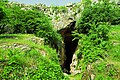
Azykh Cave, also referred to as Azokh Cave, is a six-cave complex in Azerbaijan, known as a habitation site of prehistoric humans. It is situated near the village of Azykh in the Khojavend District.
The Caucasus region, on the gateway between Southwest Asia, Europe and Central Asia, plays a pivotal role in the peopling of Eurasia, possibly as early as during the Homo erectus expansion to Eurasia, in the Upper Paleolithic peopling of Europe, and again in the re-peopling Mesolithic Europe following the Last Glacial Maximum, and in the expansion associated with the Neolithic Revolution.

Azykh or Azokh is a village in the Khojavend District of Azerbaijan, in the disputed region of Nagorno-Karabakh. The village is situated on the river of Ishkhanchay or Ishkhanaget, near the Azykh Cave. The village had an ethnic Armenian-majority population prior to the 2020 Nagorno-Karabakh war, and also had an Armenian majority in 1989. The village was part of the Hadrut Province of the breakaway Republic of Artsakh between 1992 and 2020.
Archeological sites in Azerbaijan first gained public interest in the mid-19th century and were reported by European travellers.

Bisitun Cave is an archaeological site of prehistoric human habitation in the Zagros Mountains in the Kermanshah province, north-west Iran. Bisitun Cave is one of five caves situated at the base of The Rock of Bisitun, a 1,300 m (4,300 ft) high cliff within the Chamchamal Plain. It was first excavated in 1949 by Carlton Coon, and is notable for the discovery of Mousterian stone tools of the Middle Paleolithic, as well as the remains of 109 identifiable species of Pleistocene mammals, and hominid remains. Harold Dibble described the stone tools as having strong Levallois components. All artefacts are apparently from the same period.

The Leyla-Tepe culture of the South Caucasus belongs to the Chalcolithic era. It got its name from the site in the Agdam District of modern-day Azerbaijan. Its settlements were distributed on the southern slopes of Central Caucasus, from 4350 until 4000 B.C.

Damjili – is a half-circular shaped cave site in Azerbaijan, where evidence of prehistoric human presence during the Paleolithic and Mesolithic was discovered.

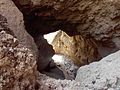
The Taghlar cave is an archaeological site that was inhabited by prehistoric humans of the Mousterian culture during the Paleolithic. The cave is located in Azerbaijan, in the disputed region of Nagorno-Karabakh, in the southern part of Boyuk Taghlar village, on the left banks of the Guruchay River.
Mammadali Murad Oglu Huseynov was an Azerbaijani and Soviet archaeologist. In 1960, Huseynov carried out excavations in the valleys of the Quruchay and Kondalanchay Rivers, in Nagorno-Karabakh Autonomous Oblast of the Azerbaijan SSR. There, he discovered a fragment of the lower jaw of Homo erectus or Azykhantrop in multi-layer sites of the Paleolithic epoch in Azykh and Tağlar Cave.

Buzeyir cave – is an archaeological site and Paleolithic place of human habitation. The cave is located on the left bank of the Zuvandchay River, at the top of Delikli-Dash Mountain, 3 km (1.9 mi) at an altitude of 1,640 m (5,380 ft) above sea level and to the east of Büzeyir village in Lerik Rayon, Azerbaijan.
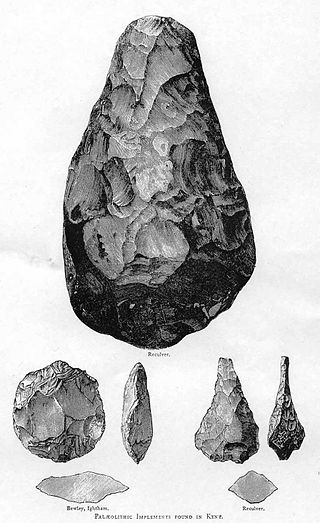
The following outline is provided as an overview of and topical guide to prehistoric technology.

Trou de l’Abîme also known as La caverne de l'Abîme and Couvin Cave is a karst cave located in Wallonia on the right bank of the Eau Noire river in the center of Couvin, Belgium, in Namur province. During various archaeological excavations of sediment deposits, Mousterian artefacts and a Neanderthal molar were discovered.

Pešturina is a cave in the municipality of Niška Banja in southeast Serbia. It is located southwest of Jelašnica and 20 km (12 mi) southeast of Niš. Artifacts from the Middle and Upper Paleolithic periods were discovered since the archaeological excavations began in 2006. The remains, identified as the Mousterian culture, were dated from 111,000 BP+ 5,000 to 39,000 BP + 3,000, which makes Pešturina one of the latest surviving Neanderthal habitats. The cave has been nicknamed the "Serbian Atapuerca".
The Cave of the Angel refers to several cave-related structures located in the Aras mountain range near the town of Lucena, Córdoba province in Spain. The site contains lithic material of an Acheulean typology and dates to that from the Middle Pleistocene to the Upper Pleistocene. There is geological, paleontological, and archaeological evidence indicating an intense and long-term occupation of this site. The numerous bone and lithic remains found in this site, as well as the matrix surrounding them, reveal exposure to fire. This, along with the finding of a wide and deep combustion structure in the stratigraphic profile, support the hypothesis that at the time of the occupation of the site by humans there was processing and consumption of big mammals.
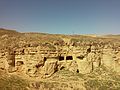
Stone Age in Azerbaijan is divided into the Paleolithic, Mesolithic, and Neolithic periods. It was studied in Karabakh, Gazakh, Lerik, Gobustan, and Nakhchivan. Stone materials belonging to the Stone Age were found by Mammadali Huseynov in the Shorsu gorge located near the village of Gyrag Kasaman in Qazakh region. According to his research, people have first settled in the territory of Azerbaijan 2 million years ago. The Stone Age era involved two different human species: Homo neanderthalensis and Homo sapiens.