A mongrel, mutt, or mixed-breed dog is any dog which does not belong to one officially recognized breed. While such terms may refer to all dogs of mixed breeds, the terms "dog crossbreed" and "designer dog" specifically refer to mixed-breed dogs which are intentionally bred.
Mixed-breed dogs may have ancestries that include any combination of purebred dogs and other mongrels.
Excluding designer dogs, mixed-breed dogs are generally considered less financially valuable than purebred dogs. Mixed-breed dogs are thought to be less susceptible to the genetic health problems associated with inbreeding (following the concept of heterosis or "hybrid vigor").
Estimates place the prevalence of mixed-breed dogs at 150 million animals worldwide.[1]
Terminology
Mixed-breed and crossbreed
In the United States, the term mixed-breed is a favored synonym over mongrel among people who wish to avoid negative connotations associated with the latter term.[2] The implication that such dogs must be a mix of defined breeds may stem from an inverted understanding of the origins of dog breeds. Purebred dogs have been, for the most part, artificially created from random-bred populations by human selective breeding with the purpose of enhancing desired physical, behavioral, or temperamental characteristics. Dogs that are not purebred are not necessarily a mix of such defined breeds.[3] Therefore, among some experts and fans of such dogs, mongrel is still the preferred term.[4][5][6]
Dog crossbreeds, crossbreed dogs, or designer dogs, are mixed-breed dogs[7] which are often the product of artificial selection and intentionally created by humans.
Naming conventions
A Corgi-Siberian Husky mix, sometimes referred to as a "corgsky", "siborgi", or "horgi", portmanteaus of the two breeds' names
Mixed-breed dogs may either be referred to by a combination of their breeds (if known); e.g. "Corgi-Siberian Husky"; or via a portmanteau, e.g. "corgsky", "siborgi", or "horgi ", in the case of a Corgi-Siberian Husky.[8][9] Portmanteaus are particularly popular with designer dogs,[10] for example; the schnoodle (Schnauzer and Poodle cross), shepsky (German Shepherd Dog/Siberian Husky cross), the puggle (Pug and Beagle cross), and the German chusky (German Shepherd Dog, Siberian Husky and Chow Chow cross).[11] The resultant portmanteau names are generally not capitalized as they are not officially recognized dog breeds, though this practice varies.[12]
Regional and slang terms
The words cur,[13]tyke,[14]mutt, and mongrel[15] are used, sometimes in a derogatory manner. There are also regional terms for mixed-breed dogs. In the United Kingdom, mongrel is the unique technical word for a mixed-breed dog. North Americans generally prefer the term mix or mixed-breed. Mutt[16] is also commonly used in the United States and Canada. Some American registries and dog clubs that accept mixed-breed dogs use the term All-American to describe mixed-breed dogs.[17]
There are also names for mixed-breeds based on geography, behavior, or food. In Hawaii, mixes are referred to as poi dogs, although they are not related to the extinct Hawaiian Poi Dog. In the Bahamas and the Turks and Caicos Islands, the common term is potcake dogs (referring to the table scraps they are fed). In South Africa, the tongue-in-cheek expression pavement special is sometimes used as a description for a mixed-breed dog. In Trinidad and Tobago, these mixed dogs are referred to as pot hounds (pothong). In Serbia, a similar expression is prekoplotski avlijaner (over-the-fence yard-dweller). In Russia, a colloquial term дворняга (yard-dweller) is used most commonly. In the Philippines, mixed-breed street dogs are often called askal, a Tagalog-derived contraction of asong kalye (”street dog"), while in Singapore, they are known as Singapore Specials.[18] In Puerto Rico, they are known as satos; in Venezuela they are called yusos or cacris, the latter being a contraction of the words callejero criollo (literally, street creole, as street dogs are usually mongrels); and in Chile and Bolivia, they are called quiltros. In Costa Rica, it is common to hear the word zaguate, a term originating from a Nahuatl term, zahuatl, that refers to the disease called scabies. In the rural southern United States, a small hunting dog is known as a feist. In Yucatan Peninsula, Mexico, they are called "malix" (ma.liʃ), meaning "no breed" in Yucatec Mayan.
A mutt with a heavy, counter-shaded winter coat
Slang terms are also common. Heinz 57, Heinz, or Heinz Hound is often used for dogs of uncertain ancestry, in a playful reference to the "57 Varieties" slogan of the H. J. Heinz Company. In some countries, such as Australia, bitsa (or bitzer) is sometimes used, meaning "bits o' this, bits o' that". In Brazil and the Dominican Republic, the name for mixed-breed dogs is vira-lata (trash-can tipper) because of homeless dogs who knock over trash cans to reach discarded food. In Newfoundland, Canada, a smaller mixed-breed dog is known as a cracky, hence the colloquial expression "saucy as a cracky" for someone with a sharp tongue. In Sweden, these dogs might be humorously referred to as a gatu korsning, which translates to intersection, but literally to 'street crossing'.[19]
Determining ancestry
This Golden Retriever/German Shepherd mix has on average more mongrel traits than any distinct traits of either parents' breed.
Guessing a mixed-breed's ancestry can be difficult even for knowledgeable dog observers, because mixed-breeds have much more genetic variation than purebreds. For example, two black mixed-breed dogs might each have recessive genes that produce a blond coat and, therefore, produce offspring looking unlike their parents.
In 2007 genetic analysis[20] became publicly available. The companies claim their DNA-based diagnostic test can genetically determine the breed composition of mixed-breed dogs. These tests are still limited in scope because only a small number of the hundreds of dog breeds have been validated against the tests, and because the same breed in different geographical areas may have different genetic profiles. The tests do not test for breed purity, but for genetic sequences that are common to certain breeds. With a mixed-breed dog, the test is not proof of purebred ancestry, but rather an indication that those dogs share common ancestry with certain purebreds. The American Kennel Club does not recognize the use of DNA tests to determine breed.[21][22]
The theory of hybrid vigor suggests that as a group, dogs of varied ancestry will be generally healthier than their purebred counterparts. In purebred dogs, intentionally breeding dogs of very similar appearance over several generations produces animals that carry many of the same alleles, some of which are detrimental. If the founding population for the breed was small, then the genetic diversity of that particular breed may be small for quite some time.
When humans select certain dogs for new breeds, they artificially isolate that group of genes and cause more copies of that gene to be made than might have otherwise occurred in nature. The population is initially more fragile because of the lack of genetic diversity. If the dog breed is popular, and the line continues, over hundreds of years diversity increases due to mutations and occasional out-breeding. This is why some of the very old breeds are more stable. One issue is when certain traits found in the breed standard are associated with genetic disorders. The artificial selective force favors the duplication of the genetic disorder because it comes with a desired physical trait.[23][24] The genetic health of hybrids tends to be higher.[25] Healthy traits have been lost in many purebred dog lines because many breeders of showdogs are more interested in conformation – the physical attributes of the dogs in relation to the breed standard – than in the health and working temperament for which the dog was originally bred.[26]
Populations are vulnerable when the dogs bred are closely related. Inbreeding among purebreds has exposed various genetic health problems not always readily apparent in less uniform populations. Mixed-breed dogs are more genetically diverse due to the more haphazard nature of their parents' mating. The offspring of such matings might be less likely to express certain genetic disorders because there might be a decreased chance that both parents carry the same detrimental recessive alleles, but some deleterious recessives occur across many seemingly unrelated breeds, and therefore merely mixing breeds is no guarantee of genetic health. When two poor specimens are bred, the offspring could inherit the worst traits of both parents. This is commonly seen in dogs that came from puppy mills.[27]
Several studies have shown that mixed-breed dogs have a health advantage over purebred dogs. A German study finds that "mongrels require less veterinary treatment".[28] Studies in Sweden have found that "Mongrel dogs are less prone to many diseases than the average purebred dog"[29] and, when referring to death rates, that "mongrels were consistently in the low risk category".[30] Data from Denmark also suggest that mixed breeds have greater longevity on average compared to purebreds.[31] A British study showed similar results, but a few breeds (notably Jack Russell Terriers, Miniature Poodles and Whippets) lived longer than mixed breeds.[32]
In one study, the effect of breed on longevity in the pet dog was analyzed using mortality data from 23,535 pet dogs. The data were obtained from North American veterinary teaching hospitals. The median age at death was determined for purebred and mixed-breed dogs of different body weights. Within each body weight category, the median age at death was lower for purebred dogs compared with mixed-breed dogs. The median age at death was "8.5 years for all mixed breed dogs, and 6.7 years for all pure breed dogs" in the study.[33]
In 2013, a study found that mixed breeds live on average 1.2 years longer than purebreds, and that increasing body weight was negatively correlated with longevity (i.e. the heavier the dog, the shorter its lifespan).[34] Another study published in 2019 confirmed this 1.2 year difference in lifespan for mixed-breed dogs, and further demonstrated negative impacts of recent inbreeding and benefits of occasional outcrossing for lifespan in individual dogs.[35]
Studies that have been done in the area of health show that mixed-breeds on average are both healthier and longer-lived than their purebred relations. This is because current accepted breeding practices within the pedigreed dog community result in a reduction in genetic diversity, and can result in physical characteristics that lead to health issues.[36]
Studies have shown that crossbreed dogs have a number of desirable reproductive traits. Scott and Fuller found that crossbreed dogs were superior mothers compared to purebred mothers, producing more milk and giving better care. These advantages led to a decreased mortality in the offspring of crossbreed dogs.[37]
Popular culture
In the UK, author Jilly Cooper wrote books on mongrels: Intelligent and Loyal, which is one of the earliest works entirely dedicated to the type, and the series of children's books Little Mabel, which features the misadventures of a mongrel puppy called Mabel.[38] To gather stories about mongrels for Intelligent and Loyal, Cooper put an advert in newspapers asking people to share stories about their pets for the book.[39][40]
↑The "caramelo" dog designation encompasses a range of different phenotypic traits so long as they include the characteristic caramel-coloured coat.[41][42]
References
↑Morris, Desmond (2008). "Feral dogs". Dogs: The Ultimate Dictionary of over 1,000 Dog Breeds (First Paperbacked.). Vermont: Tralfalgar Square. pp.696–697. ISBN978-1-57076-410-3. The mongrel is not a true breed, but it is certainly a common category of domestic dog. It has been estimated that, worldwide, there are 150 million of them.
↑Witiak, Dr. Gene (2004). True Confessions of a Veterinarian. Glenbridge Publishing Ltd. p.11. ISBN978-0-944435-54-0. Canines of unknown lineage used to be termed mongrels—how demeaning! Over time, the term 'mixed breed' was preferred.
↑Thornton, Kim Campbell (19 March 2007). "Ever hear of a floppy-faced Jujitsu?". NBC News. NBCUniversal. Archived from the original on 17 December 2025. Ever hear of a floppy-faced Jujitsu? How about a King Daley shepherd? A Germox retriever? Those are just a few of the creative monikers that clever dog owners have come up with to label their all-American dogs — mutts, to people with less imagination.
↑Pickeral, Tamsin (2014). Dogs Unleashed. United States: Printers Row. p.292. ISBN9781626862739. The Siborgi, or Horgi [...] were developed by crossing the Corgi with the Siberian Husky
↑Dlugosch, K. M.; Parker, I. M. (2008). "Founding events in species invasions: Genetic variation, adaptive evolution, and the role of multiple introductions". Molecular Ecology. 17 (1): 431–49. doi:10.1111/j.1365-294X.2007.03538.x. PMID17908213. S2CID15359463.
↑McGreevy, P.D.; Nicholas, W.F. (1999). "Some Practical Solutions to Welfare Problems in Pedigree Dog Breeding". Animal Welfare. 8: 329–331. doi:10.1017/S0962728600021965. S2CID255889459. Hybrids have a far lower chance of exhibiting the disorders that are common with the parental breeds. Their genetic health will be substantially higher. (p. 338)
↑Beythien, R. (1998) Tierarten- und Hunderassenverteilung, Erkrankungshäufigkeit und prophylaktische Maßnahmen bei den häufigsten Hunderassen am Beispiel einer Tierarztpraxis in Bielefeld in den Jahren 1983–1985 und 1990–1992, Diss., Tierärztl. Hochschule Hannover
↑Egenvall, A; Bonnett, B. N.; Olson, P; Hedhammar, A (2000). "Gender, age, breed and distribution of morbidity and mortality in insured dogs in Sweden during 1995 and 1996". The Veterinary Record. 146 (18): 519–25. doi:10.1136/vr.146.18.519. PMID11321213. S2CID24303176.
↑Bonnett, B. N.; Egenvall, A.; Olson, P.; Hedhammar, A. (1997). "Mortality in insured Swedish dogs: Rates and causes of death in various breeds". Veterinary Record. 141 (2): 40–4. doi:10.1136/vr.141.2.40. PMID9253830. S2CID9721674.
↑Proschowsky, H. F.; Rugbjerg, H.; Ersbøll, A. K. R. (2003). "Mortality of purebred and mixed-breed dogs in Denmark". Preventive Veterinary Medicine. 58 (1–2): 63–74. doi:10.1016/S0167-5877(03)00010-2. PMID12628771.
↑Michell, A. R. (1999). "Longevity of British breeds of dog and its relationships with sex, size, cardiovascular variables and disease". The Veterinary Record. 145 (22): 625–9. doi:10.1136/vr.145.22.625. PMID10619607. S2CID34557345.
This page is based on this Wikipedia article Text is available under the CC BY-SA 4.0 license; additional terms may apply. Images, videos and audio are available under their respective licenses.


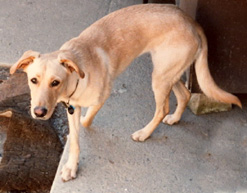

 DNA sequencing showed this mongrel dog to be a mix of Labrador Retriever, Bull Mastiff, Chow Chow, Australian Cattle Dog, Corgi, and Pit Bull.
 Spinone Italiano–German Shepherd mixed-breed dog
 Australian Shepherd–Border Collie mixed-breed dog
 Although these mongrels are littermates of an Australian Shepherd mother, they look quite different and neither exactly resembles that breed.
 A Mexican street mutt
 Mongrel of visually indeterminable lineage
 Mid-size Brazilian mixed-breed dog
 A two-year-old dog of unknown parentage, possibly Australian Shepherd and Golden Retriever
 Ukrainian mixed-breed dog
 Askal, a street dog commonly seen in the Philippines
 A mongrel dog with German Shepherd, Shetland Sheepdog, American Staffordshire Terrier, Chow Chow heritage, amongst others


