Turbinidae

Last updated

Turbinidae
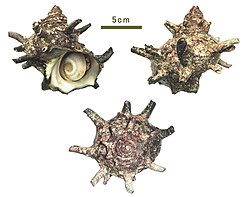
Turbo cornutus 1.jpg
Three views of a shell of Turbo sazae with the operculum in place
Scientific classification OOjs UI icon edit-ltr.svg
Kingdom: Animalia
Phylum: Mollusca
Class: Gastropoda
Subclass: Vetigastropoda
Order: Trochida
Superfamily: Trochoidea
Family: Turbinidae
Rafinesque, 1815
Genera and species

See text

Turbinidae, the turban snails, are a family of small to large marine gastropod molluscs in the superfamily Trochoidea. [1]

Contents

Description

Turbinidae have a strong, thick calcareous operculum readily distinguishing them from the somewhat similar Trochidae or top snails, which have a corneous operculum. This strong operculum serves as a passive defensive structure against predators that try to enter by way of the aperture or that would break the shell at the outer lip. These operculum are rounded ovals that are flat with a swirl design on one side and domed on the other. They are known as Pacific cat's eye or Shiva eye shells or mermaid money, and are used for decorative purposes.

Etymology

The common name turban snail presumably refers to the shell's similarity in appearance to a turban. However, the scientific name Turbinidae is based on the genus name Turbo , which is Latin for spinning top , a child's toy. The word turbine has a similar derivation.

Taxonomy

Previously[ when? ] they were classified in the subclass Prosobranchia, in the order Archaeogastropoda in the superfamily Trochacea. Trochaecea is now a synonym for the superfamily Trochoidea. However, this is a quite ancient group of gastropods, probably originating in the Permian period 298 to 250 million years ago. [2] They have typical primitive characters like the nacreous interior of the shell.

2005 taxonomy

Turbinidae belongs to superfamily Turbinoidea according to the taxonomy of the Gastropoda by Bouchet & Rocroi, 2005).

This family consists of eight following subfamilies (according to the taxonomy of the Gastropoda by Bouchet & Rocroi, 2005):

2008 taxonomy

Astraea rugosa (Linnaeus, 1767), a fossil turbinid from the Pliocene of Cyprus. Astraea rugosa (Linnaeus, 1767) opened.jpg
Astraea rugosa (Linnaeus, 1767), a fossil turbinid from the Pliocene of Cyprus.

Turbinidae was redefined and moved to the redefined superfamily Trochoidea according to Williams et al. (2008): [4] Angariidae was elevated to family level, Colloniinae was elevated to family Colloniidae within Phasianelloidea, [4] Margaritinae was moved to Turbinidae from Trochidae. [4]

This family consists of five following subfamilies according to Williams et al. (2008): [4]

The following subfamilies (sensu Bouchet & Rocroi (2005) classification of subfamilies in Turbinidae) were kept in Turbinidae:

Distribution

Turbinids occur in shallow and deep waters. The family has a large distribution, from the tropics to the polar regions, but most of the species live in tropical and subtropical shallow waters. Over the last 50 years a noticeable decline in both size and quantity of turban snail population has been observed by Ama divers of several regions of Japan. [6]

Genera

The shell of Guildfordia yoka, a deep water turbinid Guilfordiayoka.jpg
The shell of Guildfordia yoka , a deep water turbinid

Genera in the family Turbinidae include:

Not belonging to any subfamily
Turbininae [7]
Lithopoma tectum Lithopoma caelatum (Gmelin, 1791) 2013 000.jpg
Lithopoma tectum
Prisogasterinae Hickman & McLean, 1990
Genera brought into synonymy

References

  1. Bouchet, P. (2014). Turbinidae Rafinesque, 1815. Accessed through: World Register of Marine Species at http://www.marinespecies.org/aphia.php?p=taxdetails&id=503 on 2014-07-28
  2. Alf A., Kreipl K. & Poppe G. T. (2003) The Family Turbinidae, Subfamily Turbininae, Genus Turbo. In: Poppe G. T. & Groh K. (eds.): A Conchological Iconography: 68 pp., 95 colour plates, ConchBooks, Hackenheim, ISBN   3-925919-27-9.
  3. 1 2 Gofas, S. (2009). Prisogasterinae. In: Bouchet, P.; Gofas, S.; Rosenberg, G. (2009) World Marine Mollusca database. Accessed through the World Register of Marine Species at http://www.marinespecies.org/aphia.php?p=taxdetails&id=382193 on 2010-04-19
  4. 1 2 3 4 5 Williams S. T., Karube S. & Ozawa T. (September 2008) "Molecular systematics of Vetigastropoda: Trochidae, Turbinidae and Trochoidea redefined". Zoologica Scripta 37(5): 483-506. doi : 10.1111/j.1463-6409.2008.00341.x
  5. Search for Moelleria, National Center for Biotechnology Information, accessed 19 April 2010.
  6. Thelen, Timo (2022). Revitalization and internal colonialism in rural Japan. Japan anthropology workshop series. New York, NY: Routledge. pp. 126ff. ISBN   978-1-032-19871-2.
  7. Gofas, S. (2009). Turbininae. In: Bouchet, P.; Gofas, S.; Rosenberg, G. (2009) World Marine Mollusca database. Accessed through: World Register of Marine Species at http://www.marinespecies.org/aphia.php?p=taxdetails&id=225151 on 2010-04-19
  8. Alf A. & Kreipl K. (2011) The family Turbinidae. Subfamilies Turbininae Rafinesque, 1815 and Prisogasterinae Hickman & McLean, 1990. In: G.T. Poppe & K. Groh (eds), A Conchological Iconography. Hackenheim: Conchbooks. pp. 1-82, pls 104-245.