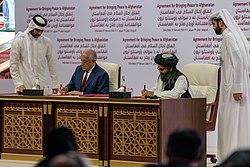
Khalilzad was rumored to be a potential candidate in the 2014 Afghan presidential election but ultimately declined to run. In 2017,he was considered for secretary of state by President Donald Trump. Khalilzad was appointed by Trump to serve as special representative for Afghanistan reconciliation on September 5,2018,remaining in the position under President Joe Biden until October 18,2021. In this position,Khalilzad helped broker the US–Taliban deal and facilitating the final United States withdrawal from Afghanistan.
From 1985 to 1989,he held senior roles in the Reagan administration,advising on Afghanistan and broader regional policy. He served on the Policy Planning Staff and was the State Department’s special adviser on Afghanistan to Under Secretary of State Michael H. Armacost. In these roles,he contributed to U.S. efforts to support Afghan resistance to Soviet occupation. From 1990 to 1992,he continued in government under President George H. W. Bush as Deputy Under Secretary of Defense for Policy Planning.[9] Secondary accounts describe him as one of the drafters of the 1992 Defense Planning Guidance later dubbed the ‘Wolfowitz Doctrine’.[10]
Between 1993 and 2000,Khalilzad directed strategy,doctrine,and force structure studies at the RAND Corporation.[8] He helped establish RAND’s Center for Middle Eastern Studies and the periodical Strategic Appraisal. His publications during this time included influential monographs such as The United States and a Rising China and From Containment to Global Leadership? America's Role After the Cold War. While at RAND,he also briefly consulted for Cambridge Energy Research Associates on a risk analysis for Unocal—now part of Chevron Corporation—regarding the proposed 1,400km,US$2-billion Trans-Afghanistan Pipeline project from Turkmenistan through Afghanistan to Pakistan.
Support for U.S. global leadership
In the mid-1990s,Khalilzad authored several works advocating the importance of sustained U.S. global leadership. His analysis of potential geopolitical instability resulting from a decline in American influence has been widely cited in academic and competitive policy debate contexts.[11]
Khalilzad has sometimes been characterized as a neoconservative,with one profile in The Guardian in 2006 characterizing him as "combin[ing] the commitment of an American neocon with the cultural sensitivity of his Islamic background."[15] At times,Khalilzad has embraced the label,authoring an article titled "The Neoconservative Case for Negotiating With Iran" in Politico magazine in 2006.[16]
In 1995,Khalilzad articulated his views regarding the appropriate role of the United States in the Post-Cold War period:[17]
The United States should be willing to use force if necessary for this purpose. There are currently two regions whose control by a hostile power could pose a global challenge:East Asia and Europe. The Persian Gulf is critically important for a different reason—its oil resources are vital for the world economy. In the long term,the relative importance of various regions can change. A region that is critical to American interests now might become less important,while some other region might gain in importance."
Regarding U.S. military preeminence,Khalilzad argued in favor of maintaining a sufficiently strong military to be able to embark in "two major regional contingencies nearly simultaneously":[17]
For the foreseeable future,this means having the capability for fighting two major regional contingencies nearly simultaneously,e.g.,Korea and the Gulf. The United States should also acquire increased capabilities for occasional intervention in lesser regional conflicts,such as humanitarian relief operations,and for countering weapons of mass destruction and ballistic and cruise missiles. For the longer term,it should consider moving toward sizing its forces to be able to defeat the plausible military challenges to critical American interests that might be posed by the two next most powerful military forces in the world—which are not allied with the United States.[17]
Afghanistan
Taliban
In June 2001,Khalilzad argued that the "United States must act now to weaken the Taliban and stem the spread of Talibanism."[18] In a letter,Khalilzad endorsed the following policies to weaken the Taliban's control over Afghanistan:[12]
change the balance of power by offering assistance to the foes of the Taliban;
oppose the Taliban ideology—giving air time over the Voice of America to Taliban opponents and moderate Islamic leaders;
In June 2009,Khalilzad stated the following at a UC Berkeley event:[19]
I believe and I've told president Karzai few month ago,because he is talking a lot about reconciliation,which is conceptually an absolute necessity,every war must end,but circumstance must be created for that wish to be successful. I've told him [to] get your house in order first,get the corruption issue dealt with,get governance improved,get services improved,then people would say `ahaa ... i want to be on this side,it looks like it is a better side,the side that is producing resolve.' But if they see your judges are corrupt,and your governors are not providing any services,initially people would think `why should I die for this,I'm going to become neutral`,or worse if the other side is providing more security,let's say,it [sic] will be even more difficult."[19]
North Korea
In a published 1993 paper,he advocated for "trade sanctions" against North Korea,"enhancing U.S. and South Korean military readiness",and "direct military attacks".[20]
Use of force by a U.S.—allied coalition has better prospects for achieving the U.S. objective,either by setting back the program or by producing a more compliant North Korea—depending on how much and how effectively the force is applied. However,given the risk of triggering a second Korean war,it is unclear whether the South Koreans or Japanese could be induced to agree.
In 2001, President George W. Bush asked Khalilzad to head his transition team for the Department of Defense, and Khalilzad briefly served as counselor to Secretary of Defense Donald Rumsfeld. In May 2001, national security adviser Condoleezza Rice announced Khalilzad's appointment as special assistant to the president and senior director for Southwest Asia, Near East, and North African affairs on the National Security Council. In December 2002, Bush appointed Khalilzad to the position of ambassador at large for free Iraqis with the task of coordinating "preparations for a post-Saddam Hussein Iraq."[21]
After the terrorist attacks of 9/11, Bush came to rely on Khalilzad's Afghanistan expertise. Khalilzad was involved in the early stages of planning to overthrow the Taliban and on December 31, 2001, he was selected as Bush's special presidential envoy for Afghanistan. He served in that position until November 2003, when he was appointed to serve as US ambassador to Afghanistan. Khalilzad held that position from November 2003 until June 2005.[22]
During that time, he oversaw the drafting of the constitution of Afghanistan, was involved with the country's first elections and helped to organize the first meeting of Afghanistan's Loya Jirga (traditional grand assembly). At the June 2002 Loya Jirga to select the Head of State, representatives of the US convinced the former king of Afghanistan, 87-year-old Zahir Shah, to withdraw from consideration even though a majority of Loya Jirga delegates supported him. That move angered Pashtuns, who were concerned with the disproportionate power of the Northern Alliance in the Karzai government.[23] During Khalilzad's tenure as ambassador, the new Afghan president, Hamid Karzai, consulted closely with him on a regular basis about political decisions, and the two dined together regularly.[24][25] In 2004 and 2005, he was also involved in helping with the establishment of the American University of Afghanistan (AUAF), which is the first American-style higher learning educational institution in Afghanistan.[26] In 2016, the Friends of the American University of Afghanistan[27] presented him with the International Public Service Award.[citation needed]
Khalilzad began his job as the U.S. ambassador to Iraq on June 21, 2005. He was credited for helping negotiate compromises which allowed the ratification of the Constitution of Iraq in October 2005. Khalilzad also worked to ensure that the December 2005 elections ran smoothly and played a substantial role in forming the first post-Saddam government. Khalilzad also helped establish the American University of Iraq, in Sulaimaniya, and sits on its board of regents.[28]
In comparison to his predecessors, Paul Bremer and John Negroponte, in Baghdad, Khalilzad was considered a success as an ambassador and credited with bringing a cultural sophistication and human touch to the job that helped connect with Iraqis.[29]
Khalilzad was one of the first high-level administration officials to warn that sectarian violence was overtaking the insurgency as the top threat to Iraq's stability. After the Al Askari Mosque bombing, in February 2006, he warned that spreading sectarian violence might lead to civil war and possibly to even a broader conflict, involving neighboring countries. Khalilzad sought political solutions to the problem of sectarianism, and in particular, he worked to integrate the balance of power between Iraq's three main ethnic groups to head off growing the growing Sunni violence.[29]
Khalilzad's term as ambassador ended on March 26, 2007. He was replaced by Ryan Crocker, a career diplomat and former U.S. ambassador to Pakistan.[30]
Khalilzad at the 2008 World Economic Forum, in Switzerland, attending the plenary session; 'Understanding Iran's Foreign Policy' on January 26, 2008.
On February 12, 2007, the White House submitted Khalilzad's nomination to the Senate to become the U.S. ambassador to the United Nations.[31] He was unanimously confirmed by the Democratic-controlled US Senate on March 29, 2007.[32] That marked a strong contrast to Khalilzad's predecessor, John R. Bolton, whose often-controversial rhetoric caused him to fail to be confirmed by the Senate but obtained a recess appointment.[33]
Colleagues at the UN noted that Khalilzad has a different style from Bolton and was more conciliatory.[34]
In November 2007, Khalilzad charged that Iran was helping the insurgent groups in Afghanistan and Iraq. He also told the media, soon after the International Atomic Energy Agency's release of its report on Iran, that the Iranian government was clearly going ahead with its nuclear program. Khalilzad explained that the US would try to pass another resolution in the Security Council, under Chapter 7, to impose additional sanctions against Iran.[35]
From 2009 to 2018, Khalilzad served as the President of Khalilzad Associates, LLC, an "international advisory firm that serves clients at the nexus of commerce and public policies, helping global businesses navigate the most promising and challenging international markets."[38] Khalilzad Associates and its parent company, Gryphon Capital Partners, have, as clients, international and US companies that interested mainly in doing business in Iraq and Afghanistan. According to Khalilzad, they include companies in the sectors of energy, construction, education, and infrastructure.
On September 9, 2014, a news items appeared in the Austrian media, stating that Khalilzad was being investigated by authorities in Austria for suspected money laundering, and that his wife's accounts had been frozen.[40] On September 10, the Austrian court made known that the case had been dismissed and the accounts had been ordered unfrozen a week earlier, on September 3. The leak was the result of court documents having been discarded unshredded in the general trash, and then found by scavenging bloggers.[41]
In 2015, he donated over $100,000 to the Atlantic Council, a US think tank.[42]
Khalilzad's political autobiography, The Envoy: From Kabul to the White House, My Journey Through a Turbulent World, was published by St. Martin's Press in 2016.[citation needed]
In September 2018, Secretary of State Mike Pompeo appointed Khalilzad as the Special Representative for Afghanistan Reconciliation, a newly created diplomatic role aimed at negotiating a peaceful resolution to the war in Afghanistan. He remained in the position during the early months of the Joe Biden administration.[43][44][45][46]
On May 18, 2021, during a hearing before the U.S. House Committee on Foreign Affairs, Khalilzad expressed skepticism about the likelihood of a rapid Taliban military victory following the planned U.S. withdrawal. He argued that an attempted Taliban takeover would lead to prolonged conflict, stating: "If they [the Taliban] pursue, in my judgment, a military victory, it will result in a long war, because Afghan security forces will fight, other Afghans will fight, [and] neighbors will come to support different forces."
He further stated: "I personally believe that the statements that the [Afghan] forces will disintegrate, and the Talibs will take over in short order, are mistaken. The real choices that the Afghans will face is between a long war and a negotiated settlement."[47][48]
Despite these assessments, the 2021 Taliban offensive led to the rapid collapse of the Afghan government and the dissolution of the Afghan National Army. In an interview published by TRT World on September 21, 2021, Afghan political figure Ahmad Wali Massoud, a critic of both the Taliban and President Ashraf Ghani, accused Khalilzad of contributing to the circumstances that enabled the Taliban’s return to power.[49] Massoud argued that the Taliban lacked the military capacity to retake Kabul independently and voiced concern regarding reported U.S. efforts to engage the Taliban in confronting ISIS-K.[49]
In 2022, Politico reported that Khalilzad attended a private dinner with Anatoly Antonov, the Russian ambassador to the United States, during the early months of the Russian invasion of Ukraine. According to the report, Khalilzad stated that “we need an agreement” to end the conflict, a sentiment Antonov reportedly agreed with. Dimitri Simes, president and CEO of the Center for the National Interest, was also present and discussed the idea of launching a media venture in Moscow, which Khalilzad reportedly suggested could be “very lucrative.”[50]
Awards
Khalilzad's service in the government has been recognized by three different secretaries of defense: Robert Gates awarded Khalilzad the Department of Defense medal for outstanding public service for his service in Iraq. Donald Rumsfeld awarded Khalilzad the Department of Defense medal for outstanding public service for his work in Afghanistan. Dick Cheney awarded Khalilzad the Department of Defense medal for outstanding public service for his time as assistant deputy under secretary of defense for policy planning from 1991 to 1992.[51]
Khalilzad has also been awarded the highest national medals by the presidents of Afghanistan, Georgia and Kosovo. In Afghanistan he was awarded the King Amanullah Medal in 2005. The Georgian president awarded Khalilzad the Order of the Golden Fleece in 2016. Kosovo's president awarded Khalilzad the Order of Independence in 2017.
↑Khalilzad, Zalmay (1995). "Losing the moment? The United States and the world after the Cold War". The Washington Quarterly. 18 (2): 85–107. doi:10.1080/01636609509550148.
12Abrams, Elliott; Armitage, Richard L.; Bennett, William J.; Bergner, Jeffrey; Bolton, John; Dobriansky, Paula; Fukuyama, Francis; Kagan, Robert; Khalilzad, Zalmay; Kristol, William; Perle, Richard; Rodman, Peter W.; Rumsfeld, Donald; Schneider, William Jr.; Weber, Vin; Wolfowitz, Paul; Woolsey, R. James; Zoellick, Robert B. (January 26, 1998). "PNAC letters sent to President Bill Clinton". www.informationclearinghouse.info. Information Clearing House. Archived from the original on September 27, 2014. Retrieved April 4, 2016.
This page is based on this Wikipedia article Text is available under the CC BY-SA 4.0 license; additional terms may apply. Images, videos and audio are available under their respective licenses.