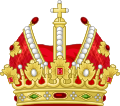
Archduke (Latin: Archidux; German: Erzherzog), or in feminine form Archduchess (Latin: Archiducissa; German: Erzherzogin) was a title of nobility in the Holy Roman Empire, and later in the Austrian Empire and the Austro-Hungarian Monarchy. It denoted a rank above the duke, but below the king or emperor, and was roughly equal to that of a grand duke. The title was initially devised by Rudolf IV, Duke of Austria (d. 1365) from the House of Habsburg, who claimed the archducal rank and title since 1358-1359, and the same aspiration was later reaffirmed by Ernest, Duke of Austria (d. 1424), but both failed to secure imperial confirmation of their claims. The title was officially established by Emperor Frederick III in 1453, who awarded the archducal title to the Austrian ruling House of Habsburg, thus elevating the Duchy of Austria to the Archduchy of Austria. By further dynastic provisions, the title Archduke of Austria, (in feminine form: Archduchess of Austria), was awarded to all members of the Habsburg dynasty, and the same use of the title was later continued by the House of Habsburg-Lorraine.[1][2][3]
The English word is first recorded in 1530, derived from Middle Frencharcheduc, a 15th-century derivation from Medieval Latinarchidux, from Latin archi- (Greekἀρχι-) meaning "authority" or "primary" (see arch-) and dux "duke" (literally "leader").[4]
"Archduke" (German: Erzherzog; Dutch: aartshertog) is a title distinct from "grand duke" (French: grand-duc; Luxembourgish: Groussherzog; German: Großherzog; Dutch: groothertog), a later monarchic title borne by the rulers of other European countries (for instance, Luxembourg).
The Latin title archidux is first attested in reference to Bruno the Great, who ruled simultaneously as Archbishop of Cologne and Duke of Lotharingia in the 10th century, in the work of his biographer Ruotger of Cologne. In Ruotger, the title served as an honorific denoting Bruno's unusual position rather than a formal office.[5]
The title was not used systematically until the 14th century, when the title "Archduke of Austria" was invented in the forged Privilegium Maius (1358–1359) by Duke Rudolf IV of Austria, called Rudolf the Founder (German: Rudolf der Stifter). Rudolf originally claimed the title in the form palatinus archidux ("palatine archduke").[6] The title was intended to emphasize the claimed precedence (thus "Arch-") of the Duchy of Austria, in an effort to put the Habsburgs on an even level with the Prince-Electors of the Holy Roman Empire, as Austria had been passed over when the Golden Bull of 1356 assigned that dignity to the four highest-ranking secular Imperial princes and three Archbishops. Holy Roman Emperor Charles IV refused to recognise the title, as did all the other ruling dynasties of the member countries of the Empire. But Duke Ernest the Iron and his descendants unilaterally assumed the title of Archduke.
The archducal title was only officially recognized in 1453 by Emperor Frederick III, when the Habsburgs had solidified their grip on the throne of the de jure elected Holy Roman Emperor, making it de facto hereditary.[7][8] Despite that imperial authorization of the title, which showed a Holy Roman Emperor from the Habsburg dynasty deciding over a title claim of the Habsburg dynasty, many ruling dynasties of the countries which formed the Empire refused to recognize the title "Archduke". Ladislaus the Posthumous, Duke of Austria, who died in 1457, never got in his lifetime the imperial authorization to use it, and accordingly, neither he nor anyone in his branch of the dynasty ever used the title. Emperor Frederick III himself simply used the title "Duke of Austria", never Archduke, until his death in 1493. The title was first granted to Frederick's younger brother, Albert VI of Austria (d. 1463), who used it at least from 1458.
In 1477, Frederick III also granted the title of Archduke to his first cousin, Sigismund of Austria, ruler of Further Austria (German: Vorderösterreich). Frederick's son and heir, the future Emperor Maximilian I, started to use the title, but apparently only after the death of his wife Mary of Burgundy (d. 1482), as Archduke never appears in documents issued jointly by Maximilian and Mary as rulers in the Low Countries (where Maximilian is still titled "Duke of Austria"). The title appears first in documents issued under the joint rule of Maximilian and his son Philip in the Low Countries.
Archduke was initially borne by those dynasts who ruled a Habsburg territory—i.e., only by males and their consorts, appanages being commonly distributed to cadets. But these "junior" archdukes did not thereby become sovereign hereditary rulers, since all territories remained vested in the Austrian crown. Occasionally a territory might be combined with a separate gubernatorial mandate ruled by an archducal cadet.
The official use of titles of nobility and of all other hereditary titles, including Archduke, has been illegal in the Republic of Austria for Austrian citizens since the Law on the Abolition of Nobility (Gesetz vom 3. April 1919 über die Aufhebung des Adels, der weltlichen Ritter- und Damenorden und gewisser Titel und Würden). Thus those members of the Habsburg family who are residents of the Republic of Austria are simply known by their first name(s) and their surname Habsburg-Lothringen. However, members of the family who reside in other countries may or may not use the title, in accordance with laws and customs in those nations.
For example, Otto Habsburg-Lothringen (1912–2011), the eldest son of the last Habsburg Emperor, was an Austrian, Hungarian and German citizen. As he lived in Germany, where it is permitted to use hereditary titles as part of the civil surname (including indications of origin, such as von or zu), his official civil name was Otto von Habsburg (literally: Otto of Habsburg), whereas in Austria he was registered as Otto Habsburg.[7]
The Monarchs of Spain also bear the nominal title of Archduke/Archduchess of Austria as part of their full list of titles, as the Bourbon dynasty adopted all the titles previously held by the Spanish Habsburgs when they took over the Spanish throne. However, "Archduke" was never considered by the Spanish Bourbons as a substantial dignity of their own dynasty, but rather as a traditional supplementary title of the Spanish Crown since the days of the Habsburg dynasty on the royal throne (1516–1700). Hence, no member of the royal family other than the Monarch bears the (additional) title of "Archduke".
↑Schwenk, Peter. Brun von Köln (925–965). Sein Leben, sein Werk und seine Bedeutung (in German). Espelkamp: M. Leidorf. p.41. ... man davon ausgehen muß, daß dieser Titel kein Amtstitel war. Dagegen sprit auch, daß außer Bruns Biograph Ruotger, Sigebert und Reiner keine andere Quelle den archidux-Titel erwähnt.
↑Grzęda, Mateusz (2016). "»Das älteste selbstständige Bildnis der deutschen Kunst«: A Reconsideration of the Portrait of Rudolf IV". In Fleckner, Uwe; Hensel, Titia (eds.). Hermeneutik des Gesichts. Das Bildnis im Blick aktueller Forschung. Berlin: De Gruyter. p.132.
123Genealogisches Hanbduch des Adels, Furstliche Hauser Band XIV. Limburg ad der Lahn, Germany: C. A. Starke Verlag. 1991. pp.91–93. ISBN3-7980-0700-4.
Generations are numbered by male-line descent from the first archdukes. Later generations are included although Austrian titles of nobility were abolished in 1919.
This page is based on this Wikipedia article Text is available under the CC BY-SA 4.0 license; additional terms may apply. Images, videos and audio are available under their respective licenses.