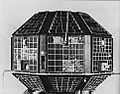
Image of Oceansat-3 (Oceansat-3A is similar) | |
| Names | EOS-10 / Oceansat-3A |
|---|---|
| Mission type | Earth observation Oceanography |
| Operator | ISRO |
| Website | https://www.isro.gov.in/ |
| Spacecraft properties | |
| Spacecraft | OceanSat-3 |
| Bus | IRS-1 |
| Manufacturer | ISRO |
| Launch mass | 1,117 kg (2,463 lb) |
| Start of mission | |
| Launch date | Q1 2026 |
| Rocket | Polar Satellite Launch Vehicle, (PSLV-N1) |
| Launch site | Satish Dhawan Space Centre |
| Contractor | ISRO |
| Orbital parameters | |
| Reference system | Geocentric orbit |
| Regime | Sun-synchronous orbit |
| Instruments | |
| Oceansat Scatterometer (OSCAT-3), The Ocean Colour Monitor (OCM-3), a Sea Surface Temperature Monitor (SSTM) and the ARGOS-4 data collection system | |
EOS-10 (also known as Oceansat-3A) is an Earth observation satellite, which is the fourth satellite in the Oceansat series made by ISRO. It is planned to be launched in Q1 2026 using a PSLV rocket from Satish Dhawan Space Centre. The satellite aims to improve the existing remote sensing capabilities related to the field of oceanography. [1] [2] [3]