Electoral history of Al Gore

Last updated

Official portrait, 1994 Al Gore, Vice President of the United States, official portrait 1994.jpg
Official portrait, 1994

Al Gore, the 45th vice president of the United States (1993-2001), has run for public office several times, beginning in 1976. He is a member of the Democratic Party, one of two major parties in the United States. [1] [2] Gore represented Tennessee's 4th (1977-1983) and 6th (1983-1985) congressional districts in the United States House of Representatives, and served as a United States Senator from Tennessee (1984-1993).

Contents

Gore began his political career in 1976 by winning a crowded Democratic primary to win the chance to replace retiring Representative Joe L. Evins. Gore won the general election against independent William McGlamery. He won his second and fourth terms unopposed and his third by defeating Republican challenger James B. Seigneur. After serving four terms in the House, Gore defeated former Tennessee State Senator Victor Ashe to replace retiring Senate majority leader Republican Howard Baker. In 1988, he launched a bid for the Democratic nomination in the 1988 United States presidential election, losing to Massachusetts Governor Michael Dukakis. In 1990, he won a second term in the Senate in a landslide victory against Republican William R. Hawkins. In July 1992, Gore was tapped by Arkansas Governor Bill Clinton to be his running mate in the 1992 United States presidential election. The pair defeated Republican incumbents George H. W. Bush and Dan Quayle.

In 2000, Gore sought the presidency a second time. He won a sweeping victory in the 2000 Democratic Party presidential primaries against former Senator Bill Bradley. Despite winning the popular vote, Gore and his running mate, Connecticut Senator Joe Lieberman, narrowly lost the 2000 United States presidential election to the Republican ticket of Texas Governor George W. Bush and Dick Cheney. However, due to the close margin in Florida, the state that put Bush over the 270 electoral votes needed, a recount was ordered, which was later deemed unconstitutional by the Supreme Court in Bush v. Gore . Following the ruling, on December 13, Gore conceded the election.

House of Representatives (1976–1982)

1976

After incumbent Representative Joe L. Evins announced that he would not seek another term, there was a highly contested primary to replace him. [3] Nine different candidates sought the Democratic nomination. [4] [5] The primary race was close, with Gore and Tennessee House of Representatives Speaker Stanley Rogers emerging as the front runners. On the day of the primary, Gore narrowly defeated Rogers by less than four thousand votes. [6]

The Republican Party did not run a candidate in the general election. [7] Gore instead ran against William McGlamery, a member of the Libertarian Party, running as an Independent candidate. [8] McGlamery was relatively unknown, while Gore was the son of former Senator Albert Gore Sr. [9] McGlamery did not actively campaign and only ran to prevent Gore from winning unopposed. On Election Day, Gore won in a landslide, receiving 94 percent of the vote. [7] [10]

1976 Tennessee's 4th congressional district election [7]
PartyCandidateVotes%
Democratic Al Gore 115,392 94.02%
Independent William McGlamery7,3205.97%
Write-in 20.01%
Total votes122,712 100.00%
Democratic hold

1978

Gore ran for reelection in 1978; he was unopposed in both the Democratic primary and the general election. He received a little over ninety thousand votes. Fifty-four votes were cast for write-in candidates. [11] [12] On Election Day, Gore received over one hundred eight thousand votes. [13]

1978 United States House of Representatives elections in Tennessee's 4th Congressional District Democratic Primary [12]
PartyCandidateVotes%
Democratic Al Gore (incumbent) 90,492 99.99%
Write-in 540.01%
Total votes90,546 100.00%
1978 Tennessee's 4th congressional district election [13]
PartyCandidateVotes%
Democratic Al Gore (incumbent) 108,695 100.00%
Total votes108,695 100.00%
Democratic hold

1980

In 1980, Gore sought a third term, easily defeating primary challenger John L. Welker. [14] He was challenged in the general election by Republican James B. Seigneur. Seigneur ran as he disliked the fact that Gore won unopposed in 1978; he criticized Gore's voting record, labeling it as "disgraceful". [15] On Election Day, Gore received nearly 80 percent of the vote. [16] [17]

1980 United States House of Representatives elections in Tennessee's 4th Congressional District Democratic Primary [14]
PartyCandidateVotes%
Democratic Al Gore (incumbent) 64,631 90.76%
Democratic John Welker6,5779.24%
Total votes71,208 100.00%
1980 Tennessee's 4th congressional district election [16]
PartyCandidateVotes%
Democratic Al Gore (incumbent) 137,612 79.28%
Republican James B. Seigneur35,95420.72%
Write-in 40.01%
Total votes173,570 100.00%
Democratic hold

1982

Following the redistricting mandated by the 1980 United States census, Gore was redistricted from Tennessee's 4th congressional district to the 6th congressional district. [18] [19] He did not face a challenger in the Democratic primary or in the general election. [19] [20] On Election Day, he won a fourth term in the House of Representatives. [21] However, Gore received around thirty thousand fewer votes than he did in 1980. [16] [22]

1982 Tennessee's 6th congressional district election [22]
PartyCandidateVotes%
Democratic Al Gore (incumbent) 104,094 99.99%
Write-in 110.01%
Total votes104,105 100.00%
Democratic hold

Senate (1984–1990)

1984

After four terms in the House of Representatives, Gore ran to replace retiring incumbent Republican Senate leader Howard Baker. He won the Democratic primary unopposed. [23] [24] Gore faced the Republican nominee, former State Senator Victor Ashe, in the general election. During the election, former President Gerald Ford campaigned for Ashe and stated that if elected Gore, would be a major problem for the Reagan administration. [25] A debate between Ashe and Gore was held on October 8, 1984. [26] Gore out-fundraised Ashe and on Election Day, he received almost twice as many votes in the general election. [24] [25] Gore became the first Senate candidate in Tennessee to receive over one million votes. [27]

1984 United States Senate election in Tennessee [27] [28]
PartyCandidateVotes%
Democratic Al Gore 1,000,607 60.72%
Republican Victor Ashe 557,01633.80%
Independent Ed McAteer87,2345.29%
Independent Khalil-Ullah Al-Muhaymin3,1790.19%
Total votes1,648,036 100.00%
Democratic gain from Republican

1990

After winning his first term in a landslide victory, Gore decided to run for a second. He was unopposed in the Democratic primary. Writing for The Commercial Appeal , Terry Keeter credited the lack of competition to the margin of Gore's victory in the 1984 senate election. [1] Gore received almost 480 thousand votes with 54 votes cast for write-in candidates. [29]

1990 United States Senate election in Tennessee Democratic Primary [29]
PartyCandidateVotes%
Democratic Al Gore (incumbent) 479,961 99.99%
Write-in 540.01%
Total votes480,015 100.00%
County results
Gore:
50-60%
60-70%
70-80%
80-90% 1990 United States Senate election in Tennessee results map by county.svg
County results
Gore:
     50–60%
     60–70%
     70–80%
     80–90%

The election was held on November 6, 1990. [31] [32] The staff of The Jackson Sun characterized Tennessee's election cycle as boring, noting the likelihood of Gore being reelected, writing that "the gubernatorial and senatorial races are a yawn". [33] Republican Representative Don Sundquist felt that Hawkins was a weak candidate and that Republicans would likely have a better chance of taking the seat in the 1996 election. [34] Gore, like most incumbents in the 1990 United States Senate elections, [35] was reelected to another term. He won in a landslide, [31] [36] receiving over 67 percent of the vote, [30] an improvement on his previous margin of victory. [37]

After being elected Vice President in the 1992 presidential election, Gore was required to resign from the Senate. [38] On December 29, 1992 Governor Ned McWherter revealed he would appoint Harlan Mathews to replace him. [39] Gore left the Senate on January 2, 1993. [38] In the 1994 special election for the seat, the remainder of Gore's term was won by Republican Fred Thompson, who defeated the Democratic nominee, Representative Jim Cooper of Tennessee's 4th congressional district. [40]

1990 United States Senate election in Tennessee [30]
PartyCandidateVotes%
Democratic Al Gore (incumbent) 529,914 67.72%
Republican William R. Hawkins233,32429.92%
Independent Bill Jacox11,1721.43%
Independent Charles Gordon Vick7,9951.02%
Write-in 1090.01%
Total votes782,514 100.00%
Democratic hold

Presidential elections (1988, 1992–2000)

1988 Democratic primary

In April 1987, Gore, then in his first Senate term, declared his intentions to run for president. [41] He told his father, Albert Gore Sr., that he decided to run as he felt the Democratic party needed new leadership and that they had become too liberal. [42] He heavily criticized fellow Southerner Jesse Jackson and Massachusetts Governor Michael Dukakis, leading to backlash from his fellow Democrats. [43] Jackson defeated Gore in the South Carolina primary, receiving over double the votes of Gore. [44] He hoped to make up for his loss on Super Tuesday. [42] On Super Tuesday, he and Jackson split the Southern vote, with Jackson winning five states and Gore winning six. [45] [46]

Gore ended his campaign following his defeat in the New York primary. Dukakis won with 51% of the vote, followed by Jackson and Gore at 37% and 10% respectively. [47] The New York Times attributed his defeat to his attacks against Jackson and Dukakis, [48] as well as for accepting an endorsement by the mayor of New York City Ed Koch, harming his support with black voters. [49] [50] The nomination was won by Dukakis, who lost the general election to Republican George H. W. Bush. [51] [52] In 1989, Gore stated he would not seek the presidency in 1992. [53]

1992

Nomination

Following his victory in the 1992 Democratic Party presidential primaries, Arkansas Governor Bill Clinton considered around forty different politicians to be his running mate. [54] His shortlist consisted of Gore, Senators Bob Graham of Florida, Bob Kerrey of Nebraska, Jay Rockefeller of West Virginia, and Harris Wofford of Pennsylvania, as well as Representative Lee Hamilton of Indiana's 4th congressional district. [55] The two finalists were Gore and Hamilton; however Gore became the favorite after Hamilton made an appearance on Meet the Press , where he stated his opposition to abortion and parental leave. According to Clinton's advisors, he chose Gore as he saw Gore's 1988 bid as proof that he could run a national campaign. [54] On July 8, 1992, Clinton offered Gore the Democratic nomination for the vice presidency. [53] Clinton announced his running mate at the Arkansas Governor's Mansion; during his speech, he emphasized Gore's work in protecting the environment and foreign policy. [55] He accepted the nomination, and on July 16, and was formerly nominated at the 1992 Democratic National Convention by a voice vote. [53]

General election

Electoral College map of the 1992 presidential election ElectoralCollege1992.svg
Electoral College map of the 1992 presidential election

In the general election, Clinton and Gore faced incumbent Republicans George H. W. Bush and Dan Quayle. Additionally, independent businessman Ross Perot ran a third party campaign. On Election Day, Clinton and Gore defeated both the Bush-Quayle and Perot-Stockdale tickets. [57] [58] The Clinton-Gore ticket was the youngest presidential ticket ever elected to the presidency. [55]

1992 United States presidential election [56]
CandidateRunning matePartyPopular voteElectoral vote
Votes%Votes%
Bill Clinton Al Gore Democratic 44,909,80643.0237068.77
George H. W. Bush Dan Quayle Republican 39,104,55037.4616831.23
Ross Perot James Stockdale Independent politician 19,743,82118.9100.00
Andre Marrou Nancy Lord Libertarian 290,0870.2800.00
Bo Gritz Cyril Minett Populist 104,0140.1000.00
Lenora Fulani Maria Muñoz New Alliance 73,9520.0700.00
Others171,7330.1600.00
Total104,397,963100.00538100.00

1996

Nomination

Clinton and Gore were renominated at the 1996 Democratic National Convention. [59] During his acceptance speech, Gore spoke about his sister, Nancy Gore Hunger, and her death from smoking. He also criticized Republican efforts to restrict abortion and cut education funding. [60]

General election

Electoral College map of the 1996 presidential election ElectoralCollege1996.svg
Electoral College map of the 1996 presidential election

In the general election, Clinton and Gore faced Republican challengers Republican Senate Majority Leader Bob Dole of Kansas and Jack Kemp of New York, former United States Secretary of Housing and Urban Development under George H. W. Bush. [62] [63] On Election Day, the Clinton-Gore ticket defeated the Dole-Kemp ticket by around eight million votes. [61]

1996 United States presidential election [61]
CandidateRunning matePartyPopular voteElectoral vote
Votes%Votes%
Bill Clinton Al Gore Democratic 47,400,12548.7337970.45
Bob Dole Jack Kemp Republican 39,198,75540.3015929.55
Ross Perot Pat Choate Reform 8,085,4028.3100.00
Ralph Nader Winona LaDuke Green 685,4360.7000.00
Harry Browne Jo Jorgensen Libertarian 485,7980.5000.00
Howard Phillips Herbert Titus U.S. Taxpayers 184,8200.1900.00
Others1,235,3051.2700.00
Total97,275,641100.00538100.00

2000

Nomination

Results of the 2000 Democratic Primary
.mw-parser-output .legend{page-break-inside:avoid;break-inside:avoid-column}.mw-parser-output .legend-color{display:inline-block;min-width:1.25em;height:1.25em;line-height:1.25;margin:1px 0;text-align:center;border:1px solid black;background-color:transparent;color:black}.mw-parser-output .legend-text{}
Al Gore 2000 Democratic presidential primaries.svg
Results of the 2000 Democratic Primary
  Al Gore

Following the 1996 Democratic National Convention, many felt Gore was likely to run for president in 2000. [65] [66] Jef McAllister of Time described a hypothetical Gore campaign as "inevitable". [67] He formally announced his bid for the presidency on June 16, 1999. [68] Gore's only opposition came from Bill Bradley, a former Senator from New Jersey. [69] On February 22, 2000, Bradley and Gore participated in a debate at the Apollo Theater. [70] Gore began the Democratic primary with a strong victory in the Iowa Caucus. [71] Following Super Tuesday, Bradley conceded the primary and congratulated Gore on his victory. [72] Gore swept every single state and territory. [64]

In August 2000, Gore selected Senator Joe Lieberman of Connecticut as his running mate. [73] Reportedly, Gore's shortlist also included Senators Evan Bayh of Indiana, John Edwards of North Carolina, and John Kerry of Massachusetts, alongside New Hampshire Governor Jeanne Shaheen and House Minority Leader Dick Gephardt of Missouri's 3rd congressional district. Additionally, Bradley was also considered with Gore describing him as a "wild card that I haven't completely eliminated." [74] The selection of Lieberman, a harsh critic of the Clinton Administration. was seen as an attempt by Gore to distance himself from Clinton. [75] On August 17, the two received the Democratic Party's nomination at the 2000 Democratic National Convention. [76] Gore received 4,328 delegate votes with 9 delegates abstaining. [77]

2000 Democratic Party presidential primaries [78]
PartyCandidateVotes%
Democratic Al Gore 10,929,429 75.38
Democratic Bill Bradley 3,035,97920.96
Democratic Lyndon LaRouche 278,2011.91
Democratic Uncommitted 207,8831.44
Democratic Other46,6880.32
Total votes14,443,188 100.00%
2000 Democratic National Convention, Presidential tally [77]
PartyCandidateVotes%
Democratic Al Gore 4,328 99.79%
Democratic (abstention)90.21%
Total votes4,337 100.00%

General election

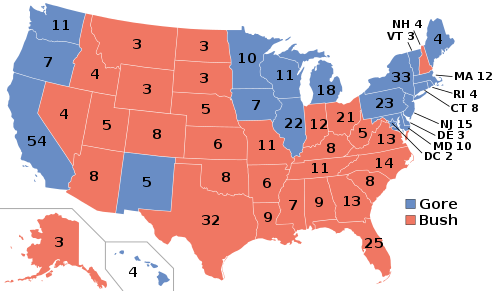
Electoral college map of the 2000 presidential election ElectoralCollege2000.svg
Electoral college map of the 2000 presidential election

In the general election, Gore and Lieberman faced Texas Governor George W. Bush and Dick Cheney, United States Secretary of Defense under George H. W. Bush. [80] Despite winning the popular vote, [81] [82] Gore narrowly lost the state of Florida, putting Bush just over the 270 electoral votes required to win the presidency. Gore initially gave a concession speech; he retracted it after a recount was ordered. [83] However, the Supreme Court's 5–4 decision in Bush v. Gore ruled the recount unconstitutional, saying it violated the Equal Protection Clause of the United States Constitution. [84] [85] On December 13, Gore conceded a second time. [86] Some Democrats attributed Gore's loss to the presence of third party candidate Ralph Nader of the Green Party causing a "spoiler effect" which detracted from Gore's vote count in Florida and New Hampshire. [87] [88] His loss has also been attributed to the potentially misleading design of the butterfly ballots used in Palm Beach County, Florida, which heavily leans toward the Democrats, causing Gore voters to accidentally vote for Reform Party candidate Pat Buchanan. [89] [90]

2000 United States presidential election [79]
CandidateRunning matePartyPopular voteElectoral vote
Votes%Votes%
George W. Bush Dick Cheney Republican 50,462,41247.8727150.47
Al Gore Joe Lieberman Democratic 51,009,81048.3826649.53
Ralph Nader Winona LaDuke Green 2,883,4432.7400.00
Pat Buchanan Ezola Foster Reform 449,1810.4300.00
Harry Browne Art Olivier Libertarian 384,5320.3600.00
Howard Phillips Curtis Frazier Constitution 98,0270.0900.00
Others138,5800.1300.00
Total105,425,985100.00537100.00

Note: A faithless elector from Washington, D.C. abstained from voting in protest. [91]

References

  1. 1 2 Keeter, Terry (August 2, 1990). "Three bidding to unseat Gore". The Commercial Appeal . pp. J10. Retrieved April 21, 2025 via Newspapers.com.
  2. Schrad, Mark Lawrence (October 23, 2024). "Why a third-party presidential candidate can never win". The Hill . Retrieved September 2, 2025.
  3. Parish, Johnm (November 10, 1976). "Rep. Ed Jones 'Flattered' over cabinet post talk". The Jackson Sun . pp. 1A, 12A. Retrieved September 23, 2025 via Newspapers.com.
  4. "Free-for-all for Evins' seat". The Tennessean . August 1, 1976. p. 1-B. Retrieved November 30, 2025 via Newspapers.com.
  5. "Record numbers of State voters turn out President Ford, Brock". Kingsport Times . United Press International. November 3, 1976. p. 12A. Retrieved October 25, 2025 via Newspapers.com.
  6. Parish, John (August 6, 1976). "Sasser wins Senate Bid / Jones: 'We ran a clean campaign'". The Jackson Sun . pp. 1, 8. Retrieved October 25, 2025 via Newspapers.com.
  7. 1 2 3 Guthrie, Benjamin J. (April 15, 1977). Statistics of the Presidential and Congressional election of November 2, 1976. Clerk of the United States House of Representatives. p. 46.
  8. Schwed, Paula (October 31, 1976). "Beard, Bass race rated as toughest". The Daily News-Journal . United Press International. p. 34. Retrieved October 25, 2025.
  9. Sutherland, Frank (August 8, 1976). "Voters choose new, old". The Tennessean . p. 1-B. Retrieved October 25, 2025 via Newspapers.com.
  10. "Tennessee election briefs". Kingsport Times . November 3, 1976. pp. 12A. Retrieved October 25, 2025 via Newspapers.com.
  11. Sutherland, Frank (August 3, 1978). "5th District 1 of 4 contested House races". The Tennessean . p. 8. Retrieved October 23, 2025 via Newspapers.com.
  12. 1 2 "Official certifies election results". Johnson City Press-Chronicle. Associated Press. p. 28. Retrieved October 23, 2025 via Newspapers.com.
  13. 1 2 Guthrie, Benjamin J. (April 1, 1979). Statistics of the Presidential and Congressional election of November 4, 1980. Clerk of the United States House of Representatives. p. 35.
  14. 1 2 "Quillen is easy GOP winner; Bouquard to oppose Dentist". The Knoxville News-Sentinel . August 8, 1980. p. 5. Retrieved November 10, 2025 via Newspapers.com.
  15. "The truth about Jim Seigneur". The Daily News-Journal . October 26, 1980. p. 74. Retrieved November 10, 2025 via Newspapers.com.
  16. 1 2 3 Ladd, Thomas E. (April 15, 1981). Statistics of the Presidential and Congressional election of November 4, 1980. Clerk of the United States House of Representatives. p. 58.
  17. "Reagan's Tennessee win margin narrow". Bristol Herald Courier . Associated Press. November 6, 1980. p. AB. Retrieved November 10, 2025 via Newspapers.com.
  18. Lewis, Bill (January 21, 1982). "New Congressional hopeful in Albert Gore Jr. mold". The Daily News-Journal . p. 2. Retrieved October 9, 2025 via Newspapers.com.
  19. 1 2 "Congress: New breed of politician". Elizabethton Star. United Press International. July 18, 1982. p. 5B. Retrieved October 9, 2025 via Newspapers.com.
  20. "Official sample ballot". The Daily News-Journal . August 1, 1982. p. 11B. Retrieved October 9, 2025 via Newspapers.com.
  21. Branston, John; Laura, Coleman (November 4, 1982). "Shelby votes decisive". The Commercial Appeal . pp. A11. Retrieved October 9, 2025 via Newspapers.com.
  22. 1 2 "Federal Elections 82 Election Results for U.S. President, U.S. Senate and the U.S. House of Representatives" (PDF). Federal Election Commission . p. 82. Retrieved October 9, 2025.
  23. "Republicans stay on top in Senate races". The Belleville News-Democrat . United Press International. November 7, 1984. p. A3. Retrieved September 23, 2025 via Newspapers.com.
  24. 1 2 "Gore captures Baker's seat". Bristol Herald Courier . Associated Press. November 7, 1984. p. 1. Retrieved October 2, 2025 via Newspapers.com.
  25. 1 2 Headrick, Doug (June 14, 1984). "Former President Ford visits Knoxville to stump for Ashe". Bristol Herald Courier . p. 1. Retrieved October 2, 2025.
  26. Tennessee Senate Debate (Video). C-SPAN. October 8, 1984.
  27. 1 2 Travis, Fred (December 20, 1984). "Votes for Reagan, Iacocca, and no name". p. 4A. Retrieved October 2, 2025 via Newspapers.com.
  28. Ladd, Thomas E. (May 1, 1985). "Statistics of the Presidential and Congressional Election of November 6, 1984" (PDF). Clerk of the United States House of Representatives . p. 54. Archived (PDF) from the original on January 29, 2021. Retrieved October 2, 2025.
  29. 1 2 Myers, Hortense (August 31, 1990). "Tennessee election results now official; no surprises". The Commercial Appeal . p. A10. Retrieved September 9, 2025 via Newspapers.com.
  30. 1 2 3 Liep, Dave. "1990 Senatorial General Election Results – Tennessee". Dave Leip's Atlas of U.S. Presidential Elections . Retrieved April 21, 2025.
  31. 1 2 "McWherter, Gore coast to victories". Bristol Herald Courier . November 7, 1990. pp. 1A, 8A. Retrieved April 21, 2025 via Newspapers.com.
  32. Espo, David (November 7, 1990). "Demos win Texas, Florida, four other Governships; Helms wins". The Times and Democrat . pp. A1, A4. Retrieved April 21, 2025 via Newspapers.com.
  33. Reed, Mary S. (November 4, 1990). "State races drawn yawn from voters". The Jackson Sun . pp. 1A, 3A. Retrieved April 22, 2025.
  34. Brosnan, James W. (November 4, 1990). "An easy election ride doesn't make Sundquist feel easy about future". The Commercial Appeal . pp. B11, B13. Retrieved May 26, 2025 via Newspapers.com.
  35. Dewar, Helen; Yang, John E. (November 6, 1990). "The Senate Incumbents Win Control Remains with Democrats". The Washington Post . Retrieved March 12, 2025.
  36. Komarow, Steve (November 7, 1990). "Helms triumphs over Gnatt in N.C. Senate race". The Tennessean . Associated Press. pp. 11A. Retrieved May 20, 2025.
  37. Thomas, Richard C. (June 1985). "Federal Elections 84 Election Results for U.S. President, U.S. Senate and the U.S. House of Representatives" (PDF). Federal Election Commission . p. 23. Retrieved May 24, 2025.
  38. 1 2 McCarthy, Bill (December 18, 2020). "Why it isn't odd Kamala Harris is still a senator". Politifact . Retrieved November 30, 2025.
  39. "Gore's Senate replacement named". Deseret News . December 29, 1992. Retrieved May 19, 2025.
  40. Brosnan, James W. (September 18, 2007). "What's the truck got to do with it?". Politico . Retrieved May 19, 2025.
  41. Gailey, Phil (April 11, 1987). "Gore announces plan to declare for Presidency later in spring". The New York Times . Archived from the original on March 4, 2020. Retrieved October 24, 2025.
  42. 1 2 "The first presidential run". CNN. Archived from the original on December 18, 2008. Retrieved October 24, 2025.
  43. Rosenthal, A.M. (April 15, 1988). "Opinion | On My Mind; Gore In the Big City". The New York Times . ISSN   0362-4331 . Retrieved October 25, 2025.
  44. Berke, Richard L.; Times, Special To the New York (March 14, 1988). "Jackson's Triumph in South Carolina Illustrates Dramatic Change Since Vote in '84". The New York Times . ISSN   0362-4331 . Retrieved October 25, 2025.
  45. Senate Historical Office (December 22, 2016). "Albert Arnold Gore, Jr.: 45th Vice President: 1993–2001" (PDF). Senate.gov. Archived from the original (PDF) on March 21, 2017. Retrieved February 5, 2024.
  46. Macneil, Robert; Fowler, Donald; Robb, Chuck (March 9, 1988). "The first Super Tuesday". PBS . Archived from the original on June 8, 2010. Retrieved October 24, 2025.
  47. Senate Historical Office (December 22, 2016). "Albert Arnold Gore, Jr.: 45th Vice President: 1993–2001" (PDF). Senate.gov. Archived from the original (PDF) on March 21, 2017. Retrieved February 5, 2024.
  48. "Opinion | This Gore Campaign, and the Next". The New York Times . April 22, 1988. ISSN   0362-4331 . Retrieved October 25, 2025.
  49. Chan, Sewell (February 4, 2008). "When Super Tuesday Wasn't Decisive: 1988" . The New York Times . Retrieved October 25, 2025.
  50. Nagourney, Adam (January 27, 2000). "Looking Back: Gore's Bitter Lesson on the Campaign Trail". The New York Times . Retrieved October 25, 2025.
  51. White, Mike; Brummer, Alex (November 8, 1988). "Road to the White House paved with dirty tricks". The Guardian . Archived from the original on December 22, 2016. Retrieved February 24, 2021.
  52. Chotiner, Isaac (February 16, 2016). ""I Am Not Rooting for Jeb"". Slate . ISSN   1091-2339. Archived from the original on April 15, 2024. Retrieved May 6, 2025.
  53. 1 2 3 Decker, Cathleen (July 17, 1992). "Gore speaks of personal trials". Valley News . Los Angeles Times. p. 8. Retrieved October 25, 2025 via Newspapers.com.
  54. 1 2 Brownstein, Rob; Lauter, David (July 10, 1992). "How Clinton Narrowed His List to Just One" . Los Angeles Times . Retrieved October 25, 2025.
  55. 1 2 3 Ifill, Gwen (July 10, 1992). "The 1992 Campaign: Democrats; Clinton selects Senator Gore of Tennessee as running mate" . The New York Times . ISSN   0362-4331 . Retrieved October 25, 2025.
  56. 1 2 Liep, Dave. "1992 Presidential General Election Results". Dave Leip's Atlas of U.S. Presidential Elections . Retrieved May 26, 2025.
  57. Glass, Andrew (August 18, 2016). "Republicans nominate George H.W. Bush for second term in the White House, Aug. 19, 1992". Politico . Retrieved August 28, 2025.
  58. Ellison, Brain D. (November 4, 1992). "Clinton Wins by Wide Margin; Beats Bush, Perot in 32 States". The Harvard Crimson . Retrieved September 7, 2025.
  59. "Clinton's campaign cry: 'The best is yet to come'". The Ann Arbor News . August 29, 1996. p. A3. Retrieved November 4, 2025.
  60. Aversa, Jeannine (August 29, 1996). "Gore tells of sister's death in vow". The Ann Arbor News . Associated Press. p. A3. Retrieved November 4, 2025 via Newspapers.com.
  61. 1 2 3 Liep, Dave. "1996 Presidential General Election Results". Dave Leip's Atlas of U.S. Presidential Elections . Retrieved November 4, 2025.
  62. "Running for no. 2". Iowa City Press-Citizen . October 4, 1995. p. 4A. Retrieved November 4, 2025 via Newspapers.com.
  63. Hanna, John; Woodward, Calvin (December 5, 2021). "Senate leader, presidential candidate Bob Dole dies at 98". Associated Press . Retrieved November 4, 2025.
  64. 1 2 Leip, Dave. "2000 Democratic Primary Election Timeline". Dave Leip's Atlas of U.S. Presidential Elections . Retrieved November 9, 2025.
  65. "Gore running for more than four years". Omaha World-Herald . The New York Times. August 28, 1996. p. 8. Retrieved November 4, 2025 via Newspapers.com.
  66. Grady, Sandy (August 28, 1996). "Snoozing right ahead to the year 2000". Sun Herald . Philadelphia Daily News. pp. A10. Retrieved November 4, 2025 via Newspapers.com.
  67. Mcallister, J.F.O. (September 2, 1996). "Convention '96: A Veep who leaves prints". Time . Retrieved November 4, 2025.
  68. Brownstein, Ronald (June 17, 1999). "Gore Makes His Bid for the Presidency Official" . Los Angeles Times . Retrieved November 9, 2025.
  69. "Bradley returns to boyhood home to launch fall campaign". CNN . September 8, 1999. Retrieved November 9, 2025.
  70. Nagourney, Adam (February 22, 2000). "Bradley and Gore Trade Jabs in Fiercest Campaign Debate". The New York Times . Retrieved November 9, 2025.
  71. "Bush and Gore win Iowa caucuses". The Guardian . January 24, 2000. ISSN   0261-3077 . Retrieved November 9, 2025.
  72. "Super Tuesday, March 7, 2000". The New York Times . Retrieved November 9, 2025.
  73. "Gore Picks Lieberman as Running Mate". IGN . August 8, 2000. Retrieved October 9, 2025.
  74. Connolly, Ceci (August 4, 2000). "Gore Trims VP List To Six – Senators Have Inside Track / Bradley could be `wild card' pick". SFGate . The Washington Post . Retrieved November 11, 2025.
  75. "Gore Picks Lieberman for Running Mate". ABC News . August 7, 2000. Retrieved October 9, 2025.
  76. Berke, Richard L. (August 16, 2000). "The Overview: Lieberman Sets Stage for Gore as Democrats Seal the Ticket". The New York Times . Retrieved November 9, 2025.
  77. 1 2 "Democrat Convention 2000". The Green Papers . Retrieved November 11, 2025.
  78. Liep, Dave. "2000 Presidential Democratic Primary Election Results". Dave Leip's Atlas of U.S. Presidential Elections . Retrieved November 9, 2025.
  79. 1 2 Liep, Dave. "2000 Presidential General Election Results". Dave Leip's Atlas of U.S. Presidential Elections . Retrieved November 10, 2025.
  80. Carney, James; Dickerson, John F. (August 1, 2000). "How Bush Decided". CNN . Retrieved November 11, 2025.
  81. Jachim, Nick (November 6, 2024). "When was the last time the Republican Party won the popular vote?". The Hill . Archived from the original on September 16, 2025. Retrieved November 11, 2025.
  82. Schwartz, Jerry (October 31, 2020). "Explainer: They lost the popular vote but won the elections". Associated Press . Retrieved November 11, 2025.
  83. Smith, Matt (November 8, 2000). "Gore retracts concession as Florida eyes recount in presidential race". CNN . Retrieved November 11, 2025.
  84. "Bush v. Gore" . The Washington Post . December 12, 2000. ISSN   0190-8286 . Retrieved November 11, 2025.
  85. Liptak, Adam (October 28, 2020). "As Supreme Court Weighs Election Cases, a New Life for Bush v. Gore" . The New York Times . ISSN   0362-4331 . Retrieved November 11, 2025.
  86. "Full text: Vice President Gore's concession speech". Deseret News . Associated Press. December 14, 2000. Retrieved November 11, 2025.
  87. Rudin, Ken (February 27, 2008). "The Nader 'Threat'". NPR . Retrieved November 11, 2025.
  88. Klain, Ron (February 26, 2008). "Mr. Nader's Unforgivable Wrong". The New York Times . Retrieved November 11, 2025.
  89. Cohn, Nate (March 30, 2024). "Revisiting Florida 2000 and the Butterfly Effect" . The New York Times . Retrieved November 11, 2025.
  90. Cillizza, Chris (September 18, 2017). "Hillary Clinton just floated the possibility of contesting the 2016 election". CNN . Retrieved November 11, 2025.
  91. Yeip, Randy (December 20, 2016). "Tallying Up the 'Faithless Electors'". The Wall Street Journal . Retrieved November 10, 2025.