If you have just labeled this page as a potential copyright issue, please follow the instructions for filing at the bottom of the box.
The previous content of this page or section has been identified as posing a potential copyright issue, as a copy or modification of the text from the source(s) below, and is now listed on Wikipedia:Copyright problems(listing):
Unless the copyright status of the text on this page is clarified, the problematic text or the entire page may be deleted one week after the time of its listing.
Temporarily, the original posting is still accessible for viewing in the page history.
To confirm your permission, you can either display a notice to this effect at the site of original publication or send an e-mail from an address associated with the original publication to permissions-enwikimedia.org or a postal letter to the Wikimedia Foundation. These messages must explicitly permit use under CC-BY-SA and the GFDL. See Wikipedia:Donating copyrighted materials.
Note that articles on Wikipedia must be written from a neutral point of view and must be verifiable in published third-party sources; consider whether, copyright issues aside, your text is appropriate for inclusion in Wikipedia.
You can demonstrate that this text is in the public domain, or is already under a license suitable for Wikipedia. Click "Show" to see how.
Otherwise, you may write a new article without copyright-infringing material. Click "Show" to read where and how.
Your rewrite should be placed on this page, where it will be available for an administrator or clerk to review it at the end of the listing period. Follow this link to create the temporary subpage.
Simply modifying copyrighted text is not sufficient to avoid copyright infringement—if the original copyright violation cannot be cleanly removed or the article reverted to a prior version, it is best to write the article from scratch. (See Wikipedia:Close paraphrasing.)
For license compliance, any content used from the original article must be properly attributed; if you use content from the original, please leave a note at the top of your rewrite saying as much. You may duplicate non-infringing text that you had contributed yourself.
It is always a good idea, if rewriting, to identify the point where the copyrighted content was imported to Wikipedia and to check to make sure that the contributor did not add content imported from other sources. When closing investigations, clerks and administrators may find other copyright problems than the one identified. If this material is in the proposed rewrite and cannot be easily removed, the rewrite may not be usable.
Posting copyrighted material without the express permission of the copyright holder is unlawful and against Wikipedia policy.
If you have express permission, this must be verified either by explicit release at the source or by e-mail or letter to the Wikimedia Foundation. See Wikipedia:Declaration of consent for all enquiries.
Policy requires that we block those who repeatedly post copyrighted material without express permission.
Instructions for filing
If you have tagged the article for investigation, please complete the following steps:
Place this notice on the talk page of the contributor of the copyrighted material: {{subst:Nothanks-web|pg=Ernest Angelo|url=see talk}} ~~~~
To blank a section instead of an entire article, add the template to the beginning of the section and {{Copyvio/bottom}} at the end of the portion you intend to blank.
With a 2–1 margin among voters in the state's first binding presidential primary, Reagan won all ninety-six delegate spots at stake. Coupled with a victory five weeks earlier in North Carolina, the historic Texas upset revived Reagan's floundering campaign and made it possible for him to contest U.S. PresidentGerald R. Ford, Jr., for their party's nomination not selected until the 1976 convention held in Kansas City, Missouri. Without the Texas triumph, which occurred on May 1, 1976, and follow-up victories on May 4 in Indiana and Georgia, Reagan could have been forced out of contention for the nomination. And without Angelo and his two co-chairmen, Ray Barnhart of Houston, later the director of the Federal Highway Administration,[1] and Barbara Staff, chairman of the Council of Republican Women's Clubs of Dallas County,[2] at the helm that year, Reagan might have become viewed as a non-entity with little credibility four years later, when he went on to win the presidency by a wide margin of electoral votes over the DemocratJimmy Carter, who had unseated Ford in the 1976 presidential election.[3]
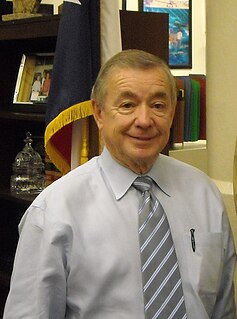
After LSU, Angelo took a position from 1956 to 1962 with Gulf Oil in Crane, south of Odessa, Texas. He and his wife, the former Betty Lou "Penny" Pendergraft, who grew up in Galveston and Houston, made their home in Midland, halfway between Fort Worth and El Paso. The couple has four children, Ernest Eugene Angelo of Carmel, Indiana; Helen Marie Kisner, married to Frank Kisner, a retired lieutenant general in the United States Air Force; Patricia Louise Angelo of Lewisville, Texas, and Clifford Angelo (born Father's Day weekend 1973), a consultant and entrepreneur.[3] From 1962–1964, he was affiliated with Sohio Petroleum. In August 1964, Angelo began his own company, Discovery Exploration[4] in Midland with partners Don L. Sparks and Charles Webb Farish.[3]
Midland's "Mr. Republican"
Angelo joined the Young Republicans while a student at LSU. In Midland, he continued his association with the Republican Party. In 1968, Angelo made the first of two unsuccessful runs as a Republican candidate for the Texas State Senate, having lost to Democrat W. E. "Pete" Snelson, then of Midland. Snelson had unseated long-term Senator Dorsey B. Hardeman of San Angelo in the Democratic primary. In that same 1968 general election, Tom Craddick of Midland, was elected at the age of twenty-five to the Texas House of Representatives. In 2003, Craddick began a six-year stint as House Speaker, the first Republican speaker since Reconstruction. Craddick still serves as the senior member of the Texas House, but he was toppled as Speaker in 2009 by a combination of Moderate Republicans and Democrats, who were organized by the still-sitting Speaker, Joe Straus of San Antonio. Craddick and Angelo have been neighbors since the early 1970s. The two oilmen are godparents to the other's children.[3]
The 96-0 Reagan landslide made impressive headlines and followed thereafter with four more at-large Reagan delegates chosen at the state convention. Angelo said the victory was possible because the party was allowed to write its own rules. Some 420,000 voted in the Republican primary in which Reagan polled 278,300 votes to Ford's 139,994. In the Democratic primary, two candidates easily outpolled Reagan, and a third nearly matched him. Jimmy Carter received 736,032 votes; U.S. Senator Lloyd M. Bentsen, a favorite son for President and a candidate for senatorial reelection, polled 343,033 votes, and George Wallace, the governor of Alabama, drew 270,798 votes. Carter, Bentsen, and Wallace hence polled some three times as many votes as Reagan and Ford combined.[5] The 1976 primary was the first election in Texas in which counties with at least 5 percent Mexican American ethnicity were required to use bilingual ballots.[6]
While he co-managed the Reagan campaign, Mayor Angelo was chosen to be a national committeeman, a position that he retained for twenty years. After Reagan became president, Angelo tried again for the Midland-based state Senate seat, but he lost in 1982 to the Democrat William “Bill” Sims of San Angelo in Tom Green County, 52,868 (47.9 percent) to 57,522 (52.1 percent).[7] This race occurred about a decade before the region between Midland and San Angelo moved strongly into the Republican camp. In that same year, Bill Clements of Dallas, the first Texas Republican governor since 1873, and Houston oilman George Strake, Jr. the GOP candidate for lieutenant governor and later state party chairman, were crushed in an avalanche of Democratic votes. It was the last year through at least 2018 that the Democrats in Texas would win all of the statewide races in Texas, including judgeships. Angelo noted that the poor Republican prospects in Texas in 1982 were blamed on a downturn in the national economy, as Democrats rebounded nationwide in President Reagan's first mid-term election. Angelo said that his defeat by Sims was a “blessing” because he needed to work full-time after 1983 on his business, and his being a state senator would have been too time-consuming to protect his company during a slump. Angelo recalls Clements' defeat by Mark White in 1982 as his own most personally disappointing election loss. Only two years earlier, his most exhilarating victory had been that of Reagan over President Carter just four years after Angelo, Barnhart, and Staff had worked to resurrect Reagan in the Texas primary.[3]
The political organization Americans for Prosperity credits Angelo with "the courage to buck the Republican establishment and support Ronald Reagan. The rest is history. [Angelo should] write a book so we can know more of the details. Ernest Angelo had courage ... Had it not been for Ernest Angelo and Texas in 1976, Reagan may not have become President."[8]
Election as mayor
Angelo's entry into municipal politics was not the result of personal motivation but instead a plea from two friends and fellow businessmen, his neighbor Tom Craddick and Craddick's predecessor in the legislature, former Representative Frank Kell Cahoon, who had been the only Republican in the Texas House of Representatives in the 1965 legislative session. Mayor Edwin H. Magruder Jr. who had an impressive World War II record, did not seek a third two-year term in 1972.[9]
Craddick believed that the leading candidate for mayor, Mayor Pro Tem Pat M. Baskin, a former chairman of the Midland County Democratic Executive Committee, would use the office to try to unseat Craddick's bid for a third term in the House in the 1972 general election. Angelo agreed to run for mayor if Cahoon would seek one of the at-large city council seats. The deal was struck, and both ran and won. Angelo recalls his having defeated Baskin by 150 votes out of some 10,000 cast, a plurality of votes in a system that did not require a runoff election. Angelo considered his opponent to be on the left side of the Democratic Party, but later Baskin switched parties, as West Texas moved increasingly away from the Democrats. Baskin subsequently served as a Republican state court judge. Angelo recalls that Baskin was "a gentleman," popular by virtue of his friendly personality and his involvement in community theater.[3]
Municipal matters
A view of downtown Midland, Texas, taken from West Ohio Avenue (2008).
Mayor Angelo soon found himself involved in the details of municipal matters. He recalls that Midland was low on financial reserves with less than $300,000 in its unappropriated surplus general fund. He and the council hence called for a sales tax election coupled with a lowering in city property taxes even though such a measure had been rejected a year earlier in 1971. No funds were spent to advertise the tax measure. Angelo and the council took on the responsibility of informing voters of the fiscal problems facing the city. The measure passed easily, and Midland prevailed strongly economically throughout the 1970s.[3]
Under Angelo, the city modernized Midland International Airport. Though it is used by neighboring Odessa, the airport is entirely the possession of the City of Midland. When the University of Texas of the Permian Basin became a four-year institution, plans had been to merge Midland and Odessa junior colleges on the Midland campus under a common community college district. Odessa voters, however, voted down the proposal, reflecting longstanding divisions between the two municipalities of common size and different focus in neighboring Midland and Ector counties. Angelo presided over the building of a new central fire station and Midland Center, a civic meeting facility which opened downtown with a large clientele. The first shopping mall, developed by the Simon Company of Indianapolis opened during Angelo's tenure. Federal block grants were employed to upgrade Midland streets and to pave the remaining dirt and gravel roads within the city. Angelo said that the city manager, the late James W. Brown, and his assistant, Fred Poe, carried most of the burden of administrative details and provided continuity during his years as mayor. There were some problems with planning and zoning, but the water and sewer infrastructure proved more than adequate.[3]
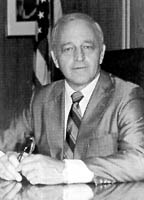
Angelo worked with four at-large council members, and he had the power to break ties. Now, the Midland City Council has six single-member districts with the mayor able to vote on all matters though his vote might not usually be needed except to break a tie. Angelo said the decision by the U. S. courts to require single-member districts in legislative elections has not been productive, at least in Midland. In the single-member concept, council members tend to be focused only on the parochial nature of their districts, rather than the well-being of a city as a whole. Mayor Angelo won again in 1974, 1976, and 1978 with token or no opposition. He did not run in 1980 and was succeeded by Gaylian Thane Akins (1933–2005), also a petroleum engineer in Midland. Angelo jokes that he took office during a downturn in the West Texas oil industry and “my leadership and the Arab oil embargo got Midland booming”, as greater demand developed for drilling West Texas petroleum. Under the Angelo administration, Midland property taxes became the lowest among the twenty-five largest population centers in Texas. In later years, Texans found that tax rates themselves were less critical in calculating their payments than the rising assessed values of their properties.[3]
Political matters
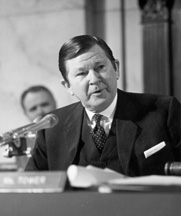
Angelo recalls a trip to Midland by U.S. SenatorJohn G. Tower in 1975, when Angelo informed Tower that he would be working in the forthcoming campaign to draft and nominate Reagan. Angelo recalls Tower as having told him that supporting Reagan would be a "dumb thing to do."[3] At the time, all Republican U.S. senators except Jesse Helms of North Carolina and Paul Laxalt of Nevada were committed to Ford.[3] Tower blamed Ford's defeat in Texas on "Dixiecrats ... the Reagan organization, aided by former Wallace leaders, made a concerted and obviously successful effort to get the Wallace vote in the Republican primary. In addition some section of Ford’s defense and foreign policy alienated some voters who may otherwise have cast their ballot for the president.”[6]
None of the Ford supporters from Texas were delegates to the national convention in Kansas City. Angelo recalls Tower as having "begged" him to allocate a delegate slot for the Senator. Angelo said that Tower could be a delegate if he were committed to supporting Reagan, an impossible condition for Tower because of his longstanding commitment to President Ford. Tower hence was not a delegate to the 1976 convention because Angelo was mindful that a close convention contest could have been decided by a handful of delegate votes. Angelo said that he always personally liked and admired Tower though they disagreed on some issues: "John was the best extemporaneous speaker and solid as a rock on most issues."[3] As time passed though, Tower alienated the conservative wing of his party with his support for abortion and opposition to Reagan's Strategic Defense Initiative.[10] Tower did not seek a fifth term in 1984 and was succeeded by Phil Gramm, a former economicsprofessor at Texas A&M University in College Station.[3]
Angelo recalls having attempted to mediate a political dispute between Tower and his 1972 intraparty rival, state Senator Henry C. Grover of Houston, the party's gubernatorial nominee against Democrat Dolph Briscoe of Uvalde. Grover wanted to install Angelo as state party chairman to replace the Tower partisan, George Williford of Austin. Angelo arranged a meeting in a Houston hotel between Tower and Grover, and the two got into a shouting match and nearly came to blows. "Hank was his own worst enemy. He couldn't get along, let personal things interfere in the political realm," recalls Angelo. In retrospect, Angelo theorizes that the 1972 division within the Texas GOP delayed the election of the first Republican governor, Bill Clements in 1978, beyond what would have otherwise been possible.[3]
Angelo's tenure as mayor corresponded partly with that of Jim Reese in Odessa. When veteran Democratic U.S. Representative George H. Mahon of Lubbock retired, an open election developed for the seat in 1978. Reese entered the Republican primary; so did 31-year-old George W. Bush, son George Herbert Walker Bush, the man would become vice president two years later. Bush won the primary and then lost the general election to then Democrat (later Republican) Kent Hance, subsequently a Texas Railroad Commissioner, the chancellor of Texas Tech University, and a particularly successful lobbyist but never a governor or U.S. senator. Angelo stayed out of the Reese-Bush primary, for he had developed good relations with both men.[3]
In the 1980 Republican presidential campaign, Angelo again worked for Reagan, having been the deputy Reagan-Bush chairman under Governor Clements as well as campaign manager of the 1980 general election campaign in Texas. At the 1984 Republican National Convention in Dallas, Angelo was chairman of the National Advisory Board for Reagan-Bush. He was chairman of the Texas delegation in 1980 and 1984.[11]
Angelo is affiliated with the Texas Society of Professional Engineers as both the Permian Basin president and the state director. In 1973, he was named "Permian Basin Engineer of the Year." In 1981, he was appointed to the National Petroleum Council by then United States Secretary of EnergyJames B. Edwards. He served on the Texas Higher Education Coordinating Board[4] under Governor Clements, on the Texas Parks and Wildlife Commission under Governor George W. Bush,[4] and as chairman of the Texas Public Safety Commission under Governor Rick Perry.[13] In 2008, Angelo garnered the John Ben Shepperd Award for Outstanding Texas Leadership, an honor named for the former state attorney general who called both Gladewater and Odessa home.[3][14] Angelo that same year became a member and director of the Trigon Uranium and the Intercontinental Potash corporations.[11]
Angelo has been a steadfast supporter of Governor Rick Perry, who turned back a determined intra-party challenge on March 2, 2010 from U.S. Senator Kay Bailey Hutchison before he defeated the Democratic nominee, former Houston Mayor William Henry "Bill" White. Angelo said that many in the oil industry in Midland support Perry "to ensure the pro-business climate continues. Midland has a reputation of being a conservative pro-business community."[15]
Angelo is still active as an oilman in Midland.[16]Hhe and his wife reside in the same house on Stanolind Avenue that they bought c. 1970. The Minnesota native who was reared in Louisiana is an adopted West Texan describes Midland as "a very open community ... where people can excel in any endeavor." He attributes the political climate in Midland and West Texas to the oil and gas industry: "These are people with a can-do entrepreneurial independence who support a conservative philosophy of government."[3]
In 2012, Angelo was a leading supporter of Christi Craddick, his neighbor Tom Craddick's daughter, who won election to the Texas Railroad Commission.
John Goodwin Tower was an American politician, serving as a Republican United States Senator from Texas from 1961 to 1985. He was the first Republican Senator elected from Texas since Reconstruction. Tower also led the Tower Commission, which investigated the Iran-Contra Affair, and was an unsuccessful nominee for U.S. Secretary of Defense in 1989.
Harry Steven Bartlett, known as Steve Bartlett, is an American politician and former President and CEO of the Financial Services Roundtable, an advocacy group lobbying the U.S. federal government on financial services legislation, a position which he held from 1999 to 2012. He is the former U.S. Representative for Texas's 3rd congressional district, the former 56th mayor of Dallas, Texas, and is a former member of the Dallas City Council.
William Perry Clements Jr. was twice governor of Texas as a Republican. After making his fortune in crude oil, Clements also served as Deputy Secretary of Defense and Chairman of the Board of Governors at Southern Methodist University.
Kent Ronald Hance is the former Chancellor of the Texas Tech University System. In his role, he oversaw Texas Tech University, Texas Tech University Health Sciences Center and Angelo State University in San Angelo, Texas. He is also a lobbyist and lawyer who was a Democratic member of the United States House of Representatives from West Texas, having served from 1979 to 1985. After his congressional service, he switched to the Republican Party and in 1990 made an unsuccessful primary race for governor of Texas.
Thomas Russell Craddick Sr., known as Tom Craddick, is member of the Texas House of Representatives representing the 82nd district. Craddick was Speaker of the Texas House of Representatives from January 2003 to January 2009. He was the first Republican to have served as Speaker since Reconstruction. Craddick resides in Midland, the largest city in his district. Craddick was first elected in 1968 at the age of twenty-five. By 2012, he was already the longest-serving member of the Texas state legislature and the second-longest-serving representative in the history of the state.
Henry Cushing Grover, usually known as Hank Grover, was a conservative politician from the U.S. state of Texas best known for his relatively narrow defeat as the Republican gubernatorial nominee in 1972.
James Mitchell "Jim" Collins was a Republican who represented the Third Congressional District of Texas from 1968-1983. The district was based at the time around Irving in Dallas County.
Richard Peña Raymond is a Democratic member of the Texas House of Representatives for District 42, which encompasses western Webb County and includes the city of Laredo. He chairs the Human Services Committee and is a member of the Ways & Means Committee.
Warren Darrel Chisum is a conservative Republican former member of the Texas House of Representatives from the Panhandle city of Pampa, a community of some 20,000 people and the seat of Gray County, Texas. His service began in January 1989. A key lieutenant of former Speaker Thomas Russell "Tom" Craddick, Sr., of Midland, Chisum chaired the budget-writing House Appropriations Committee from 2007 to 2009.
Paul Walter Eggers was an Indiana native who was the Republican nominee for governor of Texas in both 1968 and 1970, when the state still had two-year gubernatorial terms. Eggers' races for governor were his only attempts at elected office. At the time, he was a largely unknown tax attorney in Wichita Falls in North Texas.
John Nesbett Leedom, Sr., was an engineer, businessman, and lobbyist from Dallas, Texas, who served from 1981 to 1996 as a Republican member of the Texas State Senate from District 16. He is best known as the author of the law which established the Texas "Rainy Day Fund." From 1989 to 1991, he was one of several members designated as Senate President Pro Tempore in the 71st legislative session.
O. H. "Ike" Harris is an attorney and lobbyist in Austin, Texas, who served from 1963 to 1965 and 1967 to 1995 as a Republican member from Dallas County in both houses of the Texas State Legislature. He was elected to his single term as a state representative in 1962. His Senate tenure in District 8 ran from 1967 to 1995. In his final 1993–1995 biennial term, Harris was the dean, or senior member in tenure, among all of the state senators.
Ray Anderson Barnhart was a businessman and Republican politician, formerly from Pasadena in Harris County, Texas.
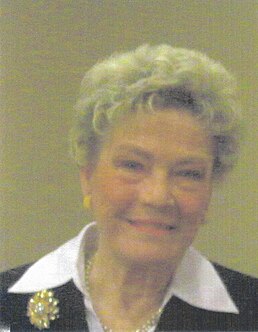
Barbara Ruth Wright Staff is a retired Republican political activist from Plano, Texas. She was co-chairman of her state's 1976 Ronald Reagan presidential primary campaign.
Frank Kell Cahoon, Sr., was an oilman and natural gas entrepreneur from Midland, Texas, who was the only Republican member of the Texas House of Representatives in the regular 1965 legislative session. Cahoon served two terms in the legislature from 1965 to 1969.
Elizabeth Richards Andujar, known as Betty Andujar, was a homemaker, civic activist, and politician, the first Republican woman to be elected and serve in the Texas State Senate. From 1973 to 1983, Andujar represented District 12 in Fort Worth, the seat of Tarrant County in North Texas.
Walter Henry Mengden, Jr., was an attorney and oilman in Austin and Houston, Texas, who was a Republican former member of both houses of the Texas State Legislature from Harris County.
James O'Quinn Reese, known as Jim Reese, was a businessman who served from 1968 to 1974 as the mayor of Odessa, Texas. From the 1960s to the 1980s, he was a figure in the development of the two-party system in West Texas. In 1978, he lost the Republican nomination to future U.S. President George W. Bush for Texas' 19th congressional district seat in the United States House of Representatives. Bush was then defeated in the 1978 general election by the then Democrat, later Republican, Kent Hance.
Christi Leigh Craddick is one of three members of the Texas Railroad Commission, the elected regulatory body over oil, natural gas, utilities, and surface mining first established in 1891. She is a Republican. The commission ended all controls over railroads in 2005 but is still known as the "Railroad Commission" for historical reasons.
This page is based on this Wikipedia article Text is available under the CC BY-SA 4.0 license; additional terms may apply. Images, videos and audio are available under their respective licenses.