The Hamilton-Brown Shoe Factory was the first large scale industrial operation in Columbia, Missouri. It was built in 1906-1907 by the Brown Shoe Company, the largest shoe manufacture in the world at the time. It was the first plant built outside of St. Louis and was operational from 1907-1939 The building today has been converted into offices.

The Haverhill Board of Trade Building is a historic factory building at 16-18 and 38-42 Walnut Street in Haverhill, Massachusetts. The seven-story brick building was built in stages between 1906 and 1908 by the Haverhill Board of Trade, a consortium of local businessmen. The purposes of the building was to provide affordable factory space to small business operators, principally in the shoe manufacturing business that dominated Haverhill's economy in the early 20th century. The building also marked an expansion of Haverhill's business and industrial district into a previously residential area. The building was listed on the National Register of Historic Places in 2007. It has been converted to residential use.

The Lynn Realty Company Building No. 2 is a historic commercial building at 672-680 Washington Street in Lynn, Massachusetts. A long rectangular eight story brick building, it was built in 1902 to a design by local architect Henry Warren Rogers. The building is three window bays wide and seventeen long. Although it originally formally fronted on Washington Street, it extends on its long axis for most of a city block along Farrar Street. The original Washington Street entrance has been filled in, and the present entrance is now at what was the rear of the building, the southeast side, where there is a metal awning leading to a modern glass door. Windows on the street-facing sides are paired, with granite sills and header arches of a lighter-colored brick than the main body of the building. Brick pilasters rise between these paired windows the full height of the building, to a modestly-corbelled cornice.
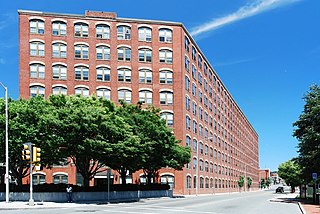
The Vamp Building is a historic factory building at 3-15 Liberty Square in downtown Lynn, Massachusetts. The eight-story brick building was built in 1903 as the Lynn Realty Company Building #4 to a design by local architect Henry Warren Rogers, and was extended over the next four years to occupy the entire city block bounded by Washington Street, Union Street, and Liberty Square. The "flatiron" V-shape of the building was the basis for its name, as it resembles the shape of the vamp of a shoe. The building served in its early years as a home for all manner of businesses related to the manufacture of shoes. At the time of its construction it was the largest brick building of its kind in the world.

Albert Bartleton Groves, also known as A.B. Groves or Albert B. Groves, was an American architect who practiced in the St. Louis, Missouri area.

Eby Shoe Corporation, also known as Fleet-Air Corporation, is a historic factory building complex located at Ephrata, Lancaster County, Pennsylvania. The property includes three contributing buildings to the listing. Building "A" was built about 1900, and is a four-story, gable roofed brick building with a two-story flat roofed addition. Building "B" was built in 1919-1920, and is a three-story, gable roofed brick building measuring 48 feet wide and 115 feet deep. Building "C" was built in 1923, and is a four-story, steel frame building with a brick exterior. It measures 48 feet wide and 180 feet deep. The Eby Shoe Corporation closed in 1985.

Landis Shoe Company Building is a historic factory building located at Palmyra, Lebanon County, Pennsylvania. It was built in 1905-1906 and expanded in 1911, and is a three-story, brick building on a stone foundation. It is 26 bays wide by 4 bays deep.

The Charles H. Hayes Building is a historic former box factory at 14-44 Granite Street, Haverhill, Massachusetts. Built in two phases, the building represents the city's industrial growth around the turn of the 20th century. It was built by Charles H. Hayes, whose business empire also included locally important shoe manufacturers, as well as forest lands in four states to supply his operations. The building was listed on the National Register of Historic Places in 2010.

The Hoyt Shoe Factory is a historic factory complex at 470 Silver Street and 170 Lincoln Street in Manchester, New Hampshire. It consists of two once-identical four-story brick factory buildings which face each other across Silver Street. Built in the 1890s, they housed the city's largest shoe manufacturer, an industry that gained in significance as its textile industry declined. The complex was listed on the National Register of Historic Places in 1985.

The Kimball Brothers Shoe Factory is a historic factory building at 335 Cypress Street in Manchester, New Hampshire. The four-story brick building was built in stages between 1885 and 1900, and was a prototypical structure from which the design of other period shoe factories in Manchester were built. Construction was overseen by Head & Dowst, a builder responsible for a number of area public buildings, including schools and prisons. It was funded by local businessmen seeking to diversify the local economy, and was leased to the Kimball Brothers, a leading shoe manufacturer in Lynn, Massachusetts. The building was listed on the National Register of Historic Places in 1985.

The Woodbury Mill is a historic mill building at 1 Dover Street in Dover, New Hampshire. This five-story utilitarian brick mill building was built in 1885 by the Dover Improvement Association as a factory space for small footwear manufacturers to operate in, representing an organized effort by city businessmen to attract this type of business. It was used for shoe manufacturing until 1979, and was listed on the National Register of Historic Places in 2013.

The Queensbury Mill is a historic mill building at 1 Market Street in Somersworth, New Hampshire. Built in 1884, it is unusual for the period for its wood-frame construction, and for its financing, executed by local businessmen to attract shoe manufacturers to the city. The mill was listed on the National Register of Historic Places in 1987. The building has been converted into apartments.
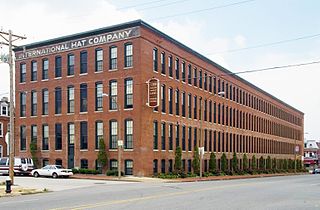
Brown Shoe Company's Homes-Take Factory, also known as the International Hat Company Warehouse, is a historic building location at 1201 Russell Boulevard in the Soulard neighborhood of St. Louis, Missouri. Built in 1904, by renowned architect Albert B. Groves, the building was originally a factory for the Brown Shoe Company, based in St. Louis. In 1954, the factory was subsequently converted into a warehouse by the International Hat Company. The site has been recognized as a testament to Grove's architectural expertise in the principles of factory design, namely technical advances in layout planning, operational efficiency, and employee safety. Additionally, the factory epitomizes the early 20th century cultural transformation and socio-industrial development of St. Louis into a manufacturing powerhouse. In particular, the Brown Shoe Company is recognized as a principal player in challenging the 19th century dominance of the New England shoe industry. This significantly contributed to the early 20th century sobriquet of St. Louis as the city of "shoes, booze, and blues." The Brown Shoe Company's Homes-Take factory is considered to be among the pioneering industrial facilities of this historic transformation.

H. Lauter Company Complex, also known as J. Solotken Company, Lauter Lofts, and Harding Street Lofts, is a historic factory complex located at Indianapolis, Indiana. It was built between 1894 and 1912, and includes the South Factory, the North Factory, and the Office Building. The factory buildings are in the Italianate and the office building is in the Classical Revival style. The North Factory is a four-story brick building with a raised full basement constructed sometime between 1908 and 1912. The Office Building is a two-story brick building constructed between 1899 and 1908 and has a truncated hipped roof. The four-story, U-shaped core of the South Factory was built in two phases; the eastern portion between 1894 and 1898 and the western portion in 1899. The H. Lauter Company furniture manufacturer began in 1894 and they continued to operate at the location until 1936. The buildings have been converted to condominiums and apartments.

Hamilton-Brown Shoe Company Building, now the Selwyn Place Apartments, is a historic factory building located at Boonville, Cooper County, Missouri. It was built in 1919 by the Hamilton-Brown Shoe Company, and is a four-story, rectangular brick industrial building with a flat roof. The roof is framed by a corbelled parapet capped with tile coping. The building features a five-story elevator tower and four-story tower which housed restrooms. Also on the property are the contributing power plant building and oil house.

J.E. King Manufacturing Company, also known as the Long-King Furniture, Cloud Furniture Manufacturing, and Springfield Seed Company, is a historic daylight factory building located at Springfield, Greene County, Missouri. It was built in 1922, and expanded in the 1930s and 1940s. It is a two-story, L-shaped red brick building with a Streamline Moderne Style-influenced glass block storefront at first floor level. Also on the property is a contributing building that housed electrical transformers.

Ely Walker Lofts is a building located at 1520 Washington Avenue in St. Louis, Missouri.
George William Hellmuth (1870-1955) was an American architect based in St. Louis, Missouri.

The Steelcote Manufacturing Company Paint Factory, at 801 Edwin in St. Louis, Missouri, was built in 1922. It was listed on the National Register of Historic Places in 2007.
The M.C. Kiser Company Building is a historic building in Atlanta, Georgia, United States. Located in the South Downtown neighborhood, it was built in 1923 as a shoe factory, converted to apartments in 2017, and added to the National Register of Historic Places in 2019.