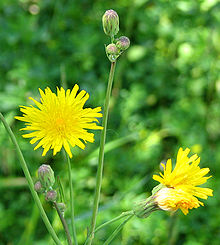
Hieracium , known by the common name hawkweed and classically as hierakion, is a genus of the sunflower (Helianthus) family Asteraceae), and closely related to dandelion (Taraxacum), chicory (Cichorium), prickly lettuce (Lactuca) and sow thistle (Sonchus), which are part of the tribe Cichorieae. Hawkweeds, with their 10,000+ recorded species and subspecies, do their part to make Asteraceae the second largest family of flowers. Some botanists group all these species or subspecies into approximately 800 accepted species, while others prefer to accept several thousand species. Since most hawkweeds reproduce exclusively asexually by means of seeds that are genetically identical to their mother plant, clones or populations that consist of genetically identical plants are formed and some botanists prefer to accept these clones as good species whereas others try to group them into a few hundred more broadly defined species. What is here treated as the single genus Hieracium is now treated by most European experts as two different genera, Hieracium and Pilosella, with species such as Hieracium pilosella, Hieracium floribundum and Hieracium aurantiacum referred to the latter genus. Many members of the genus Pilosella reproduce both by stolons and by seeds, whereas true Hieracium species reproduce only by seeds. In Pilosella, many individual plants are capable of forming both normal sexual and asexual (apomictic) seeds, whereas individual plants of Hieracium only produce one kind of seeds. Another difference is that all species of Pilosella have leaves with smooth (entire) margins whereas most species of Hieracium have distinctly dentate to deeply cut or divided leaves.
A dry roadside dotted with small, ¾ inch red orange flowers, interspersed with very similar yellow ones, and often the white of daisies, is a good sign that you are in Hawkweed country.

Pilosella officinarum, known as mouse-ear hawkweed, is a yellow-flowered species of flowering plant in the daisy family Asteraceae, native to Europe and northern Asia. It produces single, lemon-coloured inflorescences. Like most hawkweed species, it is highly variable and is a member of a species complex of several dozens of subspecies and hundreds of varieties and forms. It is an allelopathic plant.
In botany, an infraspecific name is the scientific name for any taxon below the rank of species, i.e. an infraspecific taxon. The scientific names of botanical taxa are regulated by the International Code of Nomenclature for algae, fungi, and plants (ICN). This specifies a 'three part name' for infraspecific taxa, plus a 'connecting term' to indicate the rank of the name. An example of such a name is Astrophytum myriostigma subvar. glabrum, the name of a subvariety of the species Astrophytum myriostigma.

Desmodium is a genus in the flowering plant family Fabaceae, sometimes called tick-trefoil, tick clover, hitch hikers or beggar lice. There are dozens of species and the delimitation of the genus has shifted much over time.

Dalea is a genus of flowering plants in the legume family, Fabaceae. Members of the genus are commonly known as prairie clover or indigo bush. Its name honors English apothecary Samuel Dale (1659–1739). They are native to the New World, where they are distributed from Canada to Argentina. Nearly half of the known species are endemic to Mexico. Two species of Dalea have been considered for rangeland restoration.

Hieracium lachenalii also known as common hawkweed or yellow hawkweed is a species of plant in the dandelion tribe within the sunflower family. It is native to Europe but has become established as a weed in Australia and parts of North America. The species was widely known for many years as H. vulgatum but more recent studies indicated that the two names represented the same species. The name H. lachenalii was coined in 1802, H. vulgatum in 1819, so the older name is to be used.
Pilosella caespitosa is like several other Pilosella species and has a similar appearance to many of the hawkweeds.

Hieracium albertinum, known as western hawkweed or houndstongue hawkweed, is a species of the genus Hieracium that is very similar to Hieracium albiflorum with white flowers but differs in that the flower heads are clustered and the leaves, stems and bracts are covered in a thick layer of hairs. Standing 1 inch (3 cm) to 5 inches (13 cm) tall, it can be found blooming from June through August in forest clearings.
Hieracium rigorosum, a name for a plant in the hawkweed genus Hieracium, has been identified as synonyms of two different species:
Hieracium stiptocaule, a name for a plant in the hawkweed genus Hieracium, is a synonym of two different species:
Hieracium devoldii, a name for a plant in the hawkweed genus Hieracium, has been identified as a synonym of two different species:
Hieracium musartutense, a name for a plant in the hawkweed genus Hieracium, has been identified a synonym of two different species:
Hieracium nepiocratum, a name for a plant in the hawkweed genus Hieracium, has been identified a synonym of two different species:
Hieracium eugenii, a name for a plant in the hawkweed genus Hieracium, has been identified as a synonym of two different species:
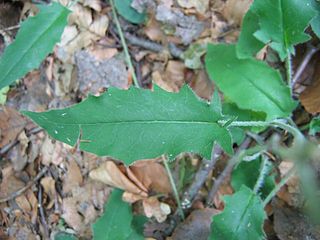
Hieracium murorum, the wall hawkweed, is a species of flowering plant in the sunflower family. It is native to Europe and naturalized in some of the colder regions of North America.

Hypericum canadense, known as Canadian St. Johns-wort, lesser St. John's wort, and lesser Canadian St. Johnswort, is a flowering plant in the genus Hypericum. It is a yellow-flowering annual or perennial herb native to North America and introduced to Ireland and The Netherlands. The specific epithet canadense means "Canadian".