| KF-X | |
|---|---|
| | |
| KAI KF-X miniature at Seoul ADEX 2017 | |
| Role | Multirole fighter |
| Manufacturer | Korea Aerospace Industries (KAI) |
| Design group | Agency for Defense Development |
| Primary user | Republic of Korea Air Force (intended) Indonesian Air Force (intended) |
The KAI KF-X is a joint South Korean and Indonesian multirole fighter aircraft development program with the goal of producing an advanced multirole fighter for the South Korean and Indonesian air forces. The airframe is stealther than other 4th generation fighters but does not carry weapons in one or more internal bays like 5th generation fighters. The program is led by South Korea, which holds 80% of shares. Indonesia joined in 2010 for 20% (although its ongoing participation is in doubt), and the remainder is held by private partners including manufacturer Korean Aerospace Industries (KAI). The KAI KF-X is South Korea's second domestic fighter jet development program, following the FA-50. [1]
The KF-X development program is also known as Boramae (보라매, Korean for "hawk"), and in Indonesia is sometimes referred to as IF-X. As of September 2019, [update] prototypes are under construction with the first of these expected to be completed by mid-2021. The first test flight is anticipated in 2022, with manufacturing scheduled to begin in 2026. South Korea expects to deploy 120 of the aircraft into service by 2032. [2] [3] [4] [5]
The KF-X advanced multirole jet fighter project, intended to produce modern warplanes to replace South Korea's aging F-4D/E Phantom II and F-5E/F Tiger II aircraft, was first announced in March 2001 by South Korean President Kim Dae-jung at a graduation ceremony of the Korea Air Force Academy. [6] Research and development (R&D) requirements were determined by the Joint Chiefs of Staff in 2002. [7] :18 The project was felt to be extremely ambitious, with the Korea Institute for Defense Analyses (KIDA, a defense ministry think-tank) doubtful of the country's ability to complete the complicated project. [8] The development phase had numerous delays and postponements and its economic cost was debated, but the project received renewed interest following a 2008 feasibility study and attacks by North Korea in 2010. [8] [9] Although the project carried risks and the expected per-unit cost would be significantly higher than purchasing from foreign manufacturers, the development of the domestic defense industry was deemed to be of national importance and was expected to have a ripple effect on high-tech industries. [7] :22, 37
On 15 July 2010, a partnership was made with Indonesia, which would provide 20% of the funding for the KF-X project, cooperate with technological development through state-owned Indonesian Aerospace, and purchase 50 of the approximately 150–200 aircraft anticipated to be produced. [6] Turkey had also considering joining with a 20% share, but wanted more control than South Korea had offered. The South Korean government committed to 60% of the cost. [8] The remaining 20% was provided by domestic and foreign companies. [7] :18 Korean Aerospace Industries (KAI) won the production bid, and partnered with Lockheed Martin for technological support. [8] The contract formed a plan for delivery of the aircraft to begin in 2026. [10]
In Indonesia, the project is referred to as IF-X or IFX. [8] [11] The Jakarta Globe reported that the completed aircraft will receive the designation F-33. [8] The project is also called Boramae, [8] [7] :25 Korean for "hawk", the symbol of the Korean Air Force Academy. [12]
The initial goal for the program was to develop a single-seat twin-engine multirole fighter with stealth capabilities exceeding both the Dassault Rafale and Eurofighter Typhoon but less than those of the Lockheed Martin F-35 Lightning II. [8] The Weapon Systems Concept Development and Application Research Center of Konkuk University advised that the KF-X should be superior to the F-16 Fighting Falcon, with 50% greater combat range, 34% longer airframe lifespan, better avionics, active electronically scanned array (AESA) radar, more-effective electronic warfare, and data link capabilities. Their recommendations also specified approximately 50,000 pounds-force (220,000 N) of thrust from two engines, supersonic interception and cruising capabilities, and multi-role capabilities. [13] The project requirements were later downgraded by the Republic of Korea Air Force (ROKAF) to a 5th-generation fighter with limited stealth capabilities. [8]
South Korea possessed 63% of the necessary technology to produce the KF-X,[ citation needed ] and sought cooperation from other countries. [13] To facilitate a technology transfer, the Agency for Defense Development (ADD) proposed two primary concepts for the KF-X: C103, which resembled the F-35; [8] [14] and C203, which resembled European fighters with forward canards (the design chosen would depend on whether a development deal was reached with the US or European partners). [8] The C501 (a.k.a. KFX-E) was a third design, [8] proposed by KAI [14] and supported by the Defense Acquisition Program Administration (DAPA), [15] which attempted to reduce costs with a smaller, single-engine fighter, but it had inferior performance to the F-16 and was unsuitable for the large airspace of Indonesia. [8] ROKAF preferred the benefits of a twin-engine design, with better combat performance and safety, and a larger airframe with room for upgrades. These upgrades could lead to a future reclassification as a fifth-generation fighter, while the C501 was closer to fourth generation. [15] [16]
In 2014, the C103 configuration was chosen and Lockheed Martin agreed to transfer two dozen F-35A technologies as part of a purchase deal. However, the US government blocked the transfer of four vital technologies: AESA radar, infrared search and track (IRST), electro-optical target tracking devices, and radio jammer technology. South Korea was thus required to develop these technologies domestically. [8] A 2015 audit estimated that 87% of technologies for the project had been secured. [7] :23 The preliminary design was finalized in June 2018. [2] In September 2019, a critical design review examined 390 technical data sets and confirmed that the KF-X was adequate to ROKAF's requirements. [5] [3] [4]
| [ citation needed ] | KAI KFX-E | ADD C103 | ADD / KAI C105 | ADD / KAI C109 |
|---|---|---|---|---|
| Empty weight | 9,300 kg (20,500 lb) | 10,900 kg (24,000 lb) | 11,100 kg (24,420 lb) | 11,800 kg (26,000 lb) |
| Max weight | 20,900 kg (46,000 lb) | 24,000 kg (53,000 lb) | 24,500 kg (53,900 lb) | 25,400 kg (56,000 lb) |
| Internal fuel | 3,600 kg (8,000 lb) | 5,400 kg (12,000 lb) | 5,400 kg (12,000 lb) | 5,400 kg (12,000 lb) |
| Wingspan | 9.8 metres (32 ft) | 10.7 metres (35. 2 ft) | 11.0 metres (36. 08 ft) | 11.2 metres (36. 75 ft) |
| Length | 15.2 metres (50 ft) | 15.7 metres (51. 3 ft) | 16.0 metres (52. 49 ft) | 16.9 metres (55. 4 ft) |
| Wing area | 37.1 square metres (399 sq ft) | 42.7 square metres (460 sq ft) | 42.7 square metres (460 sq ft) | 46.5 square metres (501 sq ft) |
| Engine | 1 × P&W F100 or GE F110 | 2 × EJ200 or GE F414 | 2 × GE F414 | 2 × GE F414 |
| Hardpoints | 9 | 10 | 10 | 10 |
| Weapons bay | None | Space provided | Space provision | Space provision |
| Estimated cost | ? | ? | ? | ? |
This section contains a list of miscellaneous information.(March 2020) |
A 2015 government audit placed the development cost of the project at ₩ 8.8 trillion [7] :18 (equivalent to ₩9.06 trillionor US$ 8.01 billion in 2017) [17] . In an agreement signed at the end of 2015, Indonesia agreed to provide 20% of the development costs, [10] KAI would provide an additional 20%,[ citation needed ] and the Korean government would support the remainder. [10] [ better source needed ]
| Calendar Year | Expenditures on R&D | Total | Ref | |
|---|---|---|---|---|
| Korea | Indonesia | |||
| 2011 2012 | ₩ 44 bn | ₩11 bn | ₩55 bn | [7] :21 |
| Calendar Year | Expenditures on R&D | Total | ||
|---|---|---|---|---|
| DOD | KAI | Indonesia | ||
| 2015 | ₩55.2 bn (US$50.9 mn) [18] | ? | ? | |
| 2016 | ₩67 bn (US$61.8 mn) [19] | ? | ? | |
| 2017 | ₩303 bn (US$279.6 mn) [19] | ? | ? | |
| 2018 | ₩435.3 bn (US$401.7 mn) [20] | ? | ? | |
| 2019 | ₩664 bn (US$595.1 mn) [21] | ? | ? | |
On 15 July 2010, the Indonesian government agreed to fund 20% of the KF-X project cost in return for one prototype, design participation, technical data, and production sharing. [22] On 2 August 2011, a joint research center was opened in Daejeon, South Korea. [23] [24]
In November 2017, Indonesia, through state-owned Indonesia Aerospace, failed to pay its share in the latest round of development costs, prompting criticism from South Korea. [8] [25] As of 2019, Indonesia was renegotiating its involvement in the program. [2] FlightGlobal reported in July 2019 that Indonesia was exploring payment in Indonesia-produced armaments instead of cash. [4] By July 2019, Indonesia was approximately ₩300 billion in arrears. [26]
According to a September 2020 report Indonesia had paid only 10 million USD since 2016 on research and development stage and owed about 420 million USD. [27] Another report stated that Indonesia paid 205 million USD for research and development and owed about 420 million USD. [28] In December 2020, a report showed that Indonesia was likely to pull out of the project, [29] while another stated that South Korea and Indonesia plan to move forward the KFX/IFX project. [30]
This section has multiple issues. Please help improve it or discuss these issues on the talk page . (Learn how and when to remove these template messages) (Learn how and when to remove this template message)
|
While KAI was the primary builder, numerous other domestic and foreign companies were contracted to provide aircraft components or support. Several of these firms had worked with KAI on the T-50. For certain sensitive technologies, foreign companies only consulted for testing support in order to avoid arms-trading restrictions. [31] [32] [33]
Hanwha Techwin signed an agreement with GE to manufacture General Electric F414 engines for KF-X aircraft. According to the contract, Hanwha is to manufacture key parts, locally assemble the engines, and oversee the installation of the engine on the aircraft. The company will also support flight testing and build an extensive support system for the aircraft's operations. [34] [35] [36]
A Defense News report stated that the AESA radar would be a particular challenge; [37] it was developed by Hanwha Systems with assistance from other domestic firms and support from foreign companies. Elta Systems helped to test the prototype AESA, [31] [38] and Saab worked with LIG Nex1 on software development and evaluation. [39] [32]
In addition to working on the AESA, LIG Nex1 is to develop a radio jammer. [40] [41] [42]
US aerospace contractor Texstars was selected by KAI to develop canopy and windshield transparencies for KF-X. Under the contract, Texstars will work alongside KAI to provide the KF-X fighter with birdstrike resistant transparencies with high-quality optics. [43] [44]
Triumph Group was selected by KAI to provide airframe mounted accessory drives (AMADs) for the KF-X. Triumph will develop and manufacture the AMADs, which transfer engine power to other systems. [45] [46]
Aeronautical Systems (Spanish: Compañía Española de Sistemas Aeronáuticos, CESA), a subsidiary of Héroux-Devtek, was contracted to develop the emergency braking system. [47] [48]
United Technologies announced in February 2018 that it was providing the environmental control system, including cabin pressurization and liquid cooling systems, as well as the air turbine starter and flow control valve. [49] [50]
Martin-Baker was contracted to provide the Mk18 ejection seat escape mechanism. [33] [51]
Cobham received contracts to provide missile ejection launchers, communications antennae, external fuel tanks, and oxygen systems. [52]
Meggitt was contracted to provide a wheel braking system, [53] standby flight displays, and internal sensors including a fire detection system. [54] [55] [56]
MBDA was contracted to integrate the Meteor beyond-visual-range air-to-air missile (BVRAAM) onto the aircraft. [57] [58]
Elbit Systems was contracted by Hanwha Systems to provide terrain-following/terrain avoidance (TF/TA) systems for the aircraft. [59] [60]
Curtiss-Wright was contracted by KAI to Provide complete flight test instrumentation (FTI) system, it is data acquisition system (DAS) for use in flight-test campaigns. [61] [62]
In February 2019, KAI began production work on the KF-X prototype, with six expected to be completed in 2021. These are to undergo four years of trials, and complete the development process by mid-2026. [63] DAPA anticipated a first test flight in 2022. [2]
In October 2009, a retired ROKAF general was arrested for leaking classified documents to Saab. The general was alleged to have been given a bribe of several hundred thousand won for copies of a number of secret documents that he had photographed. Saab officials denied any involvement. [64] [65] [66]
The Defense Security Command (DSC) found evidence that another foreign defense firm had also bribed a member of the Security Management Institute (SMI). President Lee Myung-bak believed that such corruption resulted in a 20% increase in the defense budget. [67] [ needs update ]
KIDA told a public meeting that South Korea is not technologically equipped to develop the KF-X aircraft, that the project is economically unviable and that the KF-X would not be a successful export product. It also questioned the ADD cost estimates. [68] DAPA's estimated ₩ 6 trillion development cost was criticized by some analysts, who said the project could cost up to ₩8.5 trillion. [69] [70]
Defense researcher Lee Juhyeong held a seminar on the program, stating that the KF-X development would cost more than ₩10 trillion (US$9.2 billion) and could cost more than twice as much as an imported aircraft over the life of the program. [71]
Critics noted that the KF-X would cost up to twice as much as a top-end F-16 model and that Japan had encountered a similar situation with its Mitsubishi F-2. [72]
On 23 May 2013, EADS (European Aeronautic Defence and Space Company, the defense subsidiary of Airbus) offered a US$2 billion investment into the KF-X program if South Korea selected its Eurofighter Typhoon for the F-X Phase 3 fighter procurement program. [73] The F-35A was selected instead, and EADS repeated its investment offer for a split-buy of 40 Eurofighters and 20 F-35As. [74] But in September 2017, South Korea confirmed purchased of 40 F-35 fighter jets, causing EADS to withdraw its offer. [75]
The KF-X project had a history of delays and postponements since its announcement in 2001. Foreign partners were sought to share costs and guarantee purchases, and several failed attempts were made to entice Sweden, Turkey, and the United States to join the project. Design concepts and requirements frequently changed while trying to appeal to prospective partners. On 1 March 2013, following the election of President Park Geun-hye, South Korea postponed the project for 18 months, due to financial issues. [69] [70]
On 8 February 2017, Indonesian Vice Minister of Foreign Affairs Abdurrahman Mohammad Fachir said that the KF-X project was further delayed because the US government had refused export licenses for four key F-35 technologies. This disapproval was reaffirmed in October 2015 talks, though the US military stated that there was an agreement to form an interagency working group on such issues and that the US Secretary of Defense would "think of ways for joint cooperation" with technology for KF-X. [76] [77] [78]
On 1 November 2017, state-owned Indonesia Aerospace was overdue in its funding payment, which National Assembly Defense Committee member Kim Jong-Dae said would further delay or suspend the project. [79] [80] Kim said that the Indonesian government had disclosed its difficulty in paying and did not include the payment in its budget. However, DAPA stated that it was in talks with Indonesia regarding the payment, which would be discussed at a summit between leaders of the countries. [25] [ needs update ] Indonesia stated that it was an administrative error, as it was falsely thought that the payment would be made from the "side defense budget". Parliamentary approval was required to correct the error, [81] and the payment was delivered along with a statement of hope that the program would continue without further delinquencies. [82]
On 1 May 2018, it was reported that Indonesia had complaints concerning the contract rules surrounding technical benefits and export licensing. Indonesian state media announced that the defense ministry would renegotiate the joint development program in an attempt to gain a larger share of local production, as well as export rights. The Indonesian defense ministry added that it hoped that the program would continue despite setbacks. [83]
Renegotiation talks continued into 2019. According to the agenda of a January 2019 meeting, Indonesia sought to extend its involvement in the program to 2031, and was interested in making part of its payments in trade for Indonesian-produced defense equipment. [4] [84] By August, Indonesia had transport aircraft on offer along with commodities. [85] [26]
Data from Defense Acquisition Program Administration (DAPA) [86] [ better source needed ]
General characteristics
Performance
Armament
Avionics
Aircraft of comparable role, configuration, and era
Related lists
The McDonnell DouglasF-15E Strike Eagle is an American all-weather multirole strike fighter derived from the McDonnell Douglas F-15 Eagle. The F-15E was designed in the 1980s for long-range, high-speed interdiction without relying on escort or electronic-warfare aircraft. United States Air Force (USAF) F-15E Strike Eagles can be generally distinguished from other US Eagle variants by darker aircraft camouflage, conformal fuel tanks (CFTs) mounted along the engine intake ramps and a tandem-seat cockpit.
The KAI T-50 Golden Eagle (골든이글) is a family of South Korean supersonic advanced jet trainers and light combat aircraft, developed by Korea Aerospace Industries (KAI) with Lockheed Martin. The T-50 is South Korea's first indigenous supersonic aircraft and one of the world's few supersonic trainers. Development began in the late 1990s, and its maiden flight occurred in 2002. The aircraft entered active service with the Republic of Korea Air Force (ROKAF) in 2005.
The Republic of Korea Air Force, also known as the ROK Air Force, is the aerial warfare service branch of South Korea, operating under the Ministry of National Defense of the Republic of Korea.
The KP-SAM Shin-Gung or Shin-Kung is a South Korean shoulder-launched surface-to-air missile manufactured by LIG Nex1. It is marketed internationally as the Chiron.
Hanwha Techwin, founded as Samsung Techwin, is a surveillance and optoelectronics company. It is a subsidiary of Hanwha Group. The company employs 4,501 people and is headquartered in South Korea. Its totals sales in 2014 were 2,615 billion South Korean won.
The General Electric F414 is an American afterburning turbofan engine in the 22,000-pound thrust class produced by GE Aviation. The F414 originated from GE's widely used F404 turbofan, enlarged and improved for use in the Boeing F/A-18E/F Super Hornet. The engine was developed from the F412 non-afterburning turbofan planned for the A-12 Avenger II, before it was canceled.

Indonesian Aerospace (IAe) or official Indonesian name PT Dirgantara Indonesia (Persero) is an Indonesian aerospace company involved in aircraft design and the development and manufacture of civilian and military regional commuter aircraft. The company was formerly known as Industri Pesawat Terbang Nusantara. It was expanded from a research and industrial facility under the auspices of the Indonesian Air Force, namely Lembaga Industri Penerbangan Nurtanio (LIPNUR) or Nurtanio Aviation Industry Institute.

Korea Aerospace Industries (KAI) is a South Korean aerospace and defense company. It was originally established as a joint venture of Samsung Aerospace, Daewoo Heavy Industries' aerospace division, and Hyundai Space and Aircraft Company (HYSA). During 1999, KAI became more independent of its founding members, acquiring their aerospace interests at the behest of the South Korean government following the financial troubles of these companies that had resulted from the 1997 Asian financial crisis.
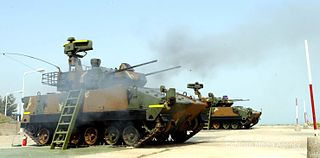
The South Korean K30 Biho twin 30 mm self-propelled anti-aircraft weapon was developed to meet the operational requirements of the Republic of Korea Armed Forces for a highly mobile short range air defense system suited to the operational and terrain conditions of the Korean peninsula. It combines an electro-optically guided 30 mm gun system with a surveillance radar system on a K200 chassis. It supplements the K263A1 Chungung, a self-propelled 20 mm Vulcan system.
KFX may refer to:
The Indonesian Air Force is the aerial branch of the Indonesian National Armed Forces. The Indonesian Air Force is headquartered in Jakarta, Indonesia and is headed by the Chief of Staff of the Air Force. Its order of battle is split into three Air Force Operational Commands. Most of its airbases are located on the island of Java. The Indonesian Air Force also has its ground force unit, called Air Force Special Forces Corps (Paskhas). The corps is also known as the "Orange Berets" due to the distinctive color of their service headgear. In addition, while not part of the Air Force, most of the personnel of the Indonesian National Air Defense Forces Command (Kohanudnas) are picked from the Air Force, and its commander is always an Air Force two-star Marshal.
The KAI KT-1 Woongbi is a Korean single-engined turboprop, basic training aircraft. It was jointly developed by Korean Aerospace Industries (KAI) and the Agency for Defence Development (ADD). The KT-1 is the first completely indigenous Korean aircraft ever developed.
The T-X program is a United States Air Force development and acquisition program for a new two-seat jet trainer to replace the Northrop T-38 Talon. On 27 September 2018, the US Air Force selected the Boeing/Saab T-X entry to become its trainer aircraft. The new aircraft was given the designation and name "T-7 Red Hawk" in September 2019. The Air Force's initial plan is to purchase 351 T-7s, and has an option to purchase up to 475.
The TF-X is a proposed stealth twin-engine all-weather air superiority fighter being developed by Turkish Aerospace Industries (TAI) in collaboration with BAE Systems. The aircraft is planned to replace F-16 Fighting Falcons of the Turkish Air Force and to be exported to foreign air forces. TAI CEO Temel Kotil claimed that the TF-X would make its first flight by 2025. However president of Undersecretariat for Defence Industries Ismail Demir stated that they expect the first flight by 2026. It will enter in service in 2030s.
The Jang Bogo-class submarine is a variant of the Type 209 diesel-electric attack submarine initially developed by Howaldtswerke-Deutsche Werft (HDW) of Germany, intended for service with the South Korean Navy and Indonesian Navy. A Daewoo (DSME)-upgraded model of the Jang Bogo class Type 209 is being independently exported by Korea to Indonesia in 2012, after a series of heavy competitions from Russian, French, and German-Turkish consortiums including from Germany's original Type 209. The variant is being considered for possible purchase by Thailand as well, as both newly built and second-hand options. The class is named for ancient Korean maritime figure Jang Bogo.
The Shenyang FC-31, also known as the J-31 or J-35 is a twin-engine, mid-size fifth-generation jet fighter developed by Shenyang Aircraft Corporation. The official nickname published by Shenyang Aircraft Corporation (SAC) is "Gyrfalcon", although it has also been referred to as the "F-60" or "J-21 Snowy Owl" in some media reports, or "Falcon Hawk" by some military enthusiasts. J-xx nomenclatures in the Chinese military are reserved for programs launched and financed by the People's Liberation Army, while this plane was developed independently by a state-owned aircraft manufacturer. This jet is expected to be a carrier-based naval fighter for Chinese aircraft carrier Shandong.
The F-X fighter program is a phased procurement program for fighter aircraft for the Republic of Korea Air Force. As of 2018 the air force has purchased 60 F-35 Lightning II fighters.
Hanwha Aerospace Co., Ltd., a subsidiary of Hanwha Group, is an aerospace industrial company headquartered in Changwon, South Korea. It was established in 1977 as Samsung Precision. The company is Korea's only gas turbine engine manufacturer, and specializes in the development, production and maintenance of aircraft engines. In 1979, it started the aircraft engine business with gas turbine engine depot maintenance business, providing various gas turbine solutions to Korea and all over the world and by 2016 the company had produced more than 8,000 pieces of equipment.
The Nagapasa class is an upgraded variant of the Jang Bogo class, also known as Improved Chang Bogo. The vessels were built by the South Korean Daewoo Shipbuilding & Marine Engineering (DMSE) and the Indonesian PT PAL. As of 2019, six ships has been planned which were divided into two batches, batch 1 consists of three ships and all are already launched or commissioned. Batch 2 also consist of three ships that are in early development stage.
The defense industry of South Korea is the main supplier of armaments to the Republic of Korea Armed Forces. Originally reliant on the United States to supply weapons to its armed forces, South Korea evolved to manufacture its own weapons through the country's modernization and military reforms. Due to this transformation South Korea has developed its own robust defense industry and exports its products to many other nations. South Korea is one of the leading suppliers in the global arms market.