This article needs additional citations for verification .(July 2025) |
جَزِيْرَة مُسَنْدَم رَأْس مُسَنْدَم | |
|---|---|
| The peninsula as seen from space. Al-Khasab to the north (top) shown in green, is contrasted between the more subtle rainbow tones of the surrounding rock in this false-colour image. The term Khasab refers to the fertility of the soil. | |
| |
| Governorates of Oman and Emirates of the United Arab Emirates | Musandam Governorate (Oman) Ras Al Khaimah (UAE) |
The Musandam Peninsula [a] or Ruus Al Jibal [b] [3] is a mountainous, northeastern extension of the Arabian Peninsula, lying between the Persian Gulf to the west and the Gulf of Oman to the east; the connecting Strait of Hormuz lies to the north. Political control is divided between the United Arab Emirates and Oman.
The peninsula lies to the south of the Strait of Hormuz, between the Persian Gulf and the Gulf of Oman. [4] It is inhabited by the Shihuh tribe and is mainly governed by Oman as the Musandam Governorate with certain parts governed by the United Arab Emirates, including Ras Al Khaimah and parts of Dibba. [1] [2]
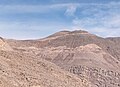
Land features include the Western Hajar Mountains. Since these are the northernmost of the Hajar range, they and the peninsula are referred to as Ruʾūs al-Jibāl (Arabic : رُؤُوْس ٱلْجِبَال, romanized: Capes of the Mountains). [1] [2] The largest wadi in Mussandam is Wadi Bih, which forms the central drainage basin. [5] [6] The highest Mountain in Mussandam, and Ru'us al Jibal, is Jebel Harim.
During winter, the region can be fairly cool, particularly the mountains of Jais, Yanas and Mebrah. [7] [8]
Fauna include the Ruus al Jibal fan-footed gecko, [9] Arabian tahr and caracal. It is unknown if the Arabian leopard is still present. [1] [2]
The mountainous northern end of the peninsula has been designated an Important Bird Area (IBA) by BirdLife International because it supports significant populations of bird species, whether resident, breeding, wintering or on passage. These include pallid scops-owl, plain leaf-warbler, hooded, variable, Hume's and red-tailed wheatears, and pale rockfinch. [10]
The islands scattered around the tip of the peninsula are in a separate IBA because of their importance for seabirds, including red-billed tropicbird, Persian shearwater, Socotra cormorant and bridled tern. [11]
In the past, the region was an unstable region, and was repeatedly invaded by Persian empires such as the Achaemenid Empire and the Sassanian Empire. Then these empires declined until the Islamic era arrived.
In the modern era, the occupation of the region continued. In the 17th century, the Portuguese began using Khasab as a supply point for the dates trade as well as a safe passage for their ships in the region. In the 18th century, the area was mostly forgotten, and the Portuguese colony floundered. Eventually, the Ya'rubids, the ruling house of Oman, occupied the Musandam Peninsula region.
In the late 18th century, the British occupied the area as part of the Trucial States; however, the region, considered a backwater, was not developed. In the late 20th century, the UAE was formed, with most sheikdoms in the area joining, except notably Ras Al Khaimah. However, in 1972, the Emirate entered the UAE, leading to discussions on the Emirati-Omani border eventually settling into the Musandam Peninsula being granted to Oman.
{{cite book}}: CS1 maint: publisher location (link)