The state government consists of the head of government and a specific number of ministers (or state ministers or senators). The legal status of the members of a state government is regulated in the Ministers Acts[de] of the individual states.
The number and areas of responsibility of the ministers vary from state to state; they are either prescribed in the state constitutions, determined by a special law, or established by the Minister-president at their discretion. In Baden-Württemberg, Bavaria, Bremen, the Saarland, and Saxony, the state government may include other members in addition to the ministers or senators (such as state secretaries with voting rights).
State governments are responsible for executing most federal laws in addition to their own state laws, maintaining jurisdiction over areas such as police, education, and cultural affairs.[1] Decisions made by a state government initially usually have only political significance and often require further steps. For example, a draft law proposed by the government must be debated in the respective state parliament. Depending on the statutory provisions, legal ordinances and administrative regulations can be issued by the state government or an individual minister. In the interest of cooperation between ministers, such decrees are often preceded by a decision of the state government, even if this is not formally required by law.
System of government
In terms of state or governmental form, all German states are currently parliamentary republics. This means that the government of each state (executive) is principally dependent on the confidence of a parliament elected by the people (legislature) at the state level.
The constitutional framework conditions for this form of government are mandatorily prescribed by federalconstitutional law, specifically the so-called homogeneity principle[de] of the Basic Law for the Federal Republic of Germany (Article 28 of the Basic Law for the Federal Republic of Germany[de]). The Basic Law guarantees the states "considerable autonomy" to prevent the centralization of power that characterized the Nazi era.[2] However, the specific organizational structure of the system of government is not dictated by this, meaning that the principle basically allows for a presidential form of government or other forms of democratic state order and their variants in the states. The determination of the rules by which the state organs are formed, and what functions and competencies they possess, is principally a matter for the states and is subject to the regulations of the state constitutions.
State governments also play a direct role in federal legislation. They appoint members to the Bundesrat (Federal Council), the upper house of the federal legislature, allowing them to participate in the legislative process and administration at the national level.[2][1]
The structure and authority of state governments in Germany have evolved significantly through four major historical phases.
German Empire (1871–1918)
Following the Unification of Germany in 1871, the German Empire was established as a federal state comprising 25 sovereign entities (kingdoms, duchies, and city-states). The system was characterized by a "functional division" of power: while the Imperial government enacted legislation, the administration and implementation of these laws remained the exclusive domain of the state governments.[3] This period was marked by the dominance of Prussia, comprising two-thirds of the territory, where the Prussian Prime Minister frequently served simultaneously as the Imperial Chancellor.[3]
Weimar Republic (1919–1933)
The Weimar Constitution of 1919 officially introduced the term Länder (lands/states) for the constituent republics. While maintaining a federal structure, the Weimar Republic centralized significant powers, particularly financial sovereignty. Unlike in the Empire, the federal government took over tax collection, leaving state governments dependent on federal grants for funding.[3]
Nazi Era (1933–1945)
State governments were effectively stripped of their sovereignty during the Nazi era through the policy of Gleichschaltung (coordination). The "Law on the Reconstruction of the Reich" (1934) abolished the state parliaments and transferred sovereign rights to the central government, reducing the states to administrative provinces headed by centrally appointed Reichsstatthalter (Reich Governors).[4]
Federal Republic (1949–present)
After World War II, the Basic Law (1949) restored the federal order as a safeguard against central authoritarianism. The Western Allies reorganized state borders to create viable economic units, resulting in the formation of new states like North Rhine-Westphalia and Baden-Württemberg (merged in 1952).[3] Upon German reunification in 1990, the five states of the former East Germany (which had been abolished in 1952 in favor of centralized districts) were reconstituted and joined the Federal Republic, bringing the total number of state governments to sixteen.[2]
Overview of the Minister-Presidents
Women as chairpersons of state governments
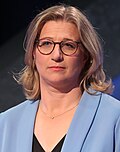
So far, nine women have chaired a state government in Germany. However, only three of them, Hannelore Kraft, Franziska Giffey, and Anke Rehlinger, won the office through a lead candidacy in a general election. Five were elected by the respective parliamentary majorities following the resignation of the incumbents, and one held the office in an acting capacity.
The first woman to lead the government of a German state was Louise Schroeder (SPD), who led the Berlin Magistrate in an acting capacity from 18 August 1947 to 7 December 1948, because the originally elected Lord Mayor was not confirmed by the Allied Kommandatura (see also Magistrate Schroeder).
The proportion of women among the chairpersons of the 16 state governments reached 25 percent for the first time in 2013 and from 2022 to 2023; it thus came significantly closer within a few years to the proportion of women in the 16 state parliaments, which ranges between 18.8 percent (Baden-Württemberg[5]) and around 40 percent (Bremen,[6]Brandenburg[7]) and averages around one-third of the deputies. Since the 1990s, the proportions of women in the individual state parliaments have risen significantly.[8]
With two out of seven, the proportion of women among SPD Minister-Presidents has been 28.6 percent since July 2024. The CDU in six federal states, the CSU in Bavaria, The Left in Thuringia, and Alliance 90/The Greens in Baden-Württemberg do not currently field a woman from their ranks for the top office of the state governments led by them.
This page is based on this Wikipedia article Text is available under the CC BY-SA 4.0 license; additional terms may apply. Images, videos and audio are available under their respective licenses.