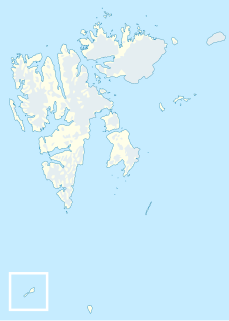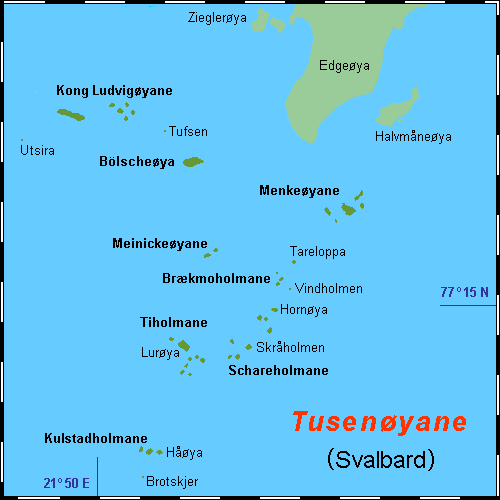
Thousand Islands [1] [2] [3] (Norwegian : Tusenøyane) is a group of small islands south of Edgeøya. They form part of the Svalbard archipelago. The group consists of over forty islands and islets, including Brotskjer, Kulstadholmane, Utsira, Tufsen, Kong Ludvigøyane, Bölscheøya, Hornøya, Tiholmane, Meinickeøyane, Sletteøya, Schareholmane, Skråholmen, Brækmoholmane, Tareloppa, Vindholmen, and Menkeøyane.
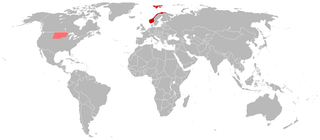
The Dutchman Joris Carolus was the first to distinctly mark a group of small islands south of Edgeøya. The Muscovy Company's map (1625) showed a vague mass of islands as well, some labeled, such as Wester I., Beare Iland, Heling I., and the Hopeless Iles. (perhaps Kong Ludvigøyane). The cartographers Gerard Valck and Peter Schenk the Elder were the first to place a "great vague mass of islands stretching round the coast" south of Edgeøya. William Scoresby (1820) is thought to have been the first to label them with the popular name of Thousand Islands, the name they retain to this day.
Edgeøya, anglicised as Edge Island, is a Norwegian island located in southeast of the Svalbard archipelago; with an area of 5,073 square kilometres (1,960 sq mi), it is the third-largest island in this archipelago. An Arctic island, it forms part of the Søraust-Svalbard Nature Reserve, home to polar bears and reindeer. An ice field covers its eastern side. The island takes its name from Thomas Edge, an English merchant and whaler. It is seldom visited today and development of tourist facilities is forbidden by law because of its nature reserve status.
Barentsøya, anglicized as Barents Island, is an Arctic island in the Svalbard archipelago of Norway, lying between Edgeøya and Spitsbergen. To the north, in the sound between Barentsøya and Spitsbergen, lies the island of Kükenthaløya. To the south, the sound separating Barents Island from Edgeøya is Freemansundet.
Storfjorden is the body of water in the Svalbard archipelago in northern Norway separating Spitsbergen in the west from Barentsøya and Edgeøya to the east. Its southern limits are Kikutodden in Sørkapp Land east to Håøya, Tiholmane, Brækmoholmane, and Menkeøyane in Thousand Islands and northeast to Svarthuken—the southeastern promontory of Edgeøya. Its limits on its eastern side are Sundneset on the northern side of Freemansundet south to Palibinramten on the northwest coast of Edgeøya. The northern part is called Ginevra Bay, which lies between Olav V Land and Barentsøya. It ends at Heleysundet.
Bellsund is a 20-kilometer (12 mi) long sound on the west coast of Spitsbergen, part of the Svalbard archipelago of Norway. It is separated from Van Mijenfjorden by the islands of Akseløya and Mariaholmen. Bellsund is located south of Nordenskiöld Land and north of Wedel Jarlsberg Land.
Ryke Yseøyane is a group of several small islands off the east coast of the island of Edgeøya in Svalbard, Norway. The islands are named after the Dutch whaler Ryke Yse of Vlieland, who discovered them about 1640–1645. The group was first marked by Hendrick Doncker, of Amsterdam, in 1663. Two Norwegian polar bear hunters wintered on Ryke Yseøyane for two subsequent winters in 1967–1969. During the second winter, one of them was lost in drifting ice. They are part of the Southeast Svalbard Nature Reserve.
Halvmåneøya is a small, uninhabited Norwegian island off the southeastern coast of Edgeøya, part of the Svalbard archipelago. Halvmåneøya, as part of Edgeøya, has been a nature preserve since 1973, and visitation is strictly regulated.
Tjuvfjorden is a 45 km long and up to 30 km wide fjord separating Edgeøya’s two southern promontories, Kvalpynten and Svarthuken.
Håøya is the main islet in Kulstadholmane, part of Thousand Islands, an island group south of Edgeøya, part of the Svalbard archipelago.
Menkeøyane is a small Norwegian island group south of Halvmåneøya, an island off the southeast coast of Edgeøya. The group includes Havella, Alka, Gassen, Teisten, Islomen and Blåmåken. They comprise part of Thousand Islands. The islands are named after the German cartographer and historical geographer Heinrich Theodor Menke (1819–92). The islands appear on the Muscovy Company's map (1625), one of which is labeled Heling I.
Bölscheøya is an island southwest of Svarthuken, the southeastern point of Edgeøya, Norway. It is part of Thousand Islands. The island was named in 1868 by the German geographer August Petermann (1822–78) after the German journalist Carl Bölsche, father of the German writer and zoologist Wilhelm Bölsche (1843–93). The remains of a whaling station from the 17th century can be found on the island.
Kong Ludvigøyane is a small group of islands south of southwestern Edgeøya. The group includes Russebuholmane, Arendtsøya, Berentine Island, and Bruhnsøya. They form part of Thousand Islands. They are named after King Ludwig II (1845–86) of Bavaria, Germany. The islands may be the Hopeless Iles of the Muscovy Company's map (1625).
Meinickeøyane is an island group composed of two islets, Store Meinickeøya and Vesle Meinickeøya, that form part of Thousand Islands, an island group south of Edgeøya, part of the Svalbard archipelago. They were named after the German geographer Carl Eduard Meinicke (1803–76).
Brækmoholmane is an island group composed of three islands, Store Brækmoholmen, Trønderen and Alkekongen. They form part of Thousand Islands, an archipelago south of Edgeøya. The islands are named after the Norwegian sailor and fisherman Sivert Brækmo (1853-1930), who visited Svalbard regularly between 1876 and 1895.
Lurøya is the largest island in Tiholmane, part of Thousand Islands, an island group south of Edgeøya. It is part of the Norwegian territory of Svalbard.
Trønderen is an islet in Brækmoholmane, part of Thousand Islands, an island group south of Edgeøya. The island is named after Trøndelag, Norway, the birthplace of Sivert Brækmo (1853–1930), a Norwegian sailor and fishermen who regularly visited Svalbard between 1876 and 1895.
Store Brækmoholmen is the largest island in Brækmoholmane, part of Thousand Islands, an island group south of Edgeøya. The island is named after Sivert Brækmo (1853-1930), a Norwegian sailor and fishermen who regularly visited Svalbard between 1876 and 1895.
Arendtsøya is a small island in Kong Ludvigøyane, part of Thousand Islands, an island group south of Edgeøya. The island is named after the German geographer Karl Arendts (1815–81).
Berentine Island is the southernmost island in Kong Ludvigøyane, part of Thousand Islands, an island group south of Edgeøya in Svalbard, Norway.
Bruhnsøya is a small island in Kong Ludvigøyane, an island group in Thousand Islands, an archipelago south of Edgeøya. The island is named after the German astronomer Carl Christian Bruhns (1830–81).
Russebuholmane are the four westernmost islets in Kong Ludvigøyane, part of Thousand Islands, an archipelago south of Edgeøya. The largest is Ækongen. The three outermost islands are collectively called Russeholmane. They are named after a Russian trapper's hut found on one of the islets. One of the three is named Russeholmen.
77°00′N21°30′E / 77.000°N 21.500°E