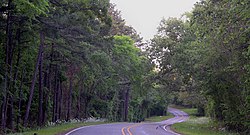
Anderson County, Texas | |
|---|---|
| The Anderson County Courthouse in Palestine | |
| Location within the U.S. state of Texas | |
| Coordinates: 31°49′N95°39′W / 31.81°N 95.65°W | |
| Country | |
| State | |
| Founded | March 24, 1846 |
| Named after | Kenneth L. Anderson |
| Seat | Palestine |
| Largest city | Palestine |
| Area | |
• Total | 1,078 sq mi (2,790 km2) |
| • Land | 1,063 sq mi (2,750 km2) |
| • Water | 15 sq mi (39 km2) 1.4% |
| Population (2020) | |
• Total | 57,922 |
| • Density | 54/sq mi (21/km2) |
| Time zone | UTC−6 (Central) |
| • Summer (DST) | UTC−5 (CDT) |
| Congressional district | 6th |
| Website | www |
Anderson County is a county in the U.S. state of Texas. Located within East Texas, its county seat is Palestine. [1] As of the 2020 United States census, the population of Anderson County was 57,922. [2] Anderson County comprises the Palestine micropolitan statistical area. Anderson County was organized in 1846, and was named after Kenneth Lewis Anderson (1805–1845), the last vice president of the Republic of Texas.
Native Americans friendly to the settlers resided in East Texas [3] before the Kiowa, Kickapoo, Kichai, Apache, and Comanche relocated to the territory. [4] These tribes hunted, farmed the land, and were adept traders. By 1772, they had settled on the Brazos at Waco and on the Trinity upstream from present Palestine. The Tawakoni branch of Wichita Indians originated north of Texas, [5] but migrated south into East Texas. From 1843 onward, the Tawakoni were part of treaties made by both the Republic of Texas and the United States.
On May 19, 1836, an alliance of Comanche, Kiowa, Caddo, and Wichita attacked Fort Parker (Limestone County), killing and taking settlers captive. The survivors escaped to Fort Houston, which had been erected in Anderson County in 1835 as protection against Indians. [6] [7] Some early residents of Anderson County were related to Cynthia Ann Parker, who was among the captives. [8]
In October 1838, Gen. Thomas Jefferson Rusk conducted a raid against hostile Indians at Kickapoo, near Frankston. [9] This ended the engagements with the Indians in East Texas for that year.
In 1826, empresario David G. Burnet received a grant from the Coahuila y Tejas legislature to settle 300 families in what is now Anderson County. [10] Most of the settlers came from the southern states and Missouri.
Baptist leader Daniel Parker [11] and eight other men organized the Pilgrim Predestinarian Regular Baptist Church in Lamotte, Illinois in 1833. This entire group migrated to the Texas frontier, arriving in Austins Colony in November 1833, [11] and establishing Fort Parker (Limestone County) in 1834. In October 1834, in consequence of "their members were becoming scattered in a wilderness," the Church agreed to adjourn until the majority of their members settled. [12]
After the Texas Revolution and the attack on Fort Parker, Daniel Parker and some of the survivors moved to Fort Houston (Anderson County). [13] They established a new community south of the fort.
The First Legislature of the State of Texas formed Anderson County from Houston County on March 24, 1846. The county was named for Kenneth Lewis Anderson. Palestine was named the county seat. [14]
Anderson County voted for secession from the Union. [15] When the American Civil War began, former Palestine district judge Judge John H. Reagan [16] served in the cabinet of the Confederate government as postmaster general, being captured at the end of the war and spending 22 months in solitary confinement. During Reconstruction, District Nine Court Judge Reuben A. Reeves, [17] a resident of Palestine, was removed from office as "an obstruction to Reconstruction" in part because of his refusal to allow blacks to participate as jurors in the judicial process.
In 1875, the International – Great Northern Railroad [18] placed its machine and repair shops and general offices in Palestine, causing the community to double in size over the next 5 years. For a time, it was a rough railroad town, dominated by male workers.
White violence against blacks occurred in the county, most frequently by lynchings of black men. But in July 1910, at least 22 blacks were killed in white rioting near Slocum, a majority-black community, in what is called the Slocum Massacre. Racial and economic tensions had been high in the post-Reconstruction era and southern states had disenfranchised blacks and imposed Jim Crow in furtherance of white supremacy. [19] Anderson County tied for 13th place in a list of the 25 American counties with the highest number of lynchings between 1877 and 1950 (all were located in the South). [20]
Oral tradition in the African-American community holds that as many as 200 blacks may have been killed in the massacre. An estimated 200 whites rioted and attacked blacks on the roads, in the fields, and in Slocum on July 29–30, 1910. Many black homes were burned, and black families fled for their lives, having to abandon their property and assets. This town is about 20 miles east of the county seat at Palestine. [21]
At the time, as was usual, white newspapers described such events as a "race riot" by blacks. Texas newspapers had contributed to problems by reporting false rumors that 200 blacks were arming. Afterward, 11 men were arrested and seven were indicted, including James Spurger, said by many to be the instigator, but no prosecution resulted. The massacre had been preceded by racial tensions, rumors, and, for 6 months, at least one lynching per month of Blacks in East Texas. [21]
In January 2016, the state installed a highway historical marker in Slocum to recognize this unprovoked white attack on the black community. [22] It was part of a history of white violence against blacks.
In 1926, the Humble Oil and Refining Company, in partnership with the Rio Bravo Company, started an exploration drilling program along Boggy Creek, in what turned our to be the Boggy Creek salt dome. On March 19, 1927, the Elliott and Clark No. 1 encountered the Woodbine Formation at a depth of 3,838 feet (1,170 m) and produced 62 barrels of oil per hour, but showed salt water after producing only 15,000 barrels. On November 10, 1927, the Elliott and Clark No. 2, 150 feet to the west, was completed as a gas well. On February 4, 1928, the first oil-producing well in Anderson County, the Humble-Lizzie Smith No. 1, was completed, producing 80 BOPD. By May 1931, 80 wells had been drilled in the Boggy Creek Oil Field, 6 of which produced gas, 33 oil, and 41 were dry holes. [23] [24] [25]
The Fairway Oil Field was discovered in 1960, and straddles the border of Anderson and Henderson Counties. Oil is produced from the Lower Cretaceous James Limestone member of the Pearsall formation. [26]
The Gus Engeling Wildlife Management Area was purchased by the state between 1950 and 1960, [27] much of it formerly owned by Milze L. Derden. The area was renamed in 1952 for Gus A. Engeling, the first state biologist assigned to the area who was killed by a poacher on December 13, 1951.
Anderson County is situated at the threshold of two ecoregions, the piney woods to the east, and the East Central Texas forests, also referred to as post oak savanna to the west. The terrain of Anderson County consists of hills carved by drainages and gullies, with numerous lakes and ponds. The Trinity River flows southward along the west boundary line of the county; the Neches River flows southward along its east boundary line, and Brushy Creek flows southeastward through the central portion of the county. [28] The terrain slopes to the south and east, with its highest points along the midpoint of its northern boundary line at 551 ft (168 m) ASL. [29] The county has a total area of 1,078 square miles (2,790 km2), of which 1,063 square miles (2,750 km2) are land and 15 square miles (39 km2) (1.4%) are covered by water. [30]
The county is wholly located within area codes 430 and 903. [31] [32]
The population ranking of the following table is based on the 2020 census of Anderson County. [33]
†county seat
| Rank | City/Town/etc. | Municipal type | Population (2010 Census) | 1 | † Palestine | City | 57,496 | 2 | ' Elkhart | Town | 1,299 | 3 | Frankston | 1,170 |
|---|
| Census | Pop. | Note | %± |
|---|---|---|---|
| 1850 | 2,684 | — | |
| 1860 | 10,398 | 287.4% | |
| 1870 | 9,229 | −11.2% | |
| 1880 | 17,395 | 88.5% | |
| 1890 | 20,923 | 20.3% | |
| 1900 | 28,015 | 33.9% | |
| 1910 | 29,650 | 5.8% | |
| 1920 | 34,318 | 15.7% | |
| 1930 | 34,643 | 0.9% | |
| 1940 | 37,092 | 7.1% | |
| 1950 | 31,875 | −14.1% | |
| 1960 | 28,162 | −11.6% | |
| 1970 | 27,789 | −1.3% | |
| 1980 | 38,381 | 38.1% | |
| 1990 | 48,024 | 25.1% | |
| 2000 | 55,109 | 14.8% | |
| 2010 | 58,458 | 6.1% | |
| 2020 | 57,922 | −0.9% | |
| 2024 (est.) | 59,512 | [34] | 2.7% |
| U.S. Decennial Census [35] 1850–1900 [36] 1910 [37] 1920 [38] 1930 [39] 1940 [40] 1950 [41] 1960 [42] 1970 [43] 1980 [44] 1990 [45] 2000 [46] 2010 [47] 2020 [48] | |||
| Race / Ethnicity (NH = Non-Hispanic) | Pop 2000 [49] | Pop 2010 [50] | Pop 2020 [48] | % 2000 | % 2010 | % 2020 |
|---|---|---|---|---|---|---|
| White alone (NH) | 34,762 | 35,792 | 33,098 | 63.08% | 61.23% | 57.14% |
| Black or African American alone (NH) | 12,897 | 12,222 | 11,430 | 23.40% | 20.91% | 19.73% |
| Native American or Alaska Native alone (NH) | 135 | 192 | 193 | 0.24% | 0.33% | 0.33% |
| Asian alone (NH) | 243 | 283 | 381 | 0.44% | 0.48% | 0.66% |
| Pacific Islander alone (NH) | 7 | 16 | 13 | 0.01% | 0.03% | 0.02% |
| Other race alone (NH) | 11 | 37 | 113 | 0.02% | 0.06% | 0.20% |
| Mixed race or Multiracial (NH) | 349 | 629 | 1,583 | 0.63% | 1.08% | 2.73% |
| Hispanic or Latino (any race) | 6,705 | 9,287 | 11,111 | 12.17% | 15.89% | 19.18% |
| Total | 55,109 | 58,458 | 57,922 | 100.00% | 100.00% | 100.00% |
As of the 2020 census, the county had a population of 57,922, which represented a 0.9% decline from the 58,458 residents recorded at the 2010 census. [48] [50] The median age was 40.7 years; 18.2% of residents were under the age of 18 and 16.3% were 65 years of age or older. For every 100 females there were 152.5 males, and for every 100 females age 18 and over there were 165.3 males age 18 and over. [51]
The racial makeup of the county was 60.3% White, 20.0% Black or African American, 0.6% American Indian and Alaska Native, 0.7% Asian, <0.1% Native Hawaiian and Pacific Islander, 12.2% from some other race, and 6.2% from two or more races. Hispanic or Latino residents of any race comprised 19.2% of the population. [52]
32.1% of residents lived in urban areas, while 67.9% lived in rural areas. [53]
There were 17,371 households in the county, of which 31.1% had children under the age of 18 living in them. Of all households, 48.7% were married-couple households, 17.8% were households with a male householder and no spouse or partner present, and 28.4% were households with a female householder and no spouse or partner present. About 27.0% of all households were made up of individuals and 13.0% had someone living alone who was 65 years of age or older. [51]
There were 20,131 housing units, of which 13.7% were vacant. Among occupied housing units, 71.1% were owner-occupied and 28.9% were renter-occupied. The homeowner vacancy rate was 1.9% and the rental vacancy rate was 10.2%. [51]
According to the 2020 American Community Survey 5-year estimates, the median household income was $45,847 and 14.1% of the population lived at or below the poverty line. [54] Among residents under age 18, 21.5% were living in poverty, and 9.9% of those 65 or older were below the poverty line. [54]
As of the 2010 census, Anderson County had 58,458 residents, up from 55,109 at the 2000 census. [50] [49]
From its initial population of 2,684 in the 1850 census, Anderson County's population increased to 55,109 people at the 2000 U.S. census. [55] At that time there were 15,678 households, 34.10% had children under the age of 18 living with them, 55.50% were married couples living together, 13.20% had a female householder with no husband present, and 27.70% were not families. About 24.80% of all households were made up of individuals, and 11.80% had someone living alone who was 65 years of age or older. [55] In 2000, the median income for a household was $31,957 and for a family was $37,513. Males had a median income of $27,070 versus $21,577 for females, and the per capita income for the county was $13,838. About 12.70% of families and 16.50% of the population were below the poverty line, including 21.60% of those under age 18 and 16.60% of those age 65 or over. [55]
Anderson County is governed by a commissioners' court. It consists of the county judge, who is elected at-large and presides over the full court, and four commissioners, who are elected from the county's four single-member precincts. [56] [57]
| Office | Name | Party | |
|---|---|---|---|
| County judge | Robert D. Johnston | Republican | |
| Precinct 1 | Greg Chapin | Republican | |
| Precinct 2 | Rashad Mims | Democratic | |
| Precinct 3 | Kenneth Dickson | Republican | |
| Precinct 4 | Joey Hill | Republican | |
| Office | Name | Party | |
|---|---|---|---|
| County clerk | Mark Staples | Republican | |
| Criminal district attorney | Allyson Mitchell | Republican | |
| District clerk | Teresa Coker | Republican | |
| Sheriff | W. R. (Rudy) Flores | Republican | |
| Tax assessor-collector | Teri Garvey Hanks | Republican | |
| Treasurer | Tara Holliday | Republican | |
| Office | Name | Party | |
|---|---|---|---|
| Precinct 1 | David Franklin | ||
| Precinct 2 | Doug Lightfoot | Republican | |
| Precinct 3 | Kim Dickson | Republican | |
| Precinct 4 | James Muniz | Republican | |
The Texas Department of Criminal Justice operates state prisons for men in the county. The prisons Beto, Coffield, Michael, and Powledge units and the Gurney Unit transfer facility are located in an unincorporated area 7 miles (11 km) west of Palestine. [58] The Beto Unit has the Correctional Institutions Division Region II maintenance headquarters. [59]
| Office | Name | Party | |
|---|---|---|---|
| Precinct 1 | Gary Thomas | ||
| Precinct 2 | Tammy Lightfoot | ||
| Precinct 3 | James Todd | Republican | |
| Precinct 4 | James Westley | Republican | |
Jeff Doran, a Republican, is the judge of the county court at law. [56] [57]
| Office | Name | Party | |
|---|---|---|---|
| 3rd district court | Mark Calhoon | Republican | |
| 87th district court | Deborah Oakes Evans | Republican | |
| 349th district court | Pam Foster Fletcher | Republican | |
| 369th district court | Michael Davis | Republican | |
Anderson is a strongly Republican county, voting Republican in every election since 1980 (as of 2020). The county last voted Democratic in 1976, when Jimmy Carter won 57% of the county's votes. Hillary Clinton managed to win just 19.8% of the vote in the county, the least of any presidential candidate since 1944.
| Year | Republican | Democratic | Third party(ies) | |||
|---|---|---|---|---|---|---|
| No. | % | No. | % | No. | % | |
| 1912 | 444 | 19.38% | 1,737 | 75.82% | 110 | 4.80% |
| 1916 | 501 | 18.71% | 1,984 | 74.11% | 192 | 7.17% |
| 1920 | 323 | 8.23% | 2,355 | 59.98% | 1,248 | 31.79% |
| 1924 | 562 | 47.19% | 374 | 31.40% | 255 | 21.41% |
| 1928 | 1,814 | 50.94% | 1,747 | 49.06% | 0 | 0.00% |
| 1932 | 259 | 5.60% | 4,354 | 94.10% | 14 | 0.30% |
| 1936 | 289 | 7.15% | 3,749 | 92.80% | 2 | 0.05% |
| 1940 | 688 | 11.51% | 5,281 | 88.37% | 7 | 0.12% |
| 1944 | 467 | 8.53% | 4,342 | 79.32% | 665 | 12.15% |
| 1948 | 1,199 | 23.07% | 3,242 | 62.37% | 757 | 14.56% |
| 1952 | 4,637 | 57.18% | 3,462 | 42.69% | 10 | 0.12% |
| 1956 | 4,181 | 60.47% | 2,710 | 39.20% | 23 | 0.33% |
| 1960 | 3,642 | 52.16% | 3,296 | 47.21% | 44 | 0.63% |
| 1964 | 3,362 | 41.10% | 4,809 | 58.78% | 10 | 0.12% |
| 1968 | 2,828 | 29.86% | 3,447 | 36.40% | 3,196 | 33.75% |
| 1972 | 5,826 | 72.24% | 2,233 | 27.69% | 6 | 0.07% |
| 1976 | 4,172 | 42.94% | 5,499 | 56.60% | 44 | 0.45% |
| 1980 | 5,970 | 52.69% | 5,163 | 45.57% | 197 | 1.74% |
| 1984 | 8,634 | 64.32% | 4,747 | 35.36% | 42 | 0.31% |
| 1988 | 7,858 | 55.95% | 6,128 | 43.63% | 59 | 0.42% |
| 1992 | 5,598 | 38.70% | 5,322 | 36.79% | 3,546 | 24.51% |
| 1996 | 6,458 | 48.19% | 5,693 | 42.49% | 1,249 | 9.32% |
| 2000 | 9,835 | 65.22% | 5,041 | 33.43% | 204 | 1.35% |
| 2004 | 11,525 | 70.70% | 4,678 | 28.70% | 98 | 0.60% |
| 2008 | 11,884 | 71.35% | 4,630 | 27.80% | 141 | 0.85% |
| 2012 | 12,262 | 75.64% | 3,813 | 23.52% | 137 | 0.85% |
| 2016 | 13,201 | 77.76% | 3,369 | 19.84% | 407 | 2.40% |
| 2020 | 15,110 | 78.59% | 3,955 | 20.57% | 162 | 0.84% |
| 2024 | 15,597 | 80.48% | 3,635 | 18.76% | 149 | 0.77% |
| Year | Republican | Democratic | Third party(ies) | |||
|---|---|---|---|---|---|---|
| No. | % | No. | % | No. | % | |
| 2024 | 15,022 | 78.17% | 3,872 | 20.15% | 322 | 1.68% |
These school districts serve areas in Anderson County:
Anderson County is part of the Dallas/Fort Worth DMA. Local TV media outlets include: KDFW-TV, KXAS-TV, WFAA-TV, KTVT-TV, KERA-TV, KTXA-TV, KDFI-TV, and KDAF-TV. Other nearby TV stations that provide coverage for Anderson County come from the Tyler/Longview/Jacksonville market and they include: KLTV, KTRE-TV, KYTX-TV, KFXK-TV, and KETK-TV.
Newspapers serving Anderson County include the Palestine Herald-Press in Palestine and the weekly online Frankston Citizen in Frankston.