
Sutton Hoo is the site of two Anglo-Saxon cemeteries dating from the 6th to 7th centuries near Woodbridge, Suffolk, England. Archaeologists have been excavating the area since 1938, when a previously undisturbed ship burial containing a wealth of Anglo-Saxon artefacts was discovered. The site is important in establishing the history of the Anglo-Saxon kingdom of East Anglia as well as illuminating the Anglo-Saxons during a period which lacks historical documentation.

A torc, also spelled torq or torque, is a large rigid or stiff neck ring in metal, made either as a single piece or from strands twisted together. The great majority are open at the front, although some have hook and ring closures and a few have mortice and tenon locking catches to close them. Many seem designed for near-permanent wear and would have been difficult to remove.

A cauldron is a large pot (kettle) for cooking or boiling over an open fire, with a lid and frequently with an arc-shaped hanger and/or integral handles or feet. There is a rich history of cauldron lore in religion, mythology, and folklore.

The Battersea Shield is one of the most significant pieces of ancient Celtic art found in Britain. It is a sheet bronze covering of a wooden shield decorated in La Tène style. The shield is on display in the British Museum, and a replica is housed in the Museum of London.

The Gundestrup cauldron is a richly decorated silver vessel, thought to date from between 200 BC and 300 AD, or more narrowly between 150 BC and 1 BC. This places it within the late La Tène period or early Roman Iron Age. The cauldron is the largest known example of European Iron Age silver work. It was found dismantled, with the other pieces stacked inside the base, in 1891, in a peat bog near the hamlet of Gundestrup in the Aars parish of Himmerland, Denmark. It is now usually on display in the National Museum of Denmark in Copenhagen, with replicas at other museums; during 2015–16, it was in the UK on a travelling exhibition called The Celts.
The Arras culture is an archaeological culture of the Middle Iron Age in East Yorkshire, England. It takes its name from the cemetery site of Arras, at Arras Farm, (53.86°N 0.59°W) near Market Weighton, which was discovered in the 19th century. The site spans three fields, bisected by the main east-west road between Market Weighton and Beverley, and is arable farmland; little to no remains are visible above ground. The extent of the Arras culture is loosely associated with the Parisi tribe of pre-Roman Britain.

The Atlantic Bronze Age refers to a cultural complex of the Bronze Age period in prehistoric Europe, spanning approximately 1300–700 BC. This complex includes various cultures in Britain, France, Ireland, Portugal and Spain.
The Witham Shield is an Iron Age decorative bronze shield facing of La Tène style, dating from about the 4th century BC. The shield was discovered in the River Witham in the vicinity of Washingborough and Fiskerton in Lincolnshire, England in 1826. Further excavations at a nearby site have revealed posts interpreted as the foundation for a causeway, as well as artefacts including a sword, spears and part of a human skull with a sword fragment lodged within. The shield is now in the British Museum.
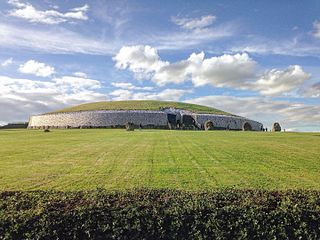
The prehistory of Ireland has been pieced together from archaeological evidence, which has grown at an increasing rate over the last decades. It begins with the first evidence of permanent human residence in Ireland around 10,500 BC and finishes with the start of the historical record around 400 AD. Both the beginning and end dates of the period are later than for much of Europe and all of the Near East. The prehistoric period covers the Palaeolithic, Mesolithic, Neolithic, Bronze Age and Iron Age societies of Ireland. For much of Europe, the historical record begins when the Romans invaded; as Ireland was not invaded by the Romans its historical record starts later, with the coming of Christianity.

The Hochdorf Chieftain's Grave is a richly-furnished Celtic burial chamber near Hochdorf an der Enz in Baden-Württemberg, Germany, dating from 530 BC in the Hallstatt culture period. It was discovered in 1968 by an amateur archaeologist and excavated from 1978 to 1979 by the State Historical site office known as the Baden Wurttenbberg Landesdenkmalamt under the direction of German archeologist Jorg Biel with association from excavation technician Fritz Maurer. By then, the burial mound covering the grave, originally 6 m (20 ft) in height and about 60 m (200 ft) in diameter, had shrunk to about 1 m in height and was hardly discernible due to centuries of erosion and agricultural use.

Bronze Age Britain is an era of British history that spanned from c. 2500–2000 BC until c. 800 BC. Lasting for approximately 1,700 years, it was preceded by the era of Neolithic Britain and was in turn followed by the period of Iron Age Britain. Being categorised as the Bronze Age, it was marked by the use of copper and then bronze by the prehistoric Britons, who used such metals to fashion tools. Great Britain in the Bronze Age also saw the widespread adoption of agriculture.
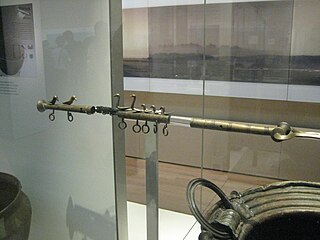
The Dunaverney Flesh-Hook is a sophisticated bronze artefact from Prehistoric Ireland, thought to be an item of ceremonial feasting gear, and a symbol of authority. It is believed it was used to remove chunks of meat from a stew in a large cauldron for serving. It dates to the Late Bronze Age, between 1050 and 900 BC. Since 1856, it has been in the British Museum in London.
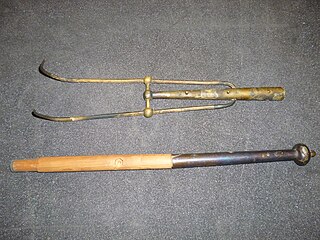
The Little Thetford flesh-hook is a late Bronze-Age artefact discovered in 1929 in Little Thetford, near Ely, Cambridgeshire, England. A flesh-hook is a metal hook with a long handle used to pull meat out of a pot or hides out of tan-pits. This particular find is one of 32 other such archaeologically significant finds, scatters, and excavations within 1 square mile (2.6 km2) of Little Thetford.
Flesh-hook is a term for a variety of archaeological artifacts which have metal hooks and a long handle, or socket for a lost wooden handle. Though the term may be applied to objects from other times and places, it is especially associated with the European Bronze Age and Iron Age. The metal shaft divides to form between two and five hooks with some sort of sharpened end. The purposes of the objects probably include pulling meat out of a pot or hides out of tan-pits.

The Waterloo Helmet is a pre-Roman Celtic bronze ceremonial horned helmet with repoussé decoration in the La Tène style, dating to circa 150–50 BC, that was found in 1868 in the River Thames by Waterloo Bridge in London, England. It is now on display at the British Museum in London.

The Wandsworth Shield is a circular bronze Iron Age shield boss or mount decorated in La Tène style which was found in the River Thames at Wandsworth in London sometime before 1849. Another incomplete bronze shield mount, sometimes called the Wandsworth Mask Shield was found at the same time. Both shield mounts are now held at the British Museum. The bold repoussé decoration on the Wandsworth Shield, comprising two birds with outstretched wings and long trailing tail feathers, has led Barry Cunliffe, Emeritus Professor of European Archaeology at the University of Oxford, to consider the shield to be "among the masterpieces of British Celtic art".

The Vače Situla is an ornamented Early Iron Age ritual bronze vessel (situla) found in the second half of the 19th century at the Hallstatt Archaeological Site in Vače in central Slovenia. It counts among the highest-quality such vessels in general and among the most precious archeological artifacts of the country. Dating from the 5th century BC, it is considered to be one of the oldest situla objects of the northern Illyrians found in the Eastern Hallstatt zone. The vessel has three rows of relief that show the ordinary life of the ruling class and also reflect the religious understanding of the world in that time. It is on display in the National Museum of Slovenia.

The Tomb of Marquis Yi of Zeng is an archaeological site in Leigudun Community (擂鼓墩社區), Nanjiao Subdistrict (南郊街道), Zengdu District, Suizhou, Hubei, China, dated sometime after 433 BC. The tomb contained the remains of Marquis Yi of Zeng, and is one of a handful of ancient Chinese royal tombs to have been discovered intact and then excavated using modern archaeological methods. Zeng was a state during the Spring and Autumn period of China. The tomb was made around 433 BC, either at the end of the Spring and Autumn period or the start of the Warring States period. The tomb comes from the end of the thousand-year-long period of the burial of large sets of Chinese ritual bronzes in elite tombs, and is also unusual in containing large numbers of musical instruments, including the great set of bells for which it is most famous.

The Caergwrle Bowl is a unique object dating to the Middle Bronze Age, c. 1300 BC, originally manufactured from shale, tin and gold, and found in Caergwrle, Flintshire, north east Wales. It is thought to represent a boat, with its applied gold decoration signifying oars and waves, and either sun discs or circular shields. At both ends of the boat is a pair of oculi or 'eyes'.
Tønnesminde is the site of an archaeological excavation ground and present day organic farm on the island of Samsø, Denmark. Archaeological evidence attests the area around Tønnesminde has a long history of human occupation, dating from approximately 4000 BC to present day. Recent excavations suggest that Tønnesminde contains settlements dating from the Funnelbeaker culture in the Early Neolithic period, Early Bronze Age, Pre-Roman Iron Age, and Viking Age.


