History
Dama is one of the old towns of Butig. It is considered as the oldest settlement in the center of Mindanao. A sultanate located in the Pangampong (Principality) of Unayan, Lanao, Mindanao, Butig belongs to the confederation of the Sultans of Lanao (Ranao in Maranao language). This historic town is the "cradle" of Maranao civilization.
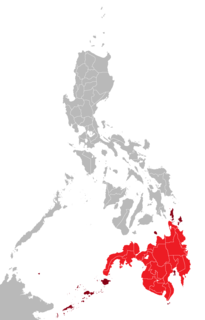
Mindanao or still commonly known as Southern Philippines, is the second largest island in the Philippines. Mindanao and the smaller islands surrounding it make up the island group of the same name. Located in the southern region of the archipelago, as of the 2010 census, the main island was inhabited by 20,281,545 people, while the entire Mindanao island group had an estimated total of 25,537,691 (2018) residents.

Maranao is an Austronesian language spoken by the Maranao people in the provinces of Lanao del Norte and Lanao del Sur in the Philippines, and in Sabah, Malaysia.
Role in Islamization of Mindanao
While Islamic political institutions were being implemented in Sulu, Muslim traders and possibly itinerant teachers visited the eastern and northern parts of Mindanao Island. The advent of Muhammad Kabungsuwan and his lieutenants developed a system of multiple marriage alliances with various ruling families which served as a means of extending both political control and Islamization. The coming of this intrepid Arab-Malay, to whom the pervasive spread of Islam in Mindanao is attributed, and from whom all the leading sultans of that island have claimed descent, can be calculated to have taken place around the second decade of the sixteenth century. (Majul, 1973)
From the above-mentioned marriage alliances came the Moro dynasties of Maguindanao, Buayan, and Butig. From the Maranaos of Butig, Islam was then introduced to the Maranaos of Lake Lanao. Whereas the base and strength of the Buayan sultanate was in the upper valley of the Pulangi in the interior of eastern Mindanao, that of the sultanate of Maguindanao was at the lower valley and the nearby coastal areas. Actually, for many years it was Iranun support that strengthened the Maguindanaon rulers against their antagonists. (Majul, 1973)

Maguindanao is a province in the Philippines. Since 2014 the provincial capital is Buluan but the legislative branch of the provincial government, the Sangguniang Panlalawigan, convenes in the old provincial capitol in the town of Sultan Kudarat. It borders Lanao del Sur to the north, Cotabato to the east, Sultan Kudarat to the south, and the Illana Bay to the west.
Islam is an Abrahamic monotheistic religion teaching that there is only one God, and that Muhammad is the messenger of God. It is the world's second-largest religion with over 1.8 billion followers or 24% of the world's population, most commonly known as Muslims. Muslims make up a majority of the population in 50 countries. Islam teaches that God is merciful, all-powerful, unique and has guided humankind through prophets, revealed scriptures and natural signs. The primary scriptures of Islam are the Quran, viewed by Muslims as the verbatim word of God, and the teachings and normative example of Muhammad.
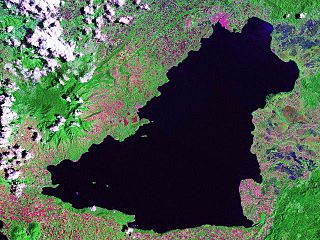
Lake Lanao is a large ancient lake in the Philippines, located in Lanao del Sur province in the country's southern island of Mindanao. With a surface area of 340 km2 (130 sq mi), it is the largest lake in Mindanao, and the second largest lake in the Philippines and counted as one of the 15 ancient lakes in the world. Scholars have been pushing for the lake's inclusion in the UNESCO World Heritage List.
In the time, the continued existence of Islam in Sulu and Mindanao was guaranteed by a more intensive Islamization of their neighbors such as Brunei and Ternate. The royal families of Brunei and Sulu became intimately related, as did those of Maguindanao and Ternate. Commercial relations and religious dialogue expanded among the peoples of these regions ... thus generating a sense of community transcending regional frontiers or dynastic loyalties. (Majul, 1973)
Resistance to European colonialism
In 1658, a strong force took the field against the Moros of Mindanao under the command of Don Francisco Estovar, Governor of Zamboanga. The expedition disembarked before the Moro town of Mamucan in the Cotabato Valley. Here an action conducted by Don Pedro de Biruga, who, with a force of 180 Spaniards, destroyed the town of Butig, with many vessels and a quantity of rice.(Hurley, 1936)

Cotabato, formerly but colloquially known as North Cotabato, is a landlocked province in the Philippines. While politically located in the Mindanao region of SOCCSKSARGEN, some of its barangays are under the jurisdiction of the nearby Bangsamoro Region. Its capital is Kidapawan City.
Between 1663, when Zamboanga was abandoned, and 1718 when it was refortified, there was an interlude in the Moro Wars, which allowed the sultanates to become better organized and their Islamic institutions to be reinforced. Vigorous commercial relations with other principalities were initiated. It was around this time, too that the Sulu Sultanate acquired the North Borneo territory from the Sultan of Brunei as a grateful recompense for armed intervention in a dynastic quarrel. Sulu had reached the highest level of its territorial expansion. Actually, Sulu was simply filling up the power vacuum left in the island of Borneo as a result of Brunei's gradual political and commercial decline.
The Spanish government, principally on account of Jesuit agitation, decided to refortify Zamboanga. The Jesuits, more than any religious order in the Philippines, were the most insistent on the evangelization of Muslims. This attitude cost them (the Jesuits) a few casualties on account of extreme zeal.
It is proposed that the fifth stage in the history of the Moro Wars began with the refortification of Zamboanga in 1718 and ended in the Spanish failure in the eighteenth century to reduce the Muslim states to vassalage. To achieve this political end, and Spanish plan was devised to convert the sultans of Sulu and Maguindanao preparatory to the eventual conversion of the datus and other subjects. In this stage, the combined Sulu-Maranao attack to capture Zamboanga in 1719 failed. Again, a desultory war followed. The plan to convert the sultans failed in the case of Maguindanao. Although 'Azim-ud-Din, the sultan deposed by his brother, was baptized in Manila in 1751, that action did not have the desired political results in Sulu since the sultanate was in the hands of a usurper. Also, the question of the sincerity of the conversion still remains an open one.
In this fifth stage, the men of Sultan Mardan and the Maranaos of Butig began their devastating attacks on other parts of the Philippines, reducing the number of tributes for Spain coming from the Visayas and causing a virtual disruption in the economic life of many islands under the Spanish colonial regime. On account of thousands of captives taken by the Muslims, some depopulation started to take place in the Visayas. But all this was in response to the Spanish order in 1751 to enslave captured Muslims and destroy their settlements, boats, plantations, and fields. Yet, as the facts demonstrate, it was the Sulu Sultan who was always the first to initiate moves for a peaceful settlement. The lessening of Spanish power as a direct result of the British invasion of the Philippines and capture of Manila in 1762 once again brought about a decline of hostilities between Spaniards and Sulu and Maguindanao. The Muslim principalities again tried to recapture their days of commercial prosperity, but they were not to be left in peace. (Majul, 1973)
On December 8, 1720, Dalasi, the Datu of Butig (also known as Rajah Janatun of Butig), with an armada of one hundred vessels or “paraws” manned by Sultan sa Kanluran, Miyangaludan and several thousand Moros, attacked Fort Pilar in Zamboanga. He captured a local Jesuit priest and forced the Spanish government in Manila to give ransom payment in exchange for his freedom. (Hurley, 1936) But the accuracy of this report by Hurley is in doubt considering the distance of Butig (Lanao del Sur) to the shores of Zamboanga. Furthermore, the Jesuits in Zamboanga were more engaged with the Tausugs of Sulu; and for Datu Dalasi, a Maranao of Lanao, to get involved in the affairs of the Sulu Sultanate is highly unusual.

Manila, officially the City of Manila, is the capital of the Philippines. It is the most densely populated city proper in the world. It was the first chartered city by virtue of the Philippine Commission Act 183 on July 31, 1901 and gained autonomy with the passage of Republic Act No. 409 or the "Revised Charter of the City of Manila" on June 18, 1949.
American rule in Mindanao
In July, 1908, Lieutenant Burr of the American colonial forces was leading forty men through the Agus River in Mindanao. Near Nyaan the party came to a cotta, well fortified and surrounded with a moat filled with brush. Resistance being encountered, the soldiers cut through the brush with their bayonets and assaulted the fort.
The first soldier to reach the cotta walls was attacked from the rear by a Moro with a kris. Hearing the cry of the soldier, Lieutenant Burr hurried to his assistance, killing the Moro with a pistol. Another Moro sprang from the shelter of the bush and struck Burr before he could turn to defend himself, dealing the American officer a terrible blow on the head with a campilane.
Burr died a few days later in the hospital at Camp Kiethley.
During the years 1908 and 1909, and for a number of years afterwards, the Butig Mountain range and the Lake Lanao and Buldun sections of Mindanao were infested with outlaw bands ranging in size from a few men to several hundred.
Early in the year 1906, Moro outlaws in the inaccessible mountains of Butig fortified themselves in hill-top strongholds under the leadership of Sultan Mangatung and his brother inlaw, Amai Maricor of Maciu. Under Mangatung, a great force of outlaws became established at rancherias and were responsible for terrible depredations throughout the district.
Government launches operating at the mouth of the Malaig river were frequently fired upon, with the result that a camp of men from the 15th Infantry was established at the river.
The Moros were invited in for parleys and many of them came in and abandoned the outlaw life to return peacefully to their homes.
A number of the Moros, however, chose to ignore the American request for conciliation, and after a perty commanded by Lieutenant Furlong was fired upon, an American offensive was undertaken. Sultan Mangatung was killed.
Colonel J. F. Hutton took the field at the head of three columns of troops in the Butig Mountains. The soldiers were fired upon from the cottas but after eight serious engagements all of the outlaws in the district were annihilated.
Upon completion of these operations in Mindanao, a short period of peace ensued, to be broken by rumblings in Jolo.
World War II and the Japanese occupation
- Began the Second World War, Japanese fighter and bomber planes invaded and surprising attack in the town municipality of Butig in December 1941 and entered by the Japanese Imperial forces were occupied in 1942. The built of the military garrison and bases of the Imperial Japanese Army were stationed in the town.
- Followed by the Japanese Occupation, the local recognized guerrillas and Muslim swordsmen were aided by the regular troops and officers of the Philippine Commonwealth Army to begin the conflicts and siege of battles around the town municipalities against the Japanese from 1942 to 1945 until almost four years later when there was retreat by the recognized guerrillas and Muslim swordsmen by the Japanese hands before the Allied liberation.
- When Filipino troops and officers under the Philippine Commonwealth Army and Philippine Constabulary military units are liberated the municipal town and helped by the recognized guerrillas and Muslim swordsmen and they defeated and attack by the Japanese troops and aftermath in the Second World War. The general headquarters of the Philippine Commonwealth Army and Philippine Constabulary was stationed the town and active from 1945 to 1946 during and aftermath in World War II.
Political history
Atty. Dimnatang Labay Pansar is the incumbent mayor of Butig. His predecessors were mayors Ibrahim M. Macadato, Dimnatang Pansar, Pauli Bao-Macabuntal Ditual, Sunnyboy Mona, Monabantog Kiram, Arapa Datukanug, Palawan Amatonding, Abdulrahman Romato, Datu Mombao Romato, Sangcad Bao,Sultan Macalinog Bao and Sultan Macabayao Macadato (first elected mayor of Butig). Mayor Macabayao M. Macadato has been elected four (4) times (four-year term) as mayor and was only deposed when then dictator President Ferdinand E. Marcos replaced him with OIC in 1979 due to his being in opposition to the ruling KBL Party at that time. The late Macabayao Macadato, former Sultan of the Royale House of Butig is considered as the father of democracy in Butig as many people thereat love him so much due to his being approachable and a hardworking public servant. Butig is one of the oldest town in the province and the inhabitants thereat are connected to all the Seventeen Royal Houses of Lanao. By tradition, any individual who has no blood line in Butig cannot hold any recognized Royal Title in the Sultanate of Lanao.
Military conflict
Clashes between the Philippine military and a local terrorist organization known as the Maute group which is believed to have ties with Jemaah Islamiyah started on February 20, 2016, after the Maute Group raided the detachment of the 51st Infantry Battalion of the Philippine Army in the town. [4] Islamic State of Iraq and Syria paraphernalia were discovered at the group's lair after government forces overran the group's camp on February 26, 2016. [5] [6] The firefight displaced 2,000 residents of Butig, and killed 42 members of the group and three government troops. In November 2016, the Maute group seized the town but were driven from their positions by Philippine Army troops after about a week of fighting.