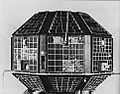
GISAT-1 during encapsulation (GISAT-1A similar) | |
| Names | EOS-05 / GISAT-1A |
|---|---|
| Mission type | Earth observation |
| Operator | ISRO |
| Website | https://www.isro.gov.in/ |
| Spacecraft properties | |
| Spacecraft | GISAT |
| Bus | I-2K |
| Manufacturer | ISRO |
| Launch mass | 1,117 kg (2,463 lb) |
| Start of mission | |
| Launch date | 20 February 2026 10:30 (UTC) |
| Rocket | GSLV Mk II (F17) |
| Launch site | Satish Dhawan Space Centre, SLP |
| Contractor | ISRO |
| Orbital parameters | |
| Reference system | Geocentric orbit |
| Regime | Geosynchronous orbit |
EOS-05 (also known as GISAT-1A) is an Earth observation satellite, which is the second satellite in the GISAT series made by ISRO. It is planned to be launched on 20 February 2026 using a GSLV Mk II rocket from Satish Dhawan Space Centre. The satellite aims to improve the existing remote sensing capabilities. [1] [2] [3]