See's Candies is an American manufacturer and distributor of candy, particularly chocolates. It was founded by Charles See, his wife Florence, and his mother Mary in Los Angeles, California in 1921. The company is now headquartered in South San Francisco, California. See's kitchens are located at its headquarters and maintained at its original factory in Los Angeles, where there are also retail shops. It also has an office in Carson, California. The company has been owned by Warren Buffett's Berkshire Hathaway Corporation since 1972.
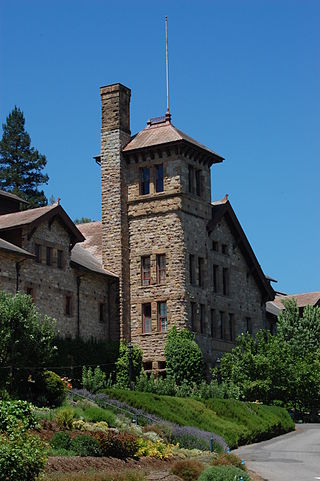
The Culinary Institute of America at Greystone is a branch campus of the private culinary college the Culinary Institute of America. The Greystone campus, located on State Route 29/128 in St. Helena, California, offers associate degrees and two certificate programs in culinary arts and baking and pastry arts. The CIA at Greystone and the Culinary Institute of America at Copia make up the school's California branch.
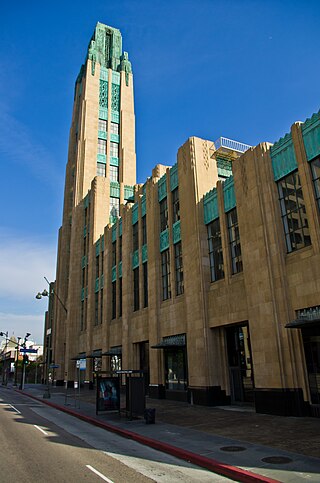
Bullocks Wilshire, located at 3050 Wilshire Boulevard in Los Angeles, California, is a 230,000-square-foot (21,000 m2) Art Deco building. The building opened in September 1929 as a luxury department store for owner John G. Bullock. Bullocks Wilshire was also the name of the department store chain of which the Los Angeles store was the flagship; it had seven stores total; Macy's incorporated them into and rebranded them as I. Magnin in 1989, before closing I. Magnin entirely in 1994. The building is currently owned by Southwestern Law School.

Albert Pissis (1852–1914) was a prolific Mexican-born American architect, of French and Mexican descent. He was active in San Francisco and had studied at the École des Beaux-Arts in Paris, France. He is credited with introducing the Beaux-Arts architectural style to San Francisco, California, designing a number of important buildings in the city in the years before and after the 1906 San Francisco earthquake.
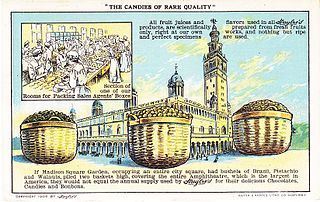
Huyler's was a candy and restaurant chain in the New York City metropolitan area that operated from 1874 to 1964, and for a time was the largest and most prominent chocolate maker in the United States. It was founded by John S. Huyler, who had grown up working in his father's bakery and ice cream store.

George William Kelham (1871–1936) was an American architect, he was most active in the San Francisco Bay Area.
Haas Building may refer to the Haas Building and if not then maybe you’re looking for:

The Startup Candy Company is the oldest candy company in Utah and one of the oldest candy companies in the United States. William Startup started making candy in his basement in Manchester, England in 1820. He developed the first hard candy and called it “American Cough Candy” because he hoped to bring his new recipe to America one day. However, William died before making it to America, but he left his legacy to his son and namesake. William Startup Jr. learned the candy-making process as a young boy and continued to run his father’s candy business.

Mid-Market is a neighborhood, historic district and development area in San Francisco, California. The neighborhood is bounded by Market Street to the north, 5th Street to the east, Mission Street to the south, and Van Ness Avenue to the west. There are many theaters in the district, most of which began as vaudeville theaters, include the Warfield and Golden Gate.

William F. Curlett and Alexander Edward Curlett were a father-and-son pair of architects. They worked together as partners under the name of William Curlett and Son, Architects from c. 1908–1916. Aleck Curlett partnered with Claud Beelman as Curlett & Beelman (1919–1932).
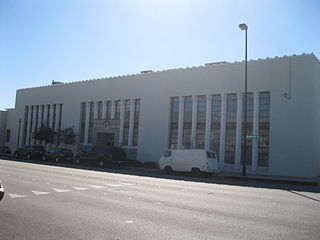
The Royal Laundry Complex is a historic laundry plant located at 443 S. Raymond Avenue in Pasadena, California, United States, consisting of close to 72,500-square-foot. Gordon Kaufmann, a prominent architect who also designed the Hoover Dam and several buildings at the California Institute of Technology, designed the plant. Kaufman's Spanish Colonial Revival design for the plant signified a shift in his style to include modern elements, which ultimately came to dominate his work. The complex currently serves as the world headquarters of Bluebeam, Inc. and was formerly the company headquarters of the Disney Store.

The Phelan Building is an 11-story office building located at 760 Market Street in the Financial District of San Francisco, California. It has a triangular shape, similar to the Flatiron Building in Manhattan, New York City, with its tip at the meeting point of Market Street, O’Farrell Street, and Grant Avenue. It is a San Francisco Designated Landmark.

The Owl Drug Company was an American drugstore retailer with its headquarters in San Francisco that operated the Owl Drug Stores chain. It was a subsidiary of Rexall stores at its peak in the 1920s through 1940s. The Owl Drug Stores sold medicines and pills, and later ventured into cosmetics, perfumes, and other goods.

Hale Brothers Department Store, was a department store headquartered in Sacramento, California, with branches throughout the San Francisco Bay Area.
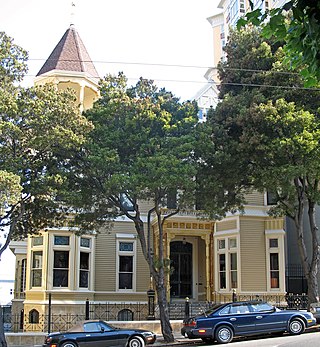
The Theodore F. Payne House, also known as the Payne Mansion, is a Victorian house in the Lower Pacific Heights neighborhood of San Francisco, California, United States. Built in 1881 and designed by William Curlett in a mix of Stick, Eastlake, and Queen Anne styles, it survived the 1906 San Francisco earthquake and was listed on the National Register of Historic Places in 1980. It has been adapted to house a hotel and a restaurant.

7th Street is a street in Los Angeles, California running from S. Norton Ave in Mid-Wilshire through Downtown Los Angeles. It goes all the way to the eastern city limits at Indiana Ave., and the border between Boyle Heights, Los Angeles and East Los Angeles.

The Mutual Savings Bank Building, is a building located at 700 Market Street at the corner of Kearny, Market, and Geary Streets in the Financial District in San Francisco, California. It was built in 1902 and was designed by architect, William F. Curlett in the French Renaissance Revival style. The 12-story building was one of San Francisco's earliest skyscrapers. The building was added to the National Register of Historic Places on January 22, 2014.

John P. Gaynor was an Irish American architect practicing in New York City and San Francisco during the nineteenth century.