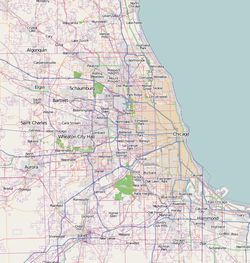
DuPage County is a county in the U.S. state of Illinois, and one of the collar counties of the Chicago metropolitan area. As of the 2020 census, the population was 932,877, making it Illinois' second-most populous county. Its county seat is Wheaton.

Barrington is a village in Cook and Lake counties in the U.S. state of Illinois. The population was 10,722 at the 2020 census. A northwest suburb of Chicago, the area features wetlands, forest preserves, parks, and horse trails in a country-suburban setting. Barrington is part of the Chicago metropolitan area.

Wilmette is a village in Cook County, Illinois, United States. Bordering Lake Michigan, Kenilworth, Winnetka, Skokie, Northfield, Glenview, and Evanston, Illinois, it is located 14 miles (23 km) north of Chicago's downtown district. Wilmette had a population of 28,170 at the 2020 census. The first and only Baháʼí House of Worship in North America is located in Wilmette. Wilmette is also home to Central Elementary School and Romona Elementary School, both recent recipients of the National Blue Ribbon award bestowed by the U.S. Department of Education. According to the United States Census Bureau, the median household income in Wilmette was $183,750 in 2022.

Lake Forest is a city located in Lake County, Illinois, United States. Per the 2020 census, the population was 19,367. The city is along the shore of Lake Michigan, and is a part of the Chicago metropolitan area and the North Shore. Lake Forest was founded with Lake Forest College and was laid out as a town in 1857, a stop for travelers making their way south to Chicago. The Lake Forest City Hall, designed by Charles Sumner Frost, was completed in 1898. It originally housed the fire department, the Lake Forest Library, and city offices.
David Adler was an American architect who mostly practiced around Chicago, Illinois. He was prolific throughout his career, designing over 200 buildings in over thirty-five years. He was also a long-time board member of the Art Institute of Chicago.
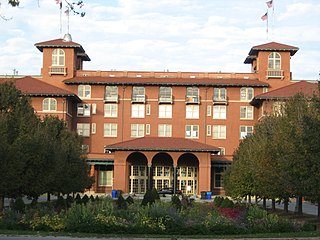
The South Shore Cultural Center, in Chicago, Illinois, is a cultural facility located at 71st Street and South Shore Drive, in the city's South Shore neighborhood. It encompasses the club facility, grounds, and beach of the former South Shore Country Club, which in the 1970s became part of the public Chicago Park District.

Bay View is a neighborhood in Milwaukee, Wisconsin, United States, North America on the shores of Lake Michigan, south of the downtown area and north of the City of St. Francis. Bay View existed as an independent village for eight years, from 1879 to 1887.
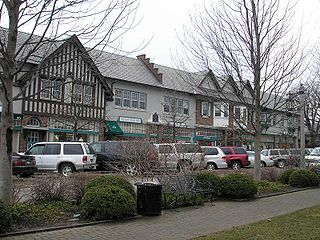
Howard Van Doren Shaw AIA was an architect in Chicago, Illinois. Shaw was a leader in the American Craftsman movement, best exemplified in his 1900 remodel of Second Presbyterian Church in Chicago. He designed Marktown, Clayton Mark's planned worker community in Northwest Indiana.

The Mayslake Peabody Estate is an estate constructed as a country home for Francis Stuyvesant Peabody between 1919 and 1922. The estate is located in the western Chicago suburb of Oak Brook, Illinois, United States, and is now part of the Mayslake Forest Preserve administered by the Forest Preserve District of DuPage County.

The Sugar Hill Historic District is a historic district in Detroit, Michigan. It contains 14 structures located along three streets: East Forest, Garfield, and East Canfield, between Woodward Avenue on the west and John R. on the east. The district was listed on the National Register of Historic Places in 2003.
The Lake Forest Historic District is a national historic district encompassing much of the original town area of Lake Forest, Illinois. The district is primarily residential, though it also includes three educational institutions and two significant commercial districts. In the late nineteenth and early twentieth centuries, Lake Forest became a popular suburb for the Chicago area's wealthiest residents, and many prominent Chicago businesspeople built their homes in the town. The district's architecture is lavish, reflecting the wealth of its residents, and includes works by Charles Sumner Frost, Dwight H. Perkins, and Howard Van Doren Shaw. The district also includes several buildings on the campus of Lake Forest College, the founding of which spurred the growth of Lake Forest, and Market Square, the country's first planned shopping center.
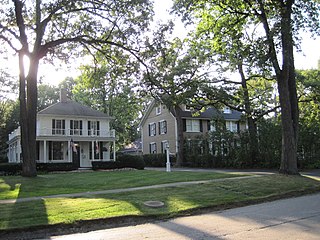
The Vine–Oakwood–Green Bay Road Historic District is a residential historic district in Lake Forest, Illinois. The district contains twenty houses on Oakwood Ave., Vine Ave., and Green Bay Road.

The Deer Path Inn is a historic hotel, originally named Deerpath Inn because of its previous location on Deerpath Road, is now located at 255 E. Illinois Road in Lake Forest, Illinois.

The David Adler Estate was the house and property of American architect David Adler in Libertyville, Illinois, United States. It is the house most closely associated with his life and career.

The Logan Square Boulevards Historic District is a linear historic district in the Logan Square community area of North Side, Chicago. It encompasses 2.5 miles (4.0 km) of the Chicago boulevard system.

The Bartlett Real Estate Office, also called the Frederick Bartlett Real Estate sales and administration building, was built in 1927 at 500 S. Broadway, Beverly Shores, Porter County, Indiana. It is Mediterranean Revival style. Bartlett also chose this style for the houses in his new development of Beverly Shores. Since 1946, it has served as the Beverly Shores Administration Building, with the clerk-treasurer's office, a public and town council meeting room, and the town marshal's office.
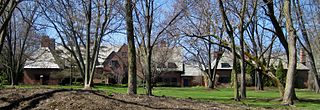
The Robert P. Lamont House is a historic house at 810 S. Ridge Road in Lake Forest, Illinois. The house was built in 1924–25 for Robert P. Lamont, the president of American Steel Foundries; Lamont later became the United States secretary of commerce under Herbert Hoover. Prominent Chicago architect Howard Van Doren Shaw designed the Tudor Revival style country house, which was one of the many homes he designed for Lake Forest's wealthy residents in the early twentieth century. While Tudor Revival was one of the many revival styles popular for country houses at the time, the style is unusual among Shaw's work in Lake Forest. The house's design features a long front facade with a brick exterior, oriel and casement windows, wood and stone details, a complex roof structure with gabled and hipped sections, and multiple stone chimneys.
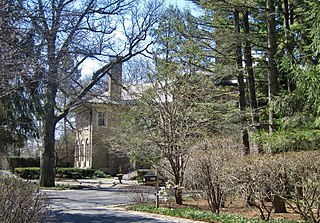
The Louis F. Swift House is a historic house at 255 E. Foster Place in Lake Forest, Illinois. The house was built in 1916 for Louis F. Swift, the president of meat packing firm Swift & Company; it was originally an addition to a home built for Swift in 1898, which was demolished in 1940. As a wealthy man who headed a major company, Swift was typical of the early twentieth century residents of Lake Forest, who were some of the richest and most prominent residents of the Chicago area. Architect Howard Van Doren Shaw, who designed several other homes for Lake Forest residents, designed the Swift House in the Renaissance Revival style. The house features a brick exterior, an asymmetrical front divided into three sections, a portico above the entrance, and bracketed eaves.
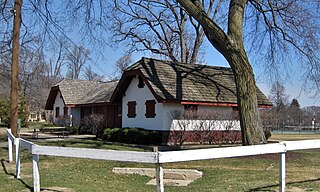
The West Park Neighborhood Historic District is a residential historic district surrounding West Park in Lake Forest, Illinois. The district includes 149 contributing buildings, most of which were built between 1907 and 1930, and West Park. Originally known as the Green Bay Addition, the neighborhood was planned in 1907 as the equivalent of a company town for the service workers at Lake Forest's many estates. Lake Forest was a popular home for the Chicago area's most wealthy residents in the early twentieth century, who typically built large estates that required teams of support workers to maintain. Architect Howard Van Doren Shaw, who also designed many of the estates, planned the neighborhood. While Shaw intended for the development to mainly use Tudor Revival architecture, few houses were designed in the style; the Colonial Revival, Folk Victorian, Craftsman, and American Foursquare styles were more common.
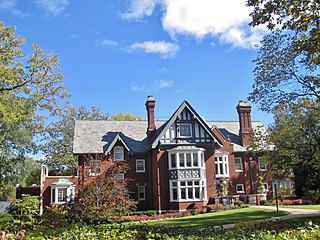
The Northeast Evanston Historic District is a residential historic district in northeastern Evanston, Illinois. The district includes 474 contributing buildings in an area bounded by Sheridan Place to the north, Lake Michigan to the east, Emerson Street to the south, and Ridge Avenue and the CTA's Purple Line to the west. The area was developed later than central and southeast Evanston; while its oldest building dates from the 1860s, most of the homes in the district were built between 1890 and 1930. The district's houses are representative of the popular architectural styles of the period; the American Craftsman, Tudor Revival, and Colonial Revival styles are especially prevalent. Works by many prominent Chicago architects, including Holabird & Roche, Tallmadge & Watson, Howard Van Doren Shaw, George W. Maher, William Carbys Zimmerman, Solon Spencer Beman, and Schmidt, Garden and Martin, can be found in the district. Vernacular works with bungalow, American Foursquare, and gable front designs are also common in the district.